I was checking Dusk’s reward percentages over coffee and realized the most important number might be the portion a generator can lose. It reveals that security is built around completed work, not entitlement.
On @Dusk , provisioners secure consensus by staking at least 1,000 $DUSK . Their capital gives them access to participation, but rewards depend on the role performed when a block moves through generation, validation, and ratification.
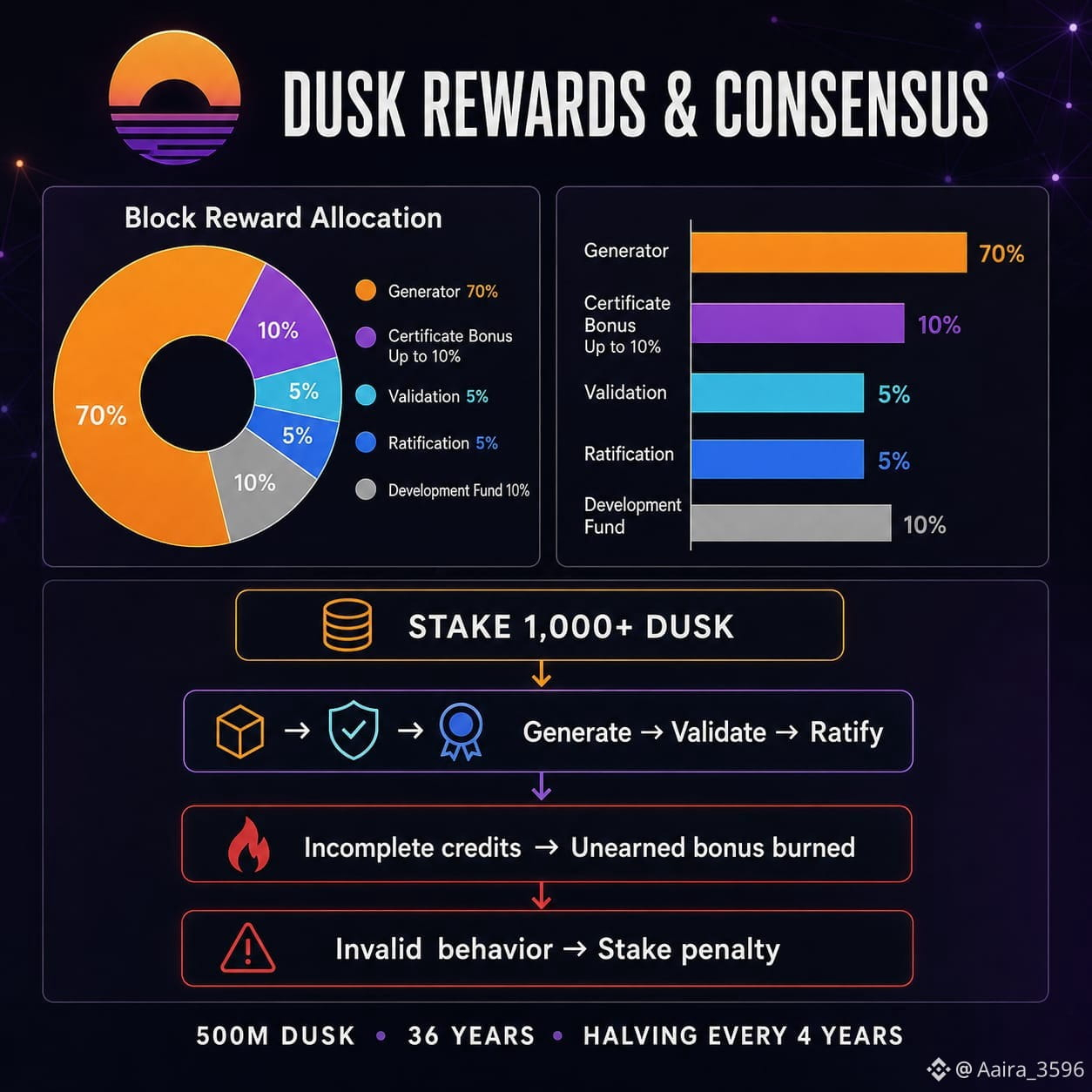
A block reward combines fresh emissions with all transaction fees paid in that block. The generator receives 70% directly and may collect another 10% based on the credits included in the final certificate. When the required consensus evidence is incomplete, the unearned part of that 10% is burned. The protocol therefore makes certificate quality financially relevant to the participant assembling the block.
Independent checks are also compensated. The validation committee receives 5% for evaluating the proposal, while the ratification committee receives 5% for confirming it. Another 10% supports the development fund. This distribution avoids placing the entire economic reward around block creation alone.
Provisioners carry downside risk too. Failed participation can lead to suspension and move active DUSK into locked stake, where it remains owned but cannot participate. Invalid votes or signatures on conflicting proposals can trigger hard penalties and burn part of the stake.
The emission plan supplies 500 million DUSK across 36 years, halving the rate every four years. That makes growing transaction fees increasingly important to #dusk security over time. $DUSK $AKE $EDEN
Does tying part of the generator reward directly to certificate credits create enough pressure for consistently strong consensus participation?
On @Dusk , provisioners secure consensus by staking at least 1,000 $DUSK . Their capital gives them access to participation, but rewards depend on the role performed when a block moves through generation, validation, and ratification.
A block reward combines fresh emissions with all transaction fees paid in that block. The generator receives 70% directly and may collect another 10% based on the credits included in the final certificate. When the required consensus evidence is incomplete, the unearned part of that 10% is burned. The protocol therefore makes certificate quality financially relevant to the participant assembling the block.
Independent checks are also compensated. The validation committee receives 5% for evaluating the proposal, while the ratification committee receives 5% for confirming it. Another 10% supports the development fund. This distribution avoids placing the entire economic reward around block creation alone.
Provisioners carry downside risk too. Failed participation can lead to suspension and move active DUSK into locked stake, where it remains owned but cannot participate. Invalid votes or signatures on conflicting proposals can trigger hard penalties and burn part of the stake.
The emission plan supplies 500 million DUSK across 36 years, halving the rate every four years. That makes growing transaction fees increasingly important to #dusk security over time. $DUSK $AKE $EDEN
Does tying part of the generator reward directly to certificate credits create enough pressure for consistently strong consensus participation?