

The next phase of blockchain adoption may not be decided by which network has the fastest transactions or the biggest token price move. It could come down to something much more important: which ecosystem can attract developers, institutions and everyday users at the same time.
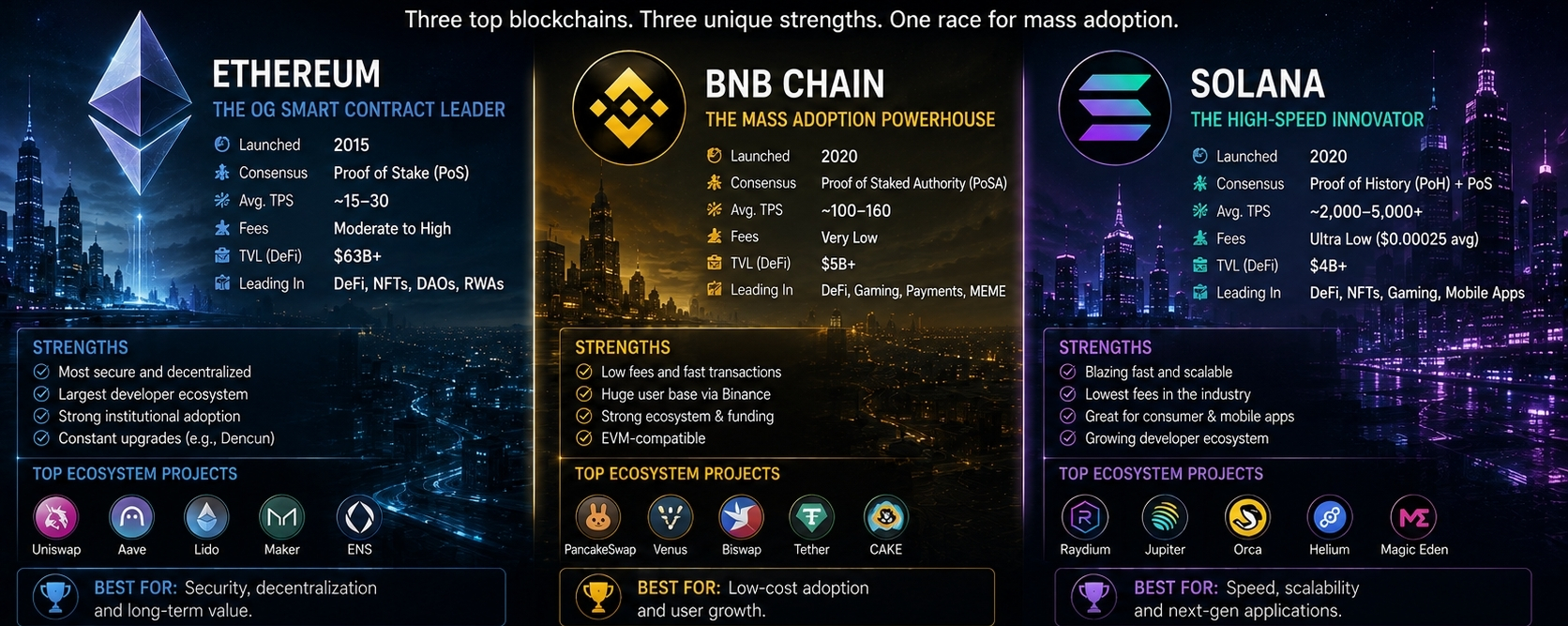
Ethereum, BNB Chain and Solana are all approaching this challenge differently. Ethereum is building around a powerful Layer-1 settlement network supported by Layer-2 chains. Solana is pushing high-performance activity directly on its base layer. BNB Chain is focusing heavily on speed, low costs and broad accessibility.
Each network has a credible growth story, but their strengths point toward very different paths to mass adoption.
Ethereum Still Has the Deepest Infrastructure Story
Ethereum's biggest advantage is the ecosystem that has developed around it.
Rather than trying to process every transaction directly on Ethereum mainnet, the network increasingly relies on Layer-2 rollups. These networks process transactions separately and then settle back to Ethereum, allowing users to benefit from lower costs while relying on Ethereum's security model.
Ethereum is also continuing to improve its base layer. Its official roadmap lists Glamsterdam and Hegotá for the second half of 2026, while the Ethereum Foundation's current priorities focus on scaling, improving user experience and strengthening the L1.
This gives Ethereum a powerful long-term position. It doesn't necessarily need every application to run directly on mainnet. Ethereum can instead become the settlement and security foundation underneath a much larger network of interconnected chains.
But Ethereum's Complexity Is Also Its Challenge
Ethereum's Layer-2 strategy creates enormous scaling potential, but it can also make the user experience more complicated.
Users may need to understand different networks, wallets, bridges and liquidity environments. That complexity can become a barrier for people who simply want to use an application without thinking about which blockchain they're on.
Ethereum's own ecosystem is increasingly focused on improving interoperability between Layer 1 and Layer 2 networks. The Ethereum Foundation has said it expects independent L2 chains to become increasingly interoperable while continuing to settle within the wider Ethereum ecosystem.
If Ethereum can make dozens of networks feel like one unified ecosystem, its adoption story becomes much stronger.
Solana Is Betting on Speed and a Unified Experience
Solana takes a very different approach.
Instead of depending heavily on Layer-2 networks, Solana aims to support large amounts of activity directly on a high-performance Layer-1 blockchain.
That architecture can create a simpler experience for users. Applications, liquidity and assets can remain within the same network rather than being spread across multiple execution environments.
Solana's current positioning increasingly emphasizes capital markets, payments and crypto applications, while its 2026 ecosystem updates highlight activity involving stablecoin settlement, tokenized assets, DeFi and payments.
This suggests Solana's next growth phase could extend well beyond the memecoin and speculative-trading activity that helped attract significant attention to the network.
Solana's Upcoming Upgrades Could Strengthen the Case
Solana is also continuing to upgrade its underlying infrastructure.
Its official network-upgrade tracker highlights developments including Alpenglow, increased compute capacity and other performance improvements.
Solana has also been developing an optimized token program designed to improve how tokens operate on the network.
If these upgrades make transactions more predictable and increase overall network capacity, Solana could become even more attractive for applications involving trading, payments and high-frequency interactions.
The opportunity is clear: make blockchain applications feel fast enough that users barely notice the infrastructure underneath them.
BNB Chain Has a Different Advantage: Accessibility
BNB Chain's growth story is built heavily around accessibility.
Low transaction costs and a large retail-focused ecosystem have historically made it easier for users to interact with decentralized exchanges, token launches, games and other Web3 applications.
Its current technical direction is also heavily focused on faster execution and larger transaction capacity.
That combination could matter enormously for adoption. Many mainstream users are unlikely to care about blockchain architecture. They will care whether an application is inexpensive, responsive and easy to use.
BNB Chain could therefore compete by making Web3 participation accessible to users who might find other ecosystems too expensive or technically complicated.
The Stablecoin Battle Could Be Huge
One of the most important adoption areas for all three networks may be stablecoins.
Stablecoins can support payments, remittances, decentralized trading and tokenized financial products. Unlike purely speculative applications, they can also provide utility even when crypto markets aren't rising.
Solana has been emphasizing stablecoin settlement and payment infrastructure in its recent ecosystem development.
Ethereum remains deeply connected to DeFi and on-chain settlement, while BNB Chain's low-cost environment gives it a strong foundation for high-volume stablecoin activity.
The ecosystem that makes stablecoin transactions easiest for everyday users could gain an important advantage in the next adoption cycle.
Tokenized Real-World Assets Could Change the Competition
Another major battleground is real-world asset tokenization.
Stocks, bonds, funds and other financial assets are increasingly being explored on public blockchains. Solana's ecosystem updates in 2026 have specifically highlighted tokenized equities and billions of dollars in real-world assets.
Ethereum also has a natural advantage here because its long history and security-focused architecture make it attractive for applications where settlement reliability matters.
BNB Chain could compete by providing lower-cost access to tokenized products, particularly for retail users.
If tokenization grows significantly, blockchain competition may shift from crypto-native applications toward financial infrastructure used by institutions and mainstream investors.
Developers Could Ultimately Decide the Winner
Technology alone doesn't create adoption.
Developers build the wallets, applications, exchanges, games and financial products that bring users onto a blockchain.
Ethereum has years of developer tooling and infrastructure behind it. Solana offers developers a high-performance environment with a growing focus on payments and capital markets. BNB Chain provides access to a large retail-oriented ecosystem and inexpensive transactions.
Whichever network makes it easiest for developers to create useful applications—and then attract users to those applications—could gain the strongest network effects.
There May Not Be One Winner
The future may not belong to a single blockchain.
Ethereum could become the dominant settlement layer for financial and institutional applications.
Solana could become a major home for high-speed trading, payments and consumer applications.
BNB Chain could continue expanding through low-cost transactions and broad retail accessibility.
Those outcomes aren't mutually exclusive.
Just as today's internet relies on different technologies serving different purposes, blockchain adoption could eventually support several major ecosystems specializing in different areas.
So, Who Could Lead the Next Adoption Wave?
Ethereum currently has one of the strongest infrastructure and settlement stories, particularly as its Layer-2 ecosystem continues expanding.
Solana may have the clearest high-performance consumer and payments narrative, with current development emphasizing faster infrastructure, stablecoins and tokenized markets.
BNB Chain's biggest advantage may remain accessibility: inexpensive transactions combined with an ecosystem capable of reaching a broad base of users.
The real winner won't necessarily be the blockchain with the highest transaction speed.
It will be the ecosystem that makes blockchain useful enough that millions of people can use it without needing to understand how the technology works underneath.
That may be the real battle behind the next crypto adoption wave.