

Pokémon cards have evolved from a children’s collectible into a multibillion-dollar market, with some buyers increasingly treating the cards as an alternative investment alongside traditional assets.
Exactly how large the Pokémon card market is remains difficult to estimate because trading is spread across decentralized dealer networks, local card shops, online marketplaces and conventions.
Estimates vary by methodology, but broadly place the market at between $10 billion and $15 billion.
Related: Shark Tank's Kevin O'Leary reveals one asset that could outperform gold
Cards over BTC, S&P500
The boom in the collectible market stands in a significant contrast to Bitcoin (BTC), the largest crypto asset that has struggled against market turmoil through 2026 so far. At the time of writing, Bitcoin was trading at $63,400, down by roughly 27% year-to-date, as per market data.
The card market also posted notable growth compared to the S&P 500. While the S&P 500 Index managed to climb up the market ladder by roughly 13%, the Pokémon card index gained about 28% year-to-date as per CoinDesk data.
On headline returns, Pokémon cards have therefore comfortably beaten both Bitcoin and the S&P 500 so far this year. The outperformance comes as some prominent investors are increasing their exposure to collectibles.
Trending on TheStreet Roundtable:
Cathie Wood trims Ethereum exposure on 11th anniversary
U.S. Treasury attacks Iran's Hormuz 'extortion' network
JPMorgan issues blunt warning on crypto's future
This visible divergence in investor interest has hurt companies heavily exposed to Bitcoin. Corporate Bitcoin treasuries have faced billions of dollars in unrealized losses as the asset declined, highlighting the risks of holding the volatile asset on corporate balance sheets.
Shark Tank investor Kevin O'Leary, for instance, recently revealed millions worth of investment into rare sports cards, calling them a legitimate alternative asset class.
He said his strategy is to own just 10 to 20 exceptional cards for the long term and suggested allocating 3% to 5% of a diversified portfolio to such collectibles, arguing that scarcity has allowed the best examples to outperform traditional assets over time
Deeper dive into the collectible cards market
Gaming and technology investor Konvoy Ventures estimated the market at about $13 billion in 2024, while Mordor Intelligence puts it at roughly $15 billion in 2026.
The longer-term gains have been even larger.
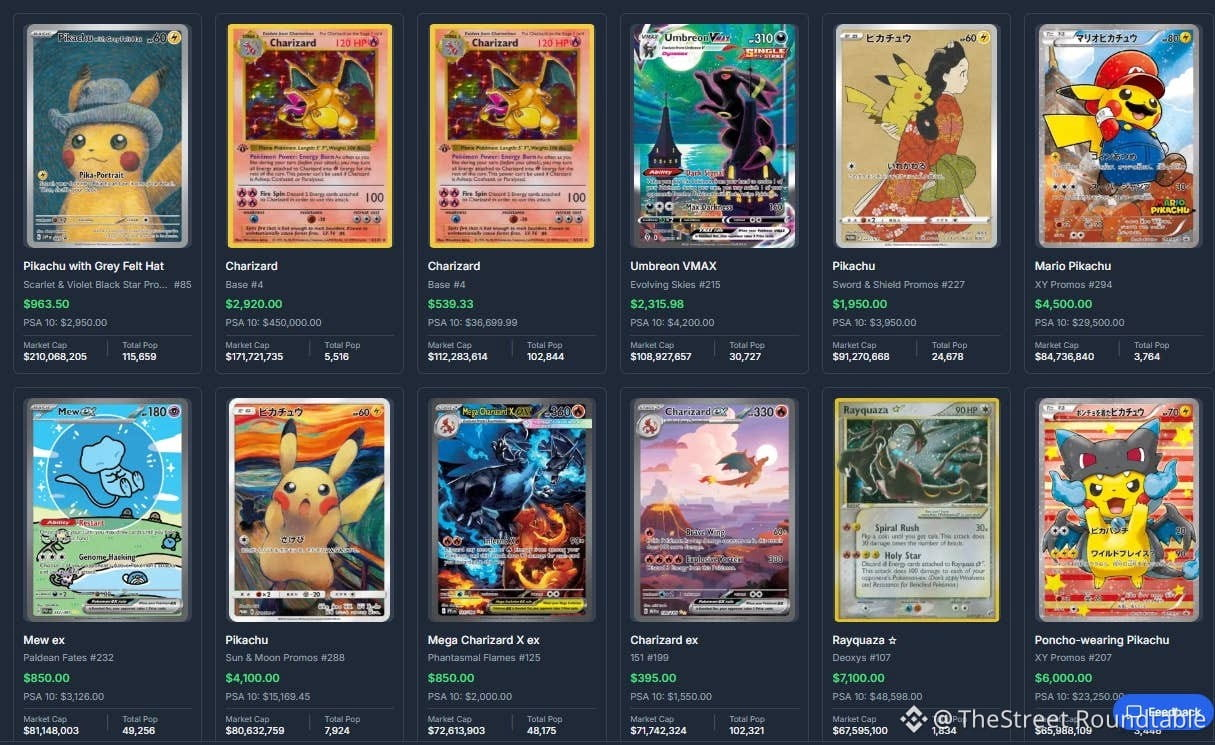 Source: TCGcharts
Pokémon cards tracked by analytics firm Card Ladder delivered a cumulative return of 3,821% between 2004 and August 2025, according to data.
Demand has also become big business for U.S. retailers. Target said trading card sales jumped nearly 70% in 2025 and were on track to exceed $1 billion, with Pokémon among the main drivers. Walmart Marketplace recorded a 200% increase in trading card sales between February 2024 and June 2025, while Pokémon sales increased more than tenfold, the company told Axios in Aug 2025.
Target executive vice president and chief commercial officer Rick Gomez said ahead of the 2025 holiday season that the retailer planned frequent new releases to capitalize on demand.
“We see trading cards being a hot gifting category for all ages that we will fuel with newness and with exclusive drops,” Gomez said.
However, cards are considerably less liquid than stocks or cryptocurrencies, and their prices can depend heavily on rarity, condition and grading, making direct comparisons with publicly traded assets imperfect.
Disclaimer: This article is for informational purposes only and should not be considered investment advice.
Related: Elon Musk's AI warning about the dollar is starting to come true