
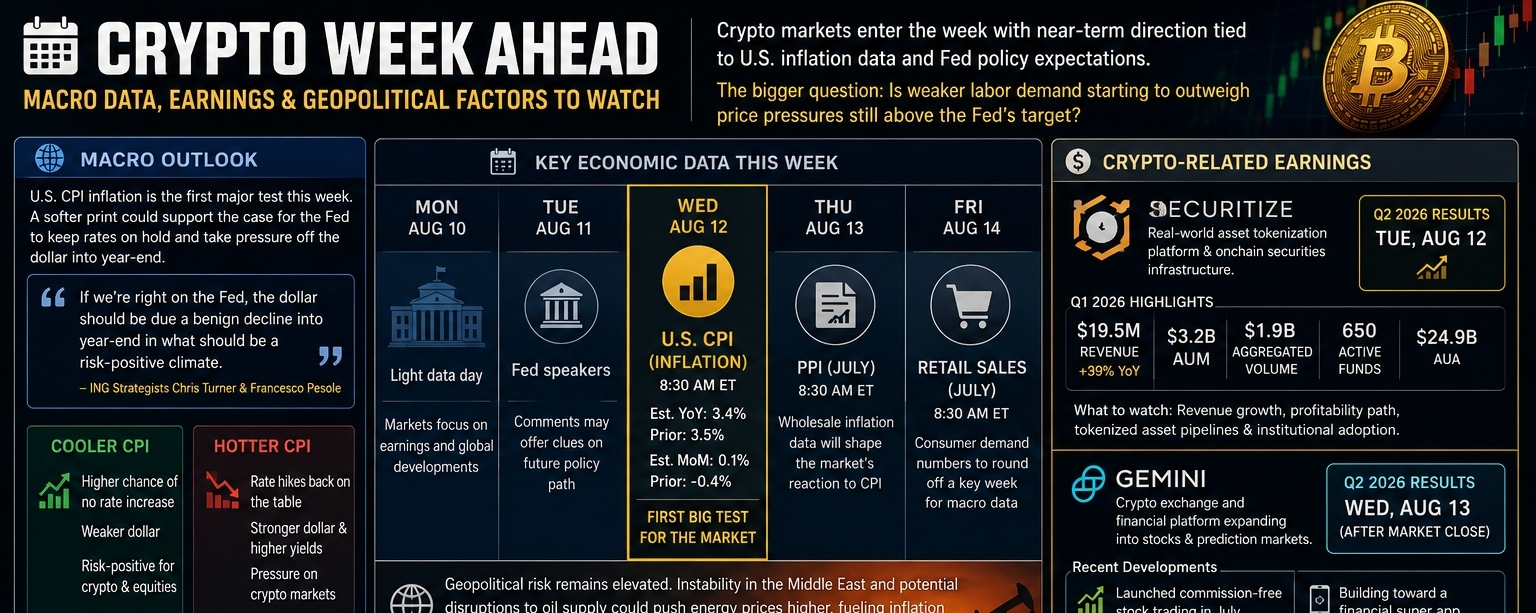
I checked the current week’s schedule against the BLS, Federal Reserve, company investor-relations pages, and current market reporting so the article reflects the August 10–16, 2026 setup rather than relying only on the supplied text. The key point is that the July CPI is scheduled for Wednesday, August 12, while PPI follows Thursday and retail sales Friday.
The part of this week that stands out to me is how little of the crypto story is actually about crypto itself.
I’ve seen this kind of week before. Bitcoin can spend days moving inside a relatively narrow range, altcoins can look directionless, and then one economic number arrives from Washington and suddenly the entire market seems to remember that digital assets are still trading inside the global liquidity system. This week feels similar, except the macro picture has a few more moving parts than usual.
The first thing I’m watching is Wednesday’s U.S. CPI report. The Bureau of Labor Statistics has scheduled the July CPI release for August 12 at 8:30 a.m. Eastern time. The current market expectation cited by CoinDesk is for headline inflation of 3.4% year over year, compared with 3.5% previously, with a 0.1% monthly increase after June’s 0.4% decline.
That number by itself is not particularly complicated. The reaction to it is.
I’ve learned over the years that markets rarely trade the inflation number in isolation. They trade what that number changes about the next few months of monetary policy. A CPI print that looks slightly better can mean something very different depending on what Treasury yields, the dollar and rate expectations are doing at the same time.
That matters especially now because the Federal Reserve has already left rates unchanged. At its July meeting, the FOMC kept the federal funds target range at 3.5% to 3.75%, while acknowledging that inflation remains elevated relative to its 2% goal. What caught my attention was the unusually divided vote: three members preferred a 25-basis-point increase.
That tells me the Fed is not operating in a completely comfortable environment.
There is still inflation pressure, but there are also questions around employment and demand. The Fed itself said economic activity was expanding at a solid pace and that job gains had kept pace with the workforce, while also pointing to uncertainty connected partly to the Middle East conflict.
So the market is effectively trying to solve two problems at once.
If inflation continues to cool, the argument for keeping rates unchanged becomes easier. If labor conditions weaken at the same time, the Fed has another reason not to tighten. That combination can be friendly to risk assets because investors start thinking less about additional monetary restraint and more about financial conditions gradually becoming easier.
That is where the dollar becomes important.
I’ve noticed that crypto traders sometimes focus almost entirely on the Fed headline and forget the transmission mechanism. Bitcoin does not need the Fed to suddenly become aggressively dovish for liquidity conditions to improve. Sometimes a slower dollar, stable Treasury yields and reduced expectations for additional tightening are enough to change the behavior of risk assets.
ING strategists Chris Turner and Francesco Pesole have previously described a benign dollar decline as an environment in which risk assets can perform better, while their broader 2026 outlook has also emphasized the tension between softer labor conditions and inflation that remains sticky.
That is basically the balance I’m watching this week.
A cooler CPI would not automatically mean crypto goes straight higher. I’ve seen too many supposedly perfect macro prints fail to produce a lasting move because the market had already priced them in. The more interesting question is whether the data changes positioning.
If traders start reducing expectations for another rate increase, Treasury yields soften and the dollar loses some momentum, then crypto could receive a broader risk-on tailwind. But if inflation comes in hotter than expected, the whole chain can work in reverse. Suddenly yields matter again, the dollar becomes more attractive, and high-beta assets have to absorb another round of tighter financial-condition expectations.
The interesting thing is that Thursday brings another inflation-related test with U.S. PPI, followed by retail sales on Friday. That gives the market several chances to question the first CPI reaction rather than allowing one number to settle the entire story. CoinDesk’s current calendar puts July PPI on August 13 and July retail sales on August 14.
That is why I’m reluctant to make a strong call based only on Wednesday.
I’d rather watch what happens after the number.
If Bitcoin initially jumps and then gives the move back, that tells me something. If it breaks higher and holds while the dollar weakens, that tells me something else. If altcoins begin attracting liquidity instead of simply following Bitcoin for a few hours, that would be more interesting still.
I’ve seen this before during previous macro-driven crypto cycles. The first move is often positioning. The second move is where you start learning whether the market actually believes the new information.
Then there is the other part of this week that I find surprisingly important: the growing number of publicly traded companies whose businesses are directly connected to crypto infrastructure.
Securitize is one of the names I’m particularly interested in watching. Its scheduled second-quarter report is not just another earnings release for a company with the word “crypto” attached to it. Securitize is sitting at the intersection of tokenization, traditional securities infrastructure and onchain markets.
Its first-quarter results give some useful context. Securitize reported $19.5 million of revenue for Q1 2026, up 39% from the previous year, while average assets under management were $3.2 billion and aggregated transaction volume reached $1.9 billion. It also reported 650 active funds being serviced and $24.9 billion in assets under administration.
Those numbers are more interesting to me than a tokenization headline.
I’ve seen the industry make enormous claims about real-world assets for years. The narrative is easy: put stocks, bonds, funds and other financial assets onchain, make them more programmable, improve settlement and eventually create a much larger financial market.
The difficult part is building the infrastructure that institutions are actually willing to use.
Securitize has been moving in that direction. In April, it announced an agreement with Computershare that would allow U.S.-listed clients to issue equity securities in tokenized form. In May, it announced FINRA approval expanding its broker-dealer capabilities to include custody of tokenized securities and atomic settlement between tokenized securities and stablecoins.
That is the kind of development I pay attention to because it is less about crypto speculation and more about whether traditional financial infrastructure is gradually absorbing blockchain technology.
But earnings will tell us something different.
They can show whether the business is actually scaling, whether revenue is following the growth of tokenized assets, how much the company is spending to build that infrastructure and whether the economics are improving. Securitize's first-quarter net loss was $7.9 million despite the revenue growth, while adjusted EBITDA was $0.8 million.
That is the part I want to understand better.
It is easy to look at rapid growth in assets and assume the business must be working. It is harder to determine how much of that activity is recurring, how much is economically valuable and how much investment is required to keep the machine running.
Tokenization is still young. The industry is likely to go through the same process we have seen with almost every major crypto narrative: early excitement, aggressive investment, too many projects, consolidation and eventually a smaller number of companies that actually become part of the financial system.
Securitize is interesting precisely because it is trying to operate on that institutional side of the market.
Then there is Gemini, which gives me a very different perspective.
Gemini is already an established crypto platform, but its public-market story is increasingly about becoming something broader than a traditional exchange. The company describes itself as a crypto and prediction-markets platform serving both individuals and institutions, and it has been expanding its product range.
Gemini is scheduled to report second-quarter 2026 results after the market closes on August 13, with management set to discuss the results on August 14.
What I’m interested in here is not simply whether Gemini beats or misses an earnings estimate.
I want to see what users are actually doing.
Crypto companies can talk about product expansion all day, but eventually the numbers have to show up in trading activity, transaction revenue, active customers, institutional participation and the cost of acquiring and retaining those users.
I’ve watched exchanges during previous cycles where everything looked great while prices were rising. Volumes increased, new users arrived and revenue exploded. Then the market cooled and suddenly it became obvious which businesses had durable customers and which ones were mostly benefiting from speculation.
That distinction is important again now.
Gemini’s move toward commission-free stock trading is another example of this broader strategy. The company announced the launch in July as part of what it called a step toward a financial super app.
I can understand the logic. If a customer already has crypto, why force that customer to leave the platform to buy stocks? The financial industry has been moving toward increasingly broad platforms for years.
But there is a risk here too.
Every company wants to become the place where users do everything. In practice, users tend to stay where the product is cheapest, easiest and most reliable. Building more features does not necessarily create more loyalty. Sometimes it simply creates more complexity.
That is what I’ll be thinking about when Gemini reports.
Can it turn its crypto-native user base into a broader financial customer base? Can it attract institutions while keeping the retail experience simple? Can it generate durable revenue when trading volumes are not being boosted by a major bull market?
Those are much harder questions than whether one quarter's earnings beat expectations.
And then, almost quietly, there is the geopolitical risk sitting over all of this.
The Middle East situation is not just a headline for oil traders anymore. The Strait of Hormuz remains central to the market's risk assessment, and developments around its reopening are already moving crude prices. Reuters reported Tuesday that Brent crude had climbed to around $88 a barrel as negotiations stalled, while Treasury yields also moved higher as investors considered the implications for inflation and rate expectations.
That creates an uncomfortable situation for central banks.
If oil rises because of a geopolitical supply shock, it can push inflation higher without necessarily creating stronger economic growth. That is the kind of inflation that monetary policy cannot easily fix. Raising rates does not produce more oil.
But markets do not always care about that distinction.
If investors see energy prices rising, they can immediately start thinking about higher inflation, higher yields and fewer rate cuts. The financial conditions tighten before the real economic consequences have fully arrived.
The European Commission's research has illustrated just how serious a prolonged Hormuz disruption could become. Its downside scenario assumes continued restrictions on maritime transit and shows oil prices potentially reaching around $180 per barrel in the fourth quarter under a severe prolonged disruption scenario. That is not a forecast of what will happen, but it demonstrates the scale of the potential shock.
That is why I don’t think the crypto market can completely separate itself from energy markets right now.
Bitcoin is sometimes treated as an isolated asset with its own internal cycle, and over long periods there is certainly more to the story than oil or the dollar. But in the short term, crypto still responds to global liquidity, leverage and investor risk appetite.
A geopolitical shock can change all three very quickly.
There is another thing I’ve learned from watching crypto for years: the market usually finds a narrative after the move has already started.
If CPI comes in soft and Bitcoin rises, the narrative will probably become “Fed easing.” If oil suddenly falls and risk assets recover, the narrative may become “geopolitical relief.” If Gemini and Securitize deliver strong numbers, investors may start talking about institutional adoption again.
But the underlying mechanisms were already there.
That is why I try not to get too attached to any single explanation.
This week is really a test of whether several different parts of the market can move in the same direction at the same time. Softer inflation would help the rates story. Stable or lower yields would help liquidity. A weaker dollar could improve the backdrop for risk assets. Calmer oil markets would remove one source of inflation anxiety. Strong crypto-company earnings would provide evidence that actual business activity is developing underneath the market.
But those pieces do not have to line up.
CPI could cool while oil remains elevated. Gemini could show strong user growth while margins remain under pressure. Securitize could continue expanding tokenized assets while spending heavily to build the infrastructure. Bitcoin could rise even while macro conditions remain complicated, simply because positioning and liquidity overwhelm the fundamental concerns for a while.
That is the part that makes this week worth watching.
I’m less interested in guessing the exact direction of Bitcoin over the next few days than in seeing how the market behaves when the information arrives. If traders respond constructively to softer inflation, I want to know whether that response lasts. If the CPI number disappoints, I want to see whether buyers step in quickly or whether the market has become too dependent on expectations of easier policy.
And with Securitize and Gemini reporting, I’m watching something that matters beyond the next candle.
I want to see whether crypto companies are becoming better businesses.
That distinction may sound boring compared with price targets and market predictions, but I think it becomes increasingly important as the industry matures. During the early years, almost any increase in users or volume could be interpreted as proof that crypto was growing. Today there are enough public companies and mature infrastructure businesses that we can start asking harder questions about revenue quality, operating leverage, customer retention, institutional demand and real-world usage.
That is progress, even if the answers are sometimes uncomfortable.
For now, I’m keeping the mindset fairly simple. Wednesday's CPI will tell us something about inflation. Thursday's PPI will help confirm or challenge that picture. Retail sales will offer another look at demand. Securitize and Gemini will give us a glimpse into the business side of the crypto economy. And oil and geopolitical headlines can change the entire macro equation if they move sharply enough.
I don't think there is a single number that will decide the crypto market's direction for the rest of the year.
I’ve seen too many markets change their mind after the first reaction.
So I’m watching the data, watching liquidity, watching how traders respond, and paying particular attention to what happens after the headlines stop being new. That is usually where the more useful information appears.
For now, I’m neither trying to force a bullish story nor a bearish one. I’m simply waiting to see whether the improving parts of the crypto economy can continue producing real activity while the broader financial system works through inflation, rates, the dollar and geopolitical risk.I kept the article continuous rather than sectioned, used the current August 2026 calendar, and cross-checked the main factual points against different sources rather than simply rewriting the supplied article.