
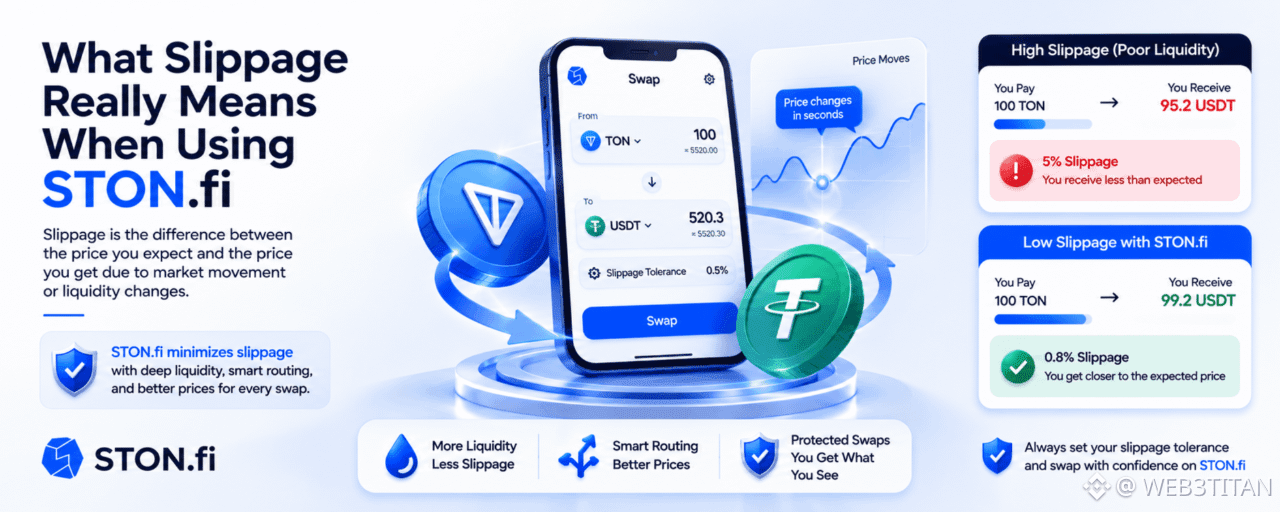
Slippage is one of those DeFi terms that can sound complicated until you actually see it happen during a swap.
You choose the token you want to sell, select what you want to receive, enter your amount, and suddenly you see a difference between the expected price and the final amount.
That difference is where slippage comes in.
Understanding it is important because it can affect how much you actually receive from a swap.
So what exactly is slippage, and how does STON.fi handle the factors that can cause it?
Let's break it down.
WHAT IS SLIPPAGE?
Slippage is the difference between the price you expect when starting a trade and the price at which the trade is actually executed.
For example, imagine you want to swap 100 USDT for another token.
The interface may show an expected amount based on the available market conditions.
But by the time your transaction is executed, the market may have moved.
You could receive slightly more or slightly less than the amount you initially expected.
That difference is commonly described as slippage.
WHY DOES SLIPPAGE HAPPEN?
There isn't just one reason.
Several factors can influence the final execution price.
PRICE MOVEMENTS
Crypto markets can move quickly.
If the price of the token changes between the time you receive a quote and when the transaction is executed, the final result can change.
This can happen even within a short period.
LIQUIDITY
Liquidity is another major factor.
If there is a lot of liquidity available for a trading pair, a swap can generally be executed with less price impact.
If liquidity is shallow, a larger trade can have a greater effect on the pool's price.
This is why the size of your trade matters.
TRADE SIZE
A small swap may have very little effect on a liquidity pool.
A much larger swap can consume a significant portion of the available liquidity.
The larger the trade compared with the available liquidity, the greater the potential price impact.
SLIPPAGE VS PRICE IMPACT
These two terms are often confused.
They are related, but they aren't exactly the same.
Price impact is the effect your own trade has on the available market liquidity.
Slippage generally refers to the difference between the expected execution and the actual execution.
For example, if you're swapping a large amount through a relatively small liquidity pool, your transaction can create significant price impact.
Market movement during execution can then create additional slippage.
Understanding both helps you better evaluate a swap.
HOW STON.fi HELPS WITH EXECUTION
This is where the infrastructure behind STON.fi becomes important.
STON.fi is designed to find efficient routes for swaps instead of simply sending every trade through one fixed path.
Depending on the available liquidity and the type of swap, routing can help find a more efficient execution path.
For cross chain swaps, Omniston coordinates the cross chain execution behind the scenes.
The goal is to keep the complicated routing and execution process away from the user.
Instead of manually searching through different routes, you select what you want to swap and review the quote presented to you.
WHY LIQUIDITY AGGREGATION MATTERS
Another important part of getting better execution is access to liquidity.
Liquidity can be spread across different pools and sources.
If a swap is restricted to one small liquidity source, a larger trade can experience greater price impact.
Liquidity aggregation can help access multiple available sources when determining an efficient route.
This can improve the chances of getting competitive execution, particularly when the direct route doesn't have enough liquidity.
MULTI HOP ROUTING CAN ALSO HELP
Sometimes the most efficient route isn't a direct swap.
Imagine you want to trade Token A for Token C.
There may be plenty of liquidity for:
Token A → Token B
and
Token B → Token C
but very little liquidity for:
Token A → Token C
In that situation, routing through Token B may provide a better execution path.
This is called multi hop routing.
The important point is that an extra hop isn't necessarily bad.
The objective is to find an efficient route that provides a better overall execution.
WHAT SHOULD YOU CHECK BEFORE SWAPPING?
Before confirming a trade on STON.fi, I think there are a few things worth checking.
CHECK THE AMOUNT YOU WILL RECEIVE
Don't focus only on the amount you're sending.
Look at the estimated amount you will receive.
This gives you a better idea of the actual trade outcome.
CHECK THE PRICE IMPACT
If the interface provides price impact information, pay attention to it.
A high price impact can indicate that your trade is large compared with the available liquidity.
CHECK THE SLIPPAGE SETTINGS
Slippage tolerance determines how much deviation from the expected execution you're willing to accept.
Setting it too low can cause a transaction to fail if the market moves before execution.
Setting it too high can expose you to a less favorable execution.
The right setting depends on the market and the trade.
CHECK THE TOKEN AND NETWORK
Always make sure you've selected the correct token and network.
This is particularly important for cross chain swaps because you're dealing with assets across different blockchain ecosystems.
WHY LARGE TRADES NEED MORE ATTENTION
Slippage isn't equally important for every trade.
If you're swapping a small amount in a deep liquidity pool, the difference may be minimal.
But when the trade becomes large relative to available liquidity, execution becomes more sensitive.
This is why larger swaps deserve more attention.
Before confirming, look at the expected output, price impact, and other transaction details rather than simply clicking swap.
SLIPPAGE DOESN'T ALWAYS MEAN SOMETHING IS WRONG
This is an important point.
Seeing slippage doesn't automatically mean the DEX is malfunctioning.
Markets are constantly changing.
Liquidity changes.
Prices move.
Other transactions can happen before yours.
All of these factors can influence execution.
The important thing is understanding what you're accepting before you confirm the transaction.
MY TAKE
Before learning more about slippage, I used to think that the price shown when starting a swap was simply the price I would receive.
DeFi doesn't always work that way.
The quote is based on current market conditions, available liquidity, routing, and the size of the trade. By the time the transaction executes, those conditions can change.
What I appreciate about STON.fi is that much of the complexity around finding an efficient route is handled behind the scenes.
Liquidity aggregation, routing, and, for cross chain swaps, Omniston's execution infrastructure all contribute to making the process easier for the user.
But the responsibility to review the trade still belongs to the user.
For me, the biggest lesson is simple:
Don't just look at the token you're buying. Look at how the swap will be executed.
Understanding slippage, liquidity, price impact, and routing makes it much easier to know what you're actually agreeing to when you click swap on STON.fi.
Visit The STONfi Platform ⬇️
https://app.ston.fi/swap
Connect with STON.fi via:
X: https://x.com/ston_fi
Telegram: https://t.me/ston_fi
Discord: https://discord.gg/bdmaGV6qUw
Linktree: https://linktr.ee/ston.fi
Blog: https://blog.ston.fi/