
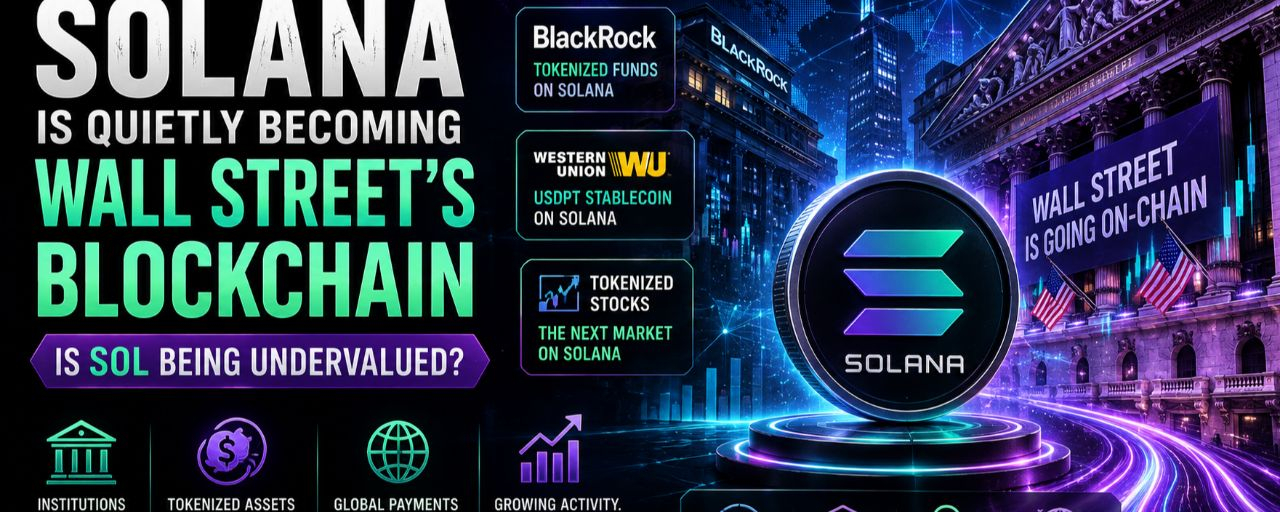

While Bitcoin Dominates Headlines, Solana Is Building Something Bigger
The crypto market often moves from one narrative to another.
Bitcoin dominates the headlines.
Ethereum remains a major smart-contract platform.
But underneath the noise, Solana is increasingly positioning itself as infrastructure for payments, tokenized assets and institutional finance.
And recent developments suggest this narrative deserves much more attention.
🏦 Wall Street Is Moving On-Chain
One of the biggest developments is the growing presence of traditional financial institutions on Solana.
BlackRock has expanded its tokenized money-market strategy onto Solana, adding another major institutional name to the network's growing financial ecosystem.
This matters because tokenization isn't simply about putting a digital version of an asset on a blockchain.
The real opportunity is creating infrastructure where assets can be:
Issued on-chain
Traded 24/7
Settled quickly
Used as collateral
Integrated with other financial applications
If that model scales, blockchains could become part of the infrastructure behind traditional markets.
💵 Western Union Is Bringing Payments to Solana
The institutional story isn't limited to investment products.
Western Union launched USDPT, a U.S. dollar-denominated payment stablecoin issued by Anchorage Digital Bank and built on Solana.
That's significant because Western Union isn't a crypto-native startup.
It's a global payments company with a massive existing financial network.
The bigger question becomes:
What happens when traditional payment companies start using public blockchains as settlement infrastructure?
That could be far more important for SOL's long-term narrative than a short-term price rally.
📈 Tokenized Stocks Are Becoming a Real Market
Solana's ecosystem is also seeing increasing activity around tokenized equities.
Recent ecosystem data highlights tokenized equity activity involving major companies, alongside significant growth in tokenized-equity trading and holders.
This creates a completely different use case for blockchain.
Instead of crypto being an isolated financial market, blockchain could become the rail connecting traditional assets with digital markets.
Stocks.
Treasuries.
Stablecoins.
Funds.
All potentially moving through the same on-chain infrastructure.
⚡ The Activity Is Also Scaling
Solana recently reported more than 1 billion non-vote transactions in a single week, showing the network is handling substantial activity beyond simple speculative trading.
Of course, transaction counts alone don't guarantee that SOL will outperform.
But they do provide an important signal:
There is increasing activity being built around the network.
For long-term investors, that may be more meaningful than one day's price movement.
🧩 Why SOL Could Benefit
If Solana becomes a major settlement layer for tokenized assets and digital payments, demand for the network could potentially come from several directions:
1️⃣ Tokenized assets
More assets moving on-chain could mean more network activity.
2️⃣ Stablecoins
Stablecoins can create recurring transaction demand.
3️⃣ Payments
Companies such as Western Union are testing blockchain-based payment infrastructure.
4️⃣ Institutional finance
Asset managers are experimenting with tokenized financial products.
5️⃣ DeFi
Tokenized real-world assets can eventually interact with decentralized financial applications.
This creates a much broader thesis than simply:
"SOL might pump."
The thesis becomes:
"Solana could become financial infrastructure."
⚠️ But There Are Still Risks
Investors shouldn't ignore the other side.
Solana faces:
Competition from Ethereum and other high-throughput networks
Regulatory uncertainty
Smart-contract and infrastructure risks
Network adoption risks
Competition for tokenized assets
Crypto market volatility
And most importantly:
Institutional adoption does not automatically translate into higher SOL prices.
The market still needs to determine how much economic value ultimately accrues to the SOL token itself.
👀 What Should Investors Watch Next?
If you're following Solana, I would watch these five indicators:
1. Institutional tokenization
Are more major financial institutions choosing Solana?
2. Stablecoin activity
Does stablecoin usage continue growing?
3. Tokenized equity volume
Are tokenized stocks becoming a real market rather than a niche experiment?
4. Payments adoption
Do more payment companies use Solana for settlement?
5. Real economic activity
Is network growth coming from genuine users and financial applications rather than speculation alone?
These signals could tell us whether the Solana institutional narrative is actually becoming a long-term trend.
🚀 Final Thoughts
The most interesting part of Solana's story isn't necessarily today's SOL price.
It's what's being built around the network.
A major asset manager moving tokenized funds onto Solana.
A global payments company using Solana for a regulated dollar stablecoin.
Tokenized equities gaining traction.
And growing on-chain activity.
These developments suggest Solana is increasingly competing for something much bigger than crypto trading:
the infrastructure of digital finance.
If that trend continues, SOL could become one of the most closely watched assets of the next phase of blockchain adoption.
But the key question remains:
Will Solana become a genuine financial settlement layer—or will another blockchain capture that role?
💬 What Do You Think?
Can Solana become one of the leading blockchains for institutional finance?
🟢 Yes — SOL is becoming financial infrastructure
🔵 Maybe — Ethereum still has the advantage
🟣 Too early to tell
🟡 Another blockchain will win
👇 Vote and tell me WHY.
🔖 Hashtags
#Solana #SOL #Crypto #Tokenization #RWA #Stablecoins #BlackRock #Blockchain #InstitutionalCrypto #BinanceSquare