
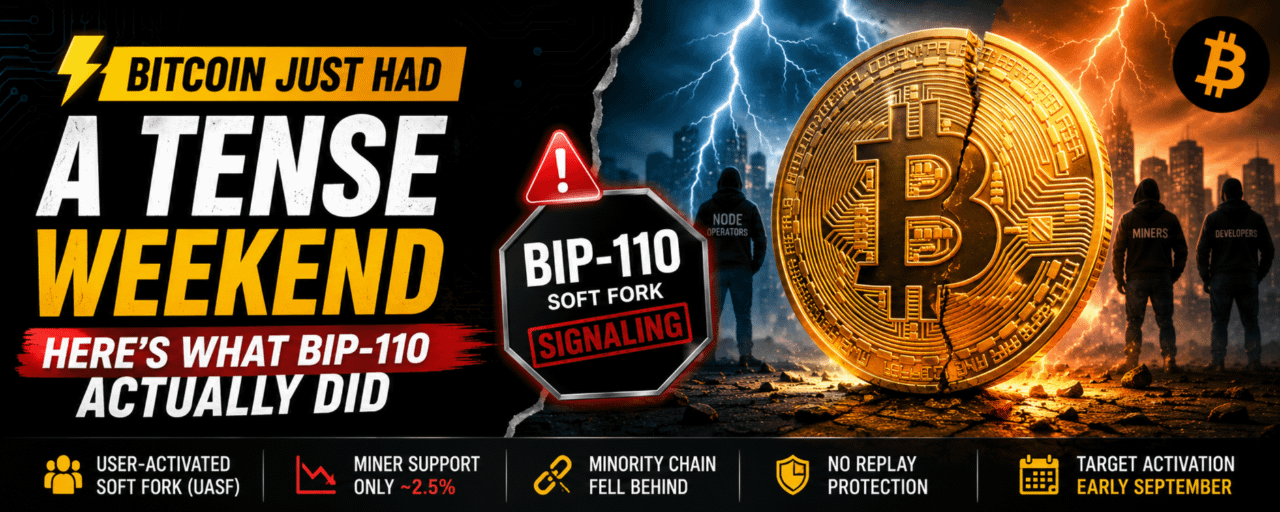

Bitcoin just entered one of its most closely watched protocol debates of 2026.
At block 961,632, BIP-110 entered its mandatory-signaling phase. The proposal aims to temporarily restrict the amount of non-financial data that can be embedded in Bitcoin transactions, including large arbitrary data payloads associated with inscriptions and similar uses of block space.
But there is a major problem for supporters: miner support was only around 2.53%, far below the 55% signaling threshold specified for activation.
That low support quickly became significant. A minority chain enforcing BIP-110 briefly produced blocks, but it failed to keep pace with the dominant Bitcoin chain. Reports on August 9 showed the enforcing branch already significantly behind.
🔍 What Does BIP-110 Actually Change?
The proposal is designed as a temporary soft fork. Its consensus rules would limit certain forms of arbitrary data in Bitcoin transactions while leaving normal financial transactions functioning as before.
According to the BIP specification, the restrictions are intended to remain temporary, with the maximum activation height set at 965,664, around September 1, 2026.
⚠️ Why Is The Debate So Serious?
This is not simply a technical argument about transaction data.
At its core, BIP-110 raises a much bigger question:
Who ultimately decides Bitcoin's rules — miners, node operators, developers, or the wider economic network?
Supporters argue that Bitcoin's limited block space should primarily serve monetary transactions. Critics argue that users should be free to use block space for any valid, fee-paying transaction.
The disagreement has already attracted opposition from influential Bitcoin figures, including Michael Saylor and Adam Back.
🚨 What Should Bitcoin Holders Do?
The biggest risk is not necessarily Bitcoin itself.
If competing chains emerge, users need to be extremely careful with transactions involving any potential forked asset. BIP-110 does not provide traditional replay protection, so careless transactions during a contentious chain split could potentially create replay-related risks.
For ordinary BTC holders, the safest approach is to avoid rushing into any “free fork coin” opportunity and wait for the situation to become clearer.
📌 The Bottom Line
BIP-110 has not simply taken over Bitcoin.
The current data shows very low miner support and a minority enforcing chain struggling to maintain momentum. But the debate itself is far from meaningless.
Bitcoin's history has shown that protocol disputes can become much bigger than the original technical issue.
Will BIP-110 fade away as a minority-chain experiment, or could the governance battle become Bitcoin's next major consensus test?
#Bitcoin #BTC #BIP110 #BitcoinNews #CryptoNews #BitcoinUpgrade #BitcoinFork #Crypto
