
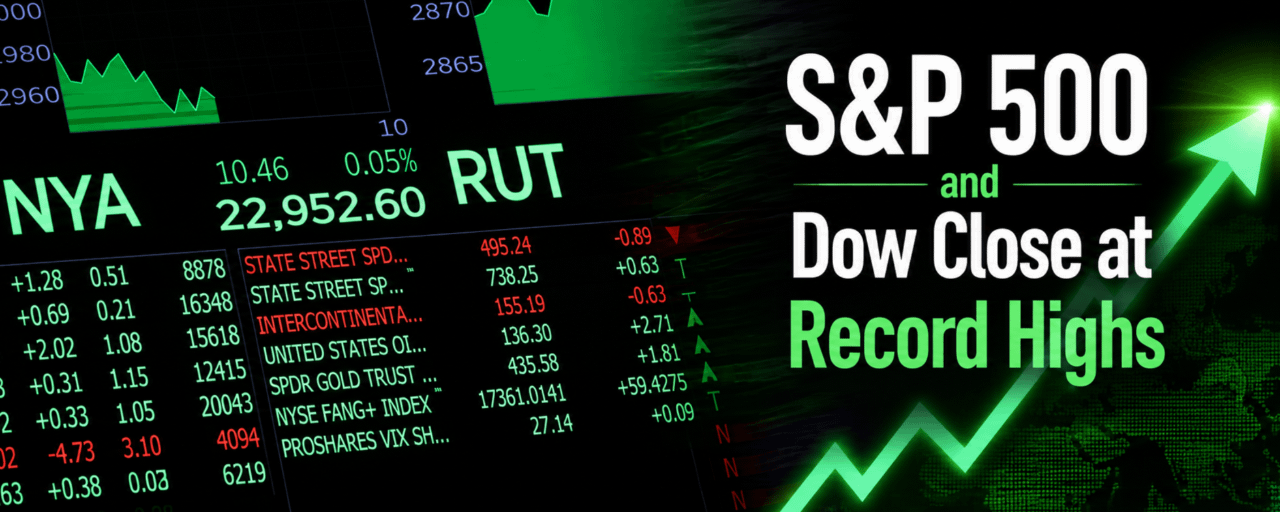
Stocks hit record highs on Tuesday. Bonds climbed. Oil sank. The catalyst: growing hope that the Strait of Hormuz could reopen. President Donald Trump discussed efforts to de-escalate US-Iran tensions in a call with Qatar's Emir, Sheikh Tamim Bin Hamad Al-Thani, according to the Gulf state's government.
A White House official confirmed the call had taken place. Beyond that, silence — no further detail offered. And in what could form part of a wider settlement, Iran is reportedly considering letting European nations help clear mines from the strait, according to diplomats familiar with the discussions.
The economic data cooperated too. June's JOLTS report showed job openings easing back. But the ratio of openings to unemployed workers actually improved, hitting its best level since January 2025. Hires rose. Quits rose too — their biggest monthly jump in a year. Layoffs held flat. Labour demand, in other words, remains solid even as the pace of hiring cools.
Corporate earnings did the rest of the work. Chipmakers logged their best four-day rally since 2020. Equity indices opened higher, led by technology, as a jump in Palantir Technologies and a continuing semiconductor rebound combined with strength across industrials — Caterpillar's earnings beat set that particular tone.
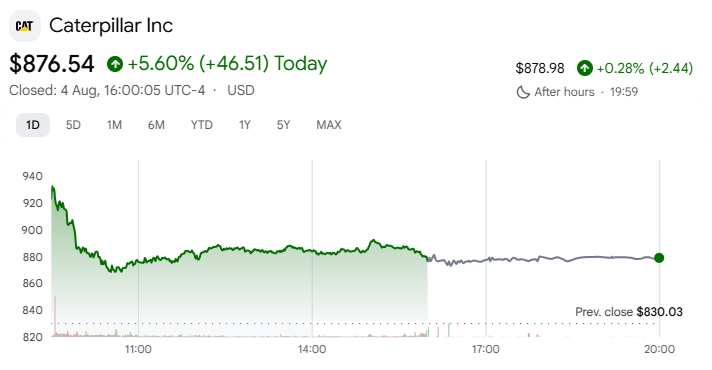
The Nasdaq Composite led again, adding 2.59% to close at 26,584.99 on Palantir's surge. The S&P 500 gained 1.79% to end at 7,736.52. Its first record close since June. The index's technology sector is now up 6.6% over two sessions and 12.2% since last Wednesday — a startling run by any measure. The small-cap Russell 2000 rose roughly 1.7%. The Dow climbed 907.47 points, or 1.71%, to 54,085.88, led by a jump of more than 5% in Caterpillar that pushed the stock past its intraday record from last month. Taken together: the S&P's second-best two-day gain since April, the Nasdaq's second-best since May. Only April's rebound did better.
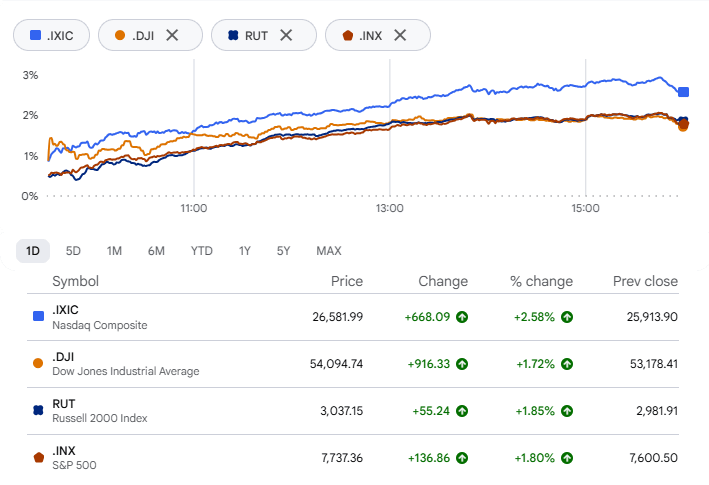
Coming off its worst month since 2008, the SOX semiconductor index is now on course for its best four-day run since the Covid bottom in 2020. Tech is back in the driver's seat. Nearly 80% of Nasdaq volume advanced on the day, according to FactSet. So did close to 70% of NYSE volume. Advancers outnumbered decliners on the Nasdaq by 3,244 to 1,099, and on the NYSE by 1,785 to 879. New 52-week highs reached 265 on the Nasdaq against 93 lows; the NYSE logged 125 new highs versus 27 new lows. One caveat, though: overall volume wasn't spectacular. Nasdaq trading ran at roughly 85% of its 30-day average by mid-afternoon. NYSE volume sat under 72%.
Caterpillar was the Dow's biggest gainer, closing up more than 5%. Better-than-expected second-quarter numbers did it, along with an upgraded revenue growth outlook — the industrial giant pointed to strong equipment demand tied to the AI data-centre build-out. It also said its full-year tariff-cost outlook should land at the lower end of its previous range.
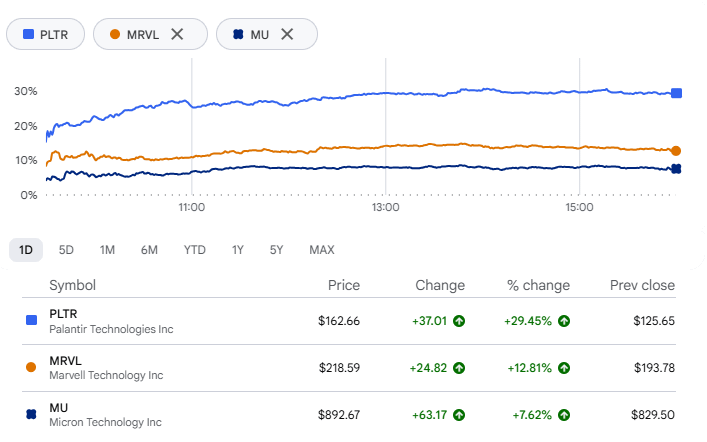
Then there was Palantir. Shares surged nearly 30% after a blowout quarter that CEO Alex Karp described as "otherworldly," driven by what the company calls AI sovereignty demand. Revenue rose 93% year-on-year to around $1.9 billion. US commercial revenue — the number investors were actually watching — jumped 149%. Palantir raised its full-year guidance across revenue, operating income and free cash flow. It was the stock's strongest single session in more than two years. Chip stocks rode the same wave: Micron Technology gained more than 7%, Marvell Technology advanced nearly 13%, both extending a comeback from a rough July.
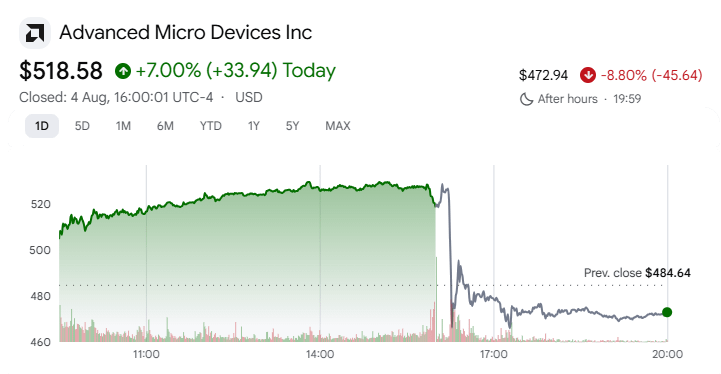
Advanced Micro Devices closed 7% higher after posting record second-quarter revenue of $11.5 billion, up 50% year-on-year, as data-centre sales more than doubled. But there was a catch. There's always a catch. AMD said it spent $808 million on capital expenditure during the quarter — a steep rise from $282 million a year earlier and $389 million in the March quarter. The stock gave back its gains in extended trading once investors had time to sit with that number. However, it shares declined by 8% in after-hours trading.
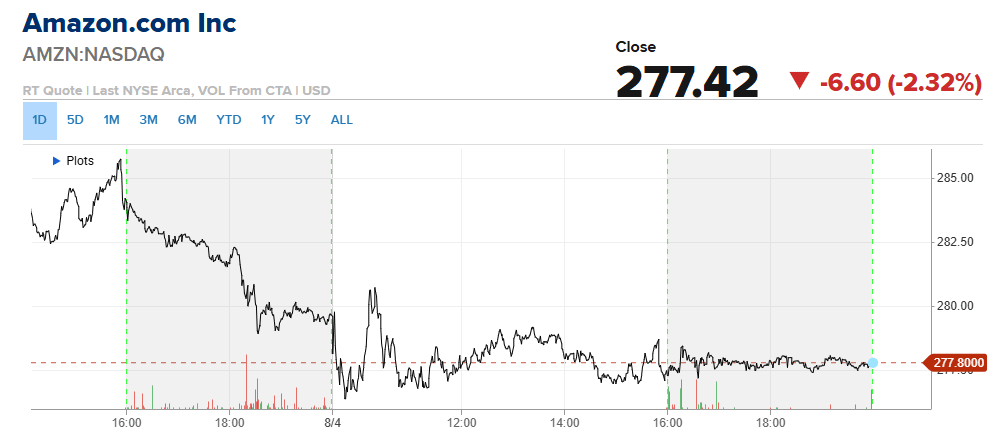
Amazon fell more than 2% on Tuesday after a filing showed founder Jeff Bezos had sold roughly 15 million shares, worth about $4.1 billion. The sale was disclosed under a Rule 10b5-1 trading plan adopted on 14 November 2025 — pre-scheduled, nothing opportunistic about the timing on paper. It came a day after the e-commerce giant's stronger-than-expected earnings pushed the stock to a record high and its market value above $3 trillion, a rally fuelled by robust cloud-computing growth that reinforced investor confidence in Amazon's AI payoff.
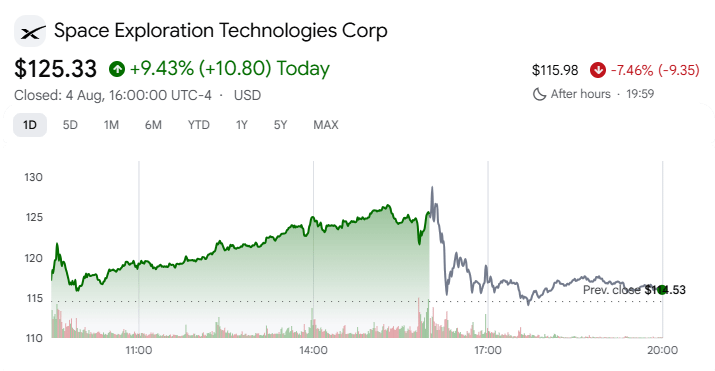
SpaceX, meanwhile, posted better-than-expected revenue of $7.8 billion in its first earnings report since June's record initial public offering — comfortably ahead of the roughly $6.8 billion Wall Street had pencilled in. Good news. Except capital spending reportedly jumped to around $18.4 billion for the quarter, and that overshadowed everything else. Shares rose before the earnings were released to close up nearly 11%. However, the stock fell about 7% in extended trading.
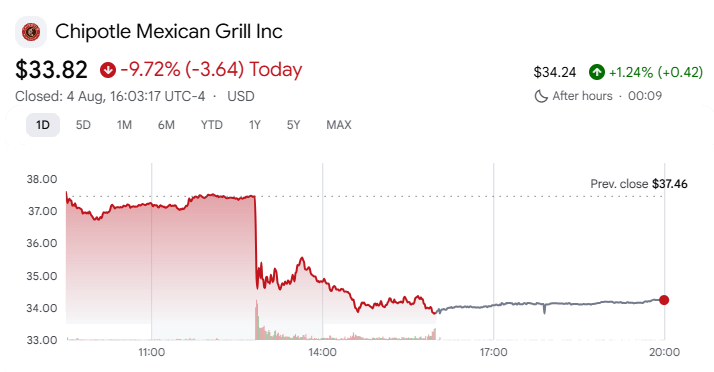
Chipotle Mexican Grill had a rougher day still: shares slid nearly 10% after the company pulled jalapeños from a number of Minnesota locations amid a state health investigation into a salmonella outbreak. Chipotle said it had proactively removed the peppers once it learned its supply may have been linked to the outbreak. Bloomberg broke the story first.
Sector Analysis:
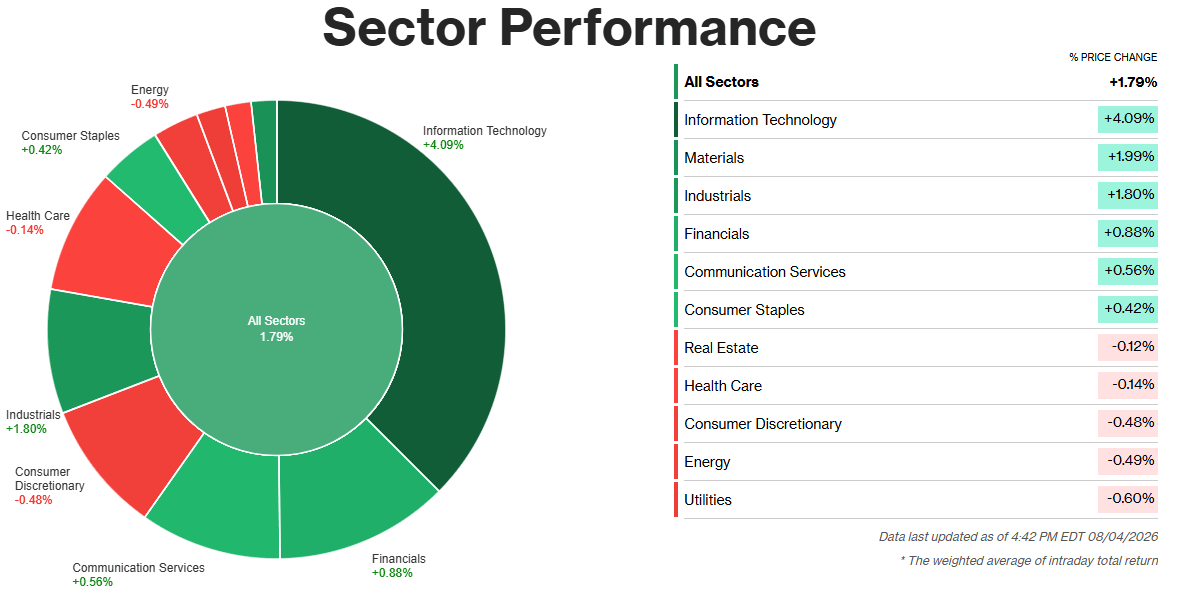
So where did the money actually go? Technology led, but participation was broad — the equal-weighted S&P 500, small caps and mid caps all posted solid gains alongside it. Beyond tech, which jumped 4%, financials advanced 0.9%, with Goldman Sachs alone gaining more than 2%. Industrials and materials each rose nearly 2%.
Technology's 4.09% gain did most of the heavy lifting. Palantir's earnings and the chipmaker rally drove a second straight session of sector leadership, which suggests something: investors are re-embracing the AI trade, not just staging a one-day bounce.
Materials, up 1.99%, and industrials, up 1.80%, rode a cleaner macro backdrop. Caterpillar gave industrials a company-specific anchor. Materials caught the broader tailwind — falling oil, easing geopolitical risk, improving sentiment that inflation pressures may be moderating. Both moves track the day's dominant macro story more than any isolated fundamentals.
Energy fell 0.49%, and the reason was simple: crude dropped. Treasury Secretary Scott Bessent told CNBC "there is a chance we may have a deal today or tomorrow to open the strait," and West Texas Intermediate fell sharply on the comment — down roughly 4%, to around $77 a barrel. That's sector-wide pressure on producer margins. Not a company-specific story.
Utilities, down 0.60%, looked like classic rotation: capital left defensive, rate-sensitive names to chase tech, industrials and materials to record highs. A textbook risk-on trade-off. Consumer discretionary, down 0.48%, had a clearer culprit in Chipotle, whose shares slid on the salmonella scare and dragged the whole group red on an otherwise green day.
Tuesday was risk-on, full stop. The S&P 500 closed at a record high on strong earnings, a tech rebound, and hopes for progress on reopening the Strait of Hormuz. Investors priced in Middle East de-escalation alongside continued AI-earnings momentum, leaving defensives and energy behind as capital chased growth and cyclicals. But hope isn't a signed agreement. Whether Tuesday's optimism survives contact with an actual deal — rather than just the promise of one — is the question markets will be sitting with for the rest of the week.