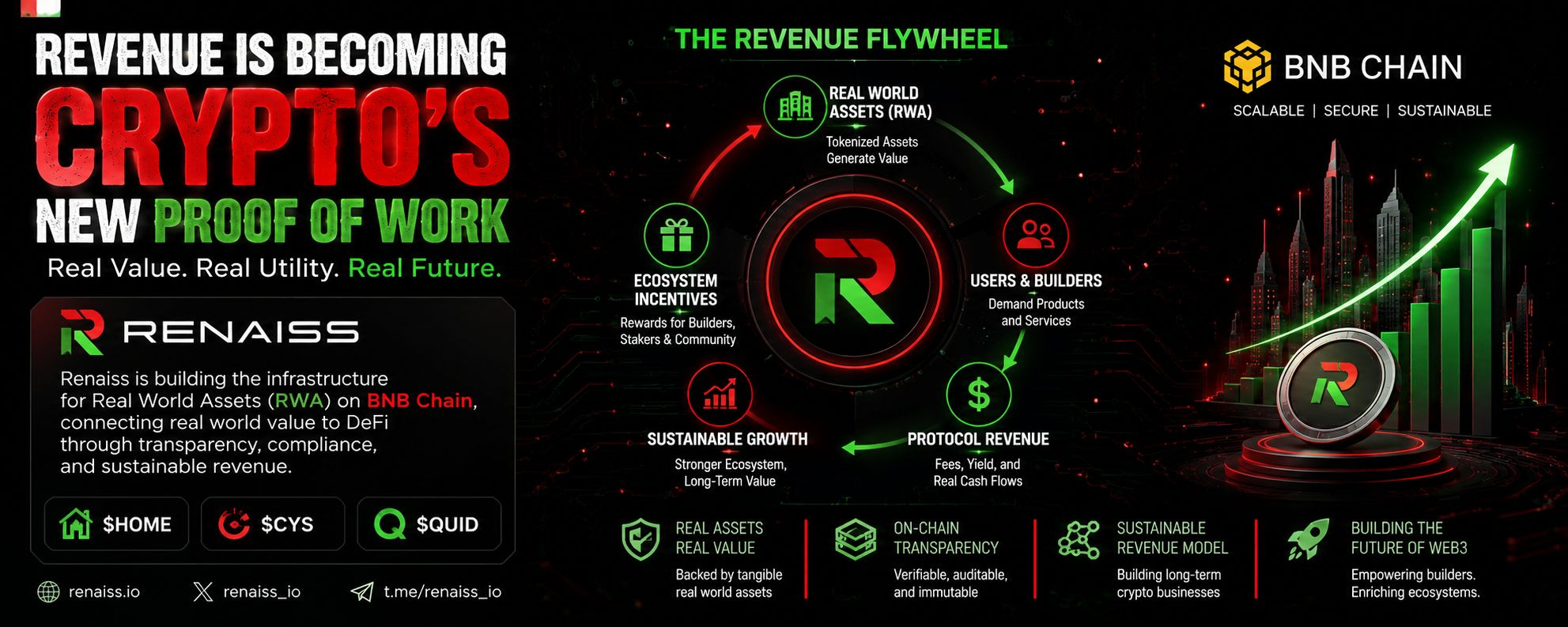

For years, crypto projects competed on narratives. Every cycle introduced a new buzzword—DeFi, NFTs, GameFi, AI, memecoins, and Real World Assets (RWAs). Capital often flowed toward the loudest story rather than the strongest business. That trend is beginning to change.
Today, revenue is emerging as one of the clearest signals of long-term sustainability.
A blockchain can process millions of transactions, attract thousands of wallets, and dominate social media discussions. Yet if it cannot generate consistent economic activity, its growth remains dependent on speculation. Markets eventually recognize that difference.
Revenue matters because it reflects demand that people are willing to pay for. Whether those payments come from trading fees, infrastructure services, tokenized assets, staking products, or enterprise applications, they represent real usage instead of temporary excitement.
This shift is especially visible across the Real World Asset (RWA) sector. Projects are moving beyond token creation and focusing on building financial products that generate recurring cash flows. Instead of asking, "How many users signed up?" investors are increasingly asking, "How much value does the protocol actually earn?"
BNB Chain has also benefited from this transition. As builders develop applications with sustainable business models, network activity becomes more resilient. Healthy ecosystems are not defined only by high transaction counts but by businesses that continue generating value through different market cycles.
Revenue alone does not guarantee success. Tokenomics, governance, security, decentralization, and developer activity still matter. However, revenue provides something many crypto metrics cannot: measurable evidence that a product solves a problem people consider worth paying for.
The next phase of Web3 may belong less to projects with the loudest marketing campaigns and more to those with the strongest economic foundations. Sustainable income creates incentives for builders, supports ecosystem growth, and reduces dependence on constant token inflation or speculative demand.
In the end, crypto is slowly adopting a principle that every successful industry eventually learns: attention is temporary, but revenue is repeatable. Projects that consistently create value for users are far more likely to survive than those relying solely on market hype.
As the industry matures, revenue is becoming crypto's new proof of work—not because it replaces innovation, but because it proves that innovation has found a market.
#Renaiss #RWA板块涨势强劲 #BNBCHAİN #Web3 #cryptofirst21 $HOME E $CYS $QUID