Most traders have a mental hierarchy for assets, and at the very top is Bitcoin held in self-custody. Everything else is usually treated as a trade-off: you either sacrifice that security for DeFi yields, or you sit on spot holdings and ignore the potential for capital efficiency.
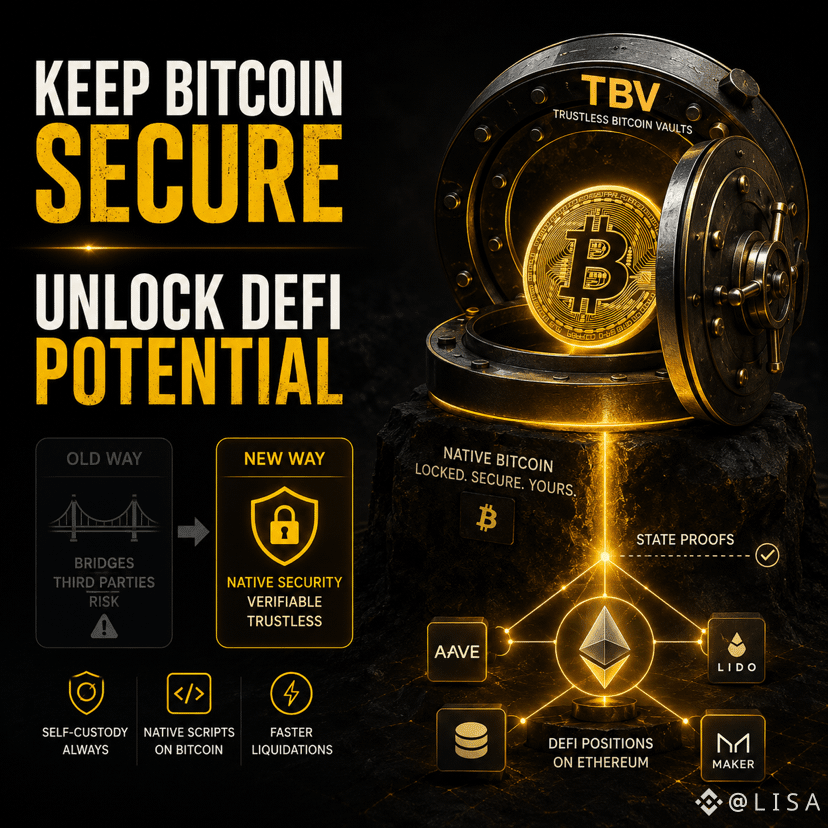
Trustless Bitcoin Vaults (TBV) are finally forcing that binary model to evolve. Instead of choosing between holding assets and putting them to work, TBV architecture allows you to maintain base layer custody while simultaneously backing DeFi positions on Ethereum.
When I look at the execution flow of borrowing against native Bitcoin, the difference in risk profile is night and day compared to wrapped token variants. Because the actual collateral stays locked in Bitcoin Taproot scripts and only emits state proofs, the entire reliance on third party bridge operators effectively evaporates.
It turns borrowing from a question of trust into a question of verifying the script execution onchain. I have been spending time looking at how these vaults handle liquidation triggers during testnet simulations, and the speed of cryptographic enforcement is a massive improvement over traditional oracle-based bridge updates.
For anyone who has stayed away from lending protocols due to bridge-related anxiety, this is the first real shift in the market. Does the transition to native cryptographic enforcement change your long term outlook on lending?
@BabylonLabs_io $BABY #baby
Trustless Bitcoin Vaults (TBV) are finally forcing that binary model to evolve. Instead of choosing between holding assets and putting them to work, TBV architecture allows you to maintain base layer custody while simultaneously backing DeFi positions on Ethereum.
When I look at the execution flow of borrowing against native Bitcoin, the difference in risk profile is night and day compared to wrapped token variants. Because the actual collateral stays locked in Bitcoin Taproot scripts and only emits state proofs, the entire reliance on third party bridge operators effectively evaporates.
It turns borrowing from a question of trust into a question of verifying the script execution onchain. I have been spending time looking at how these vaults handle liquidation triggers during testnet simulations, and the speed of cryptographic enforcement is a massive improvement over traditional oracle-based bridge updates.
For anyone who has stayed away from lending protocols due to bridge-related anxiety, this is the first real shift in the market. Does the transition to native cryptographic enforcement change your long term outlook on lending?
@BabylonLabs_io $BABY #baby