“Users directly control redemption” sounds reassuring — until the other side simply refuses to play along.
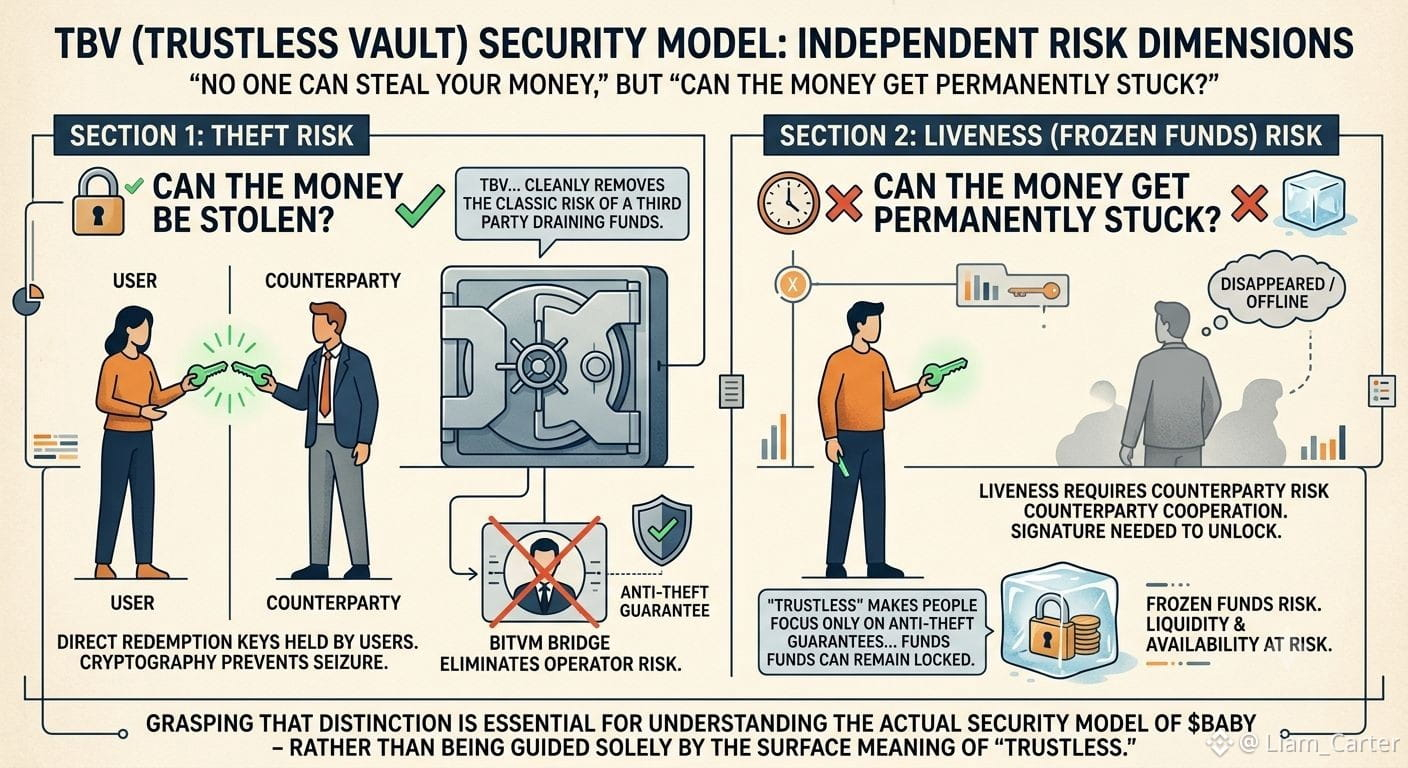
I got stuck on a section in the TBV whitepaper from @BabylonLabs_io that claims “trustless vaults eliminate operators entirely.” The design gives two predefined parties direct authority over redemption. No middleman operator is required. That cleanly removes the classic risk of a third party draining funds.
It solves the theft problem. But what about liveness?
The whitepaper contrasts trustless vaults with the BitVM bridge. In the BitVM model an operator must relay the redemption transaction; if that operator turns malicious, funds can be at risk. TBV instead lets the two counterparties hold the redemption keys themselves. Cryptography ensures that, as long as the scripts are correctly written, neither side can seize BTC that isn’t theirs. Safety is solid: no one can forcibly take what belongs to someone else.
Safety, however, is not the same as liveness. If unlocking the funds requires the counterparty to sign or complete a step, and that party goes offline, disappears, or simply refuses to cooperate, the coins can remain locked. The whitepaper stresses that “no one can steal your money,” yet it does not clearly spell out what happens when the other side fails to act. Protection against theft does not automatically protect against funds becoming frozen.
The word “trustless” often makes people focus only on anti-theft guarantees while overlooking liquidity and availability risks — both of which are part of real asset security.
My takeaway: TBV does an excellent job of preventing outright theft. But when assessing any two-party counterparty design in DeFi, two separate questions must be asked:
Can the money be stolen?
Can the money get permanently stuck?
These are independent risk dimensions. Grasping that distinction is essential for understanding the actual security model of $BABY — rather than being guided solely by the surface meaning of “trustless.”
#baby $BABY @BabylonLabs_io
I got stuck on a section in the TBV whitepaper from @BabylonLabs_io that claims “trustless vaults eliminate operators entirely.” The design gives two predefined parties direct authority over redemption. No middleman operator is required. That cleanly removes the classic risk of a third party draining funds.
It solves the theft problem. But what about liveness?
The whitepaper contrasts trustless vaults with the BitVM bridge. In the BitVM model an operator must relay the redemption transaction; if that operator turns malicious, funds can be at risk. TBV instead lets the two counterparties hold the redemption keys themselves. Cryptography ensures that, as long as the scripts are correctly written, neither side can seize BTC that isn’t theirs. Safety is solid: no one can forcibly take what belongs to someone else.
Safety, however, is not the same as liveness. If unlocking the funds requires the counterparty to sign or complete a step, and that party goes offline, disappears, or simply refuses to cooperate, the coins can remain locked. The whitepaper stresses that “no one can steal your money,” yet it does not clearly spell out what happens when the other side fails to act. Protection against theft does not automatically protect against funds becoming frozen.
The word “trustless” often makes people focus only on anti-theft guarantees while overlooking liquidity and availability risks — both of which are part of real asset security.
My takeaway: TBV does an excellent job of preventing outright theft. But when assessing any two-party counterparty design in DeFi, two separate questions must be asked:
Can the money be stolen?
Can the money get permanently stuck?
These are independent risk dimensions. Grasping that distinction is essential for understanding the actual security model of $BABY — rather than being guided solely by the surface meaning of “trustless.”
#baby $BABY @BabylonLabs_io