Babylon needed a growing list of institutional middlemen to sell a message about removing middlemen
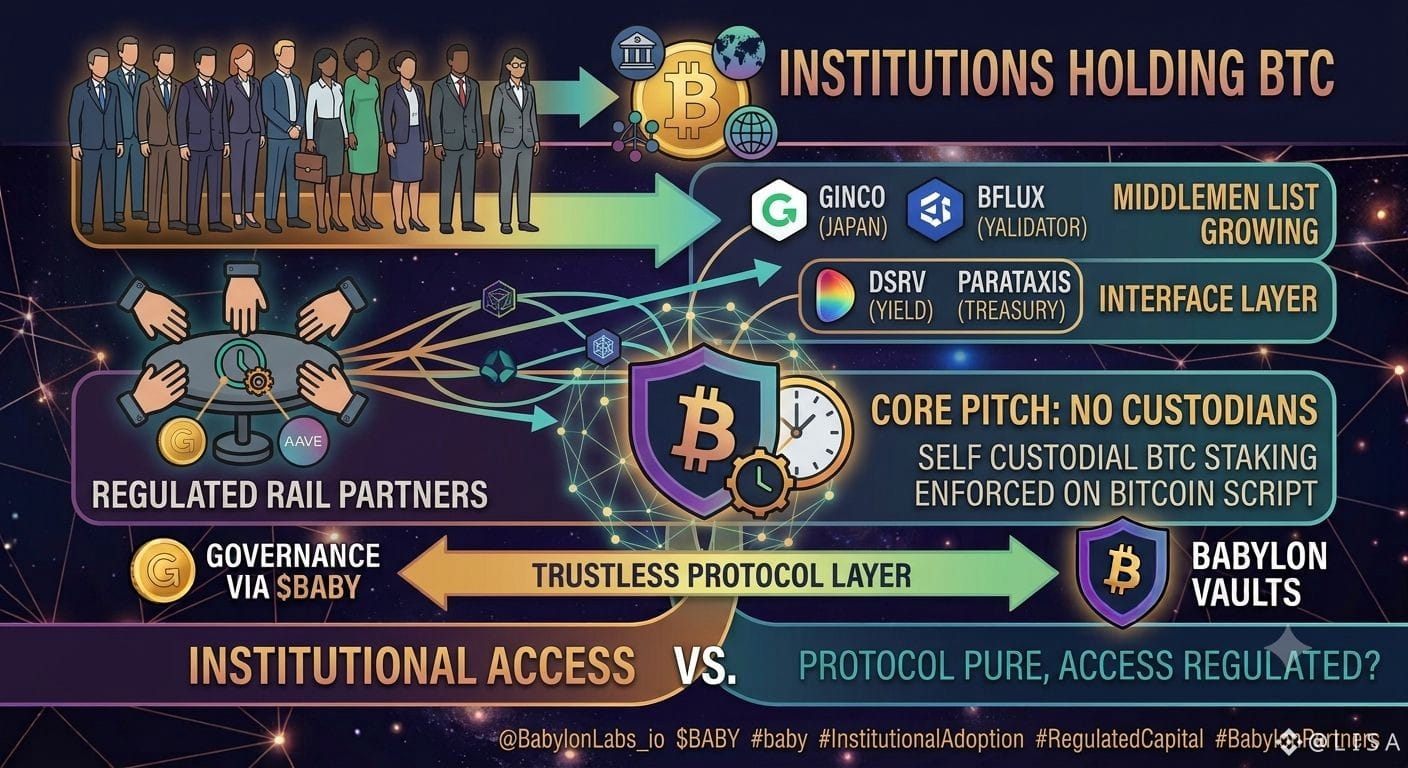
I went through the recent partnership list and it kept growing. Ginco in Japan, Bflux for institutional yield, DSRV as validator infrastructure, Parataxis for treasury strategy. All of them sit between Babylon's protocol and the institutions actually holding the Bitcoin.
That struck me as worth sitting with. The core pitch is no custodians, no intermediaries, pure self custodial staking enforced on Bitcoin itself. Yet reaching institutions apparently requires enterprise wallet providers, custody specialists, and regional partners acting as the interface layer between cold $BTC reserves and the protocol underneath.
I do not think that contradicts the trustless design. The BTC itself stays locked under Bitcoin script conditions regardless of which enterprise wallet initiates the transaction. But it does mean the actual experience of trustless staking, for a bank or a corporate treasury anyway, still runs through a chain of vetted partners handling compliance, custody interfaces, and onboarding. Protocol level trustlessness and institutional access are turning out to be two very different layers of the same system.
Maybe that is just what adoption looks like. Regulated capital does not move without regulated rails, no matter how clean the underlying cryptography is.
Does institutional Bitcoin ever actually touch a truly trustless protocol directly, or does it always pass through a layer of trusted partners first regardless of what the base layer promises
@BabylonLabs_io $BABY #baby
I went through the recent partnership list and it kept growing. Ginco in Japan, Bflux for institutional yield, DSRV as validator infrastructure, Parataxis for treasury strategy. All of them sit between Babylon's protocol and the institutions actually holding the Bitcoin.
That struck me as worth sitting with. The core pitch is no custodians, no intermediaries, pure self custodial staking enforced on Bitcoin itself. Yet reaching institutions apparently requires enterprise wallet providers, custody specialists, and regional partners acting as the interface layer between cold $BTC reserves and the protocol underneath.
I do not think that contradicts the trustless design. The BTC itself stays locked under Bitcoin script conditions regardless of which enterprise wallet initiates the transaction. But it does mean the actual experience of trustless staking, for a bank or a corporate treasury anyway, still runs through a chain of vetted partners handling compliance, custody interfaces, and onboarding. Protocol level trustlessness and institutional access are turning out to be two very different layers of the same system.
Maybe that is just what adoption looks like. Regulated capital does not move without regulated rails, no matter how clean the underlying cryptography is.
Does institutional Bitcoin ever actually touch a truly trustless protocol directly, or does it always pass through a layer of trusted partners first regardless of what the base layer promises
@BabylonLabs_io $BABY #baby