#baby $BABY While going through Babylon’s docs last night, I paused at the safety assumptions page. Everyone’s shouting “Make Bitcoin-native go into DeFi,” but a more practical question hit me: once your BTC is locked in a Taproot script, what do you actually have to do to get it back?
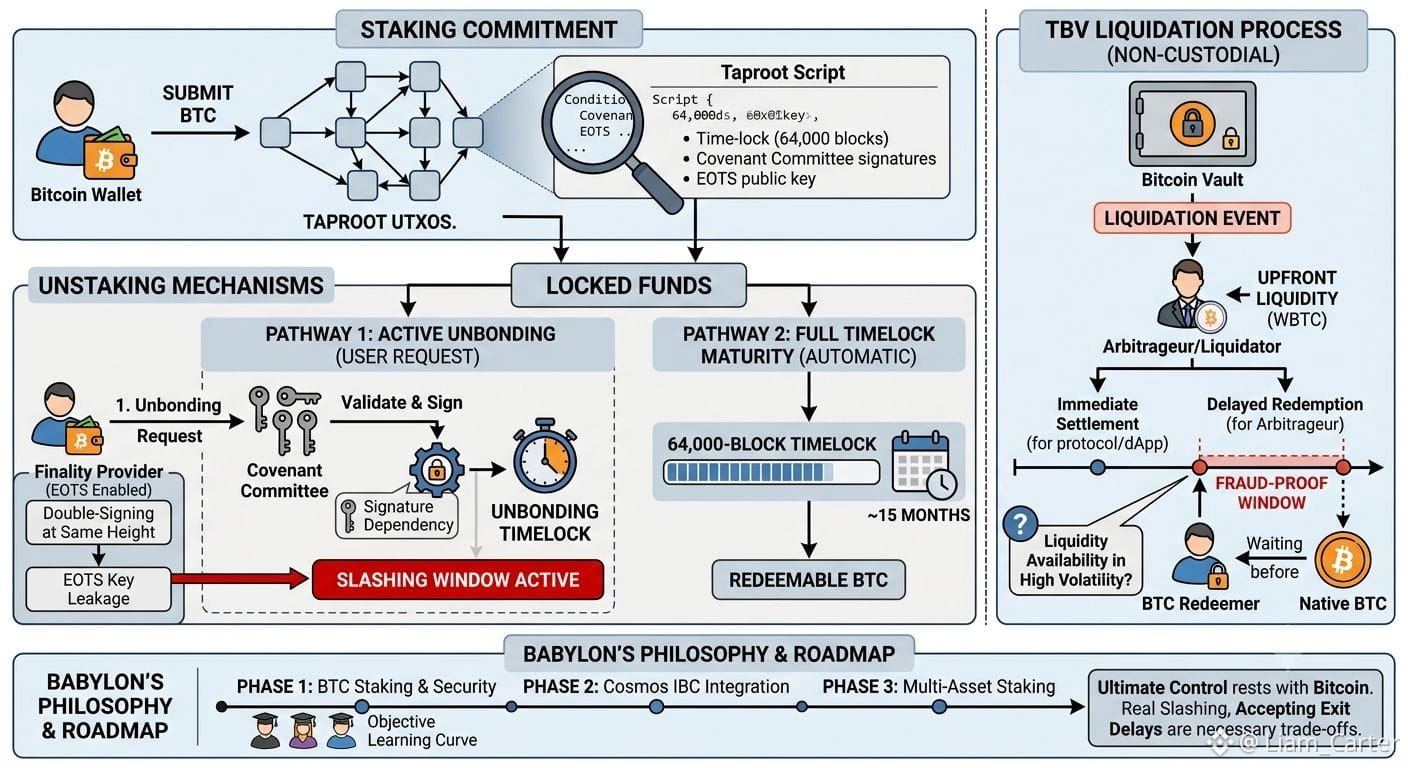
Unbonding isn't straightforward. You can wait out the full ~64,000-block timelock (about 15 months), or actively unbond—requiring the Covenant Committee to sign off and then serving a second lock-up period. EOTS makes it clear: if a Finality Provider double-signs at the same height, the key is leaked and your stake can still be slashed during that unbonding window. So exiting is a time-bound window under protocol rules, not a simple unstake anytime.
TBV liquidation is interesting too. You borrow against BTC without surrendering custody; each Vault maps to its own independent UTXO. In a liquidation event, the liquidator settles instantly using WBTC, but the native BTC only becomes redeemable after the fraud-proof window passes. This splits the timeline: the arbitrageur must front WBTC first, absorbing price swings and funding costs. I couldn’t find a clear answer on whether the willingness to supply that upfront liquidity craters when volatility spikes.
Babylon's philosophy keeps ultimate control with Bitcoin itself. The roadmap is clear: Phase 1 focuses on Bitcoin-centric development, Phase 2 moves onto Cosmos, Phase 3 brings multi-asset staking. But users must internalize that slashing is real, and accepting exit delays is part of the trade-off; there's an objective learning curve.
When you evaluate projects, do you dig this deeply into exit and liquidation mechanics? Would love to hear if you go this deep too—drop a comment.@BabylonLabs_io
$LAB
Unbonding isn't straightforward. You can wait out the full ~64,000-block timelock (about 15 months), or actively unbond—requiring the Covenant Committee to sign off and then serving a second lock-up period. EOTS makes it clear: if a Finality Provider double-signs at the same height, the key is leaked and your stake can still be slashed during that unbonding window. So exiting is a time-bound window under protocol rules, not a simple unstake anytime.
TBV liquidation is interesting too. You borrow against BTC without surrendering custody; each Vault maps to its own independent UTXO. In a liquidation event, the liquidator settles instantly using WBTC, but the native BTC only becomes redeemable after the fraud-proof window passes. This splits the timeline: the arbitrageur must front WBTC first, absorbing price swings and funding costs. I couldn’t find a clear answer on whether the willingness to supply that upfront liquidity craters when volatility spikes.
Babylon's philosophy keeps ultimate control with Bitcoin itself. The roadmap is clear: Phase 1 focuses on Bitcoin-centric development, Phase 2 moves onto Cosmos, Phase 3 brings multi-asset staking. But users must internalize that slashing is real, and accepting exit delays is part of the trade-off; there's an objective learning curve.
When you evaluate projects, do you dig this deeply into exit and liquidation mechanics? Would love to hear if you go this deep too—drop a comment.@BabylonLabs_io
$LAB