
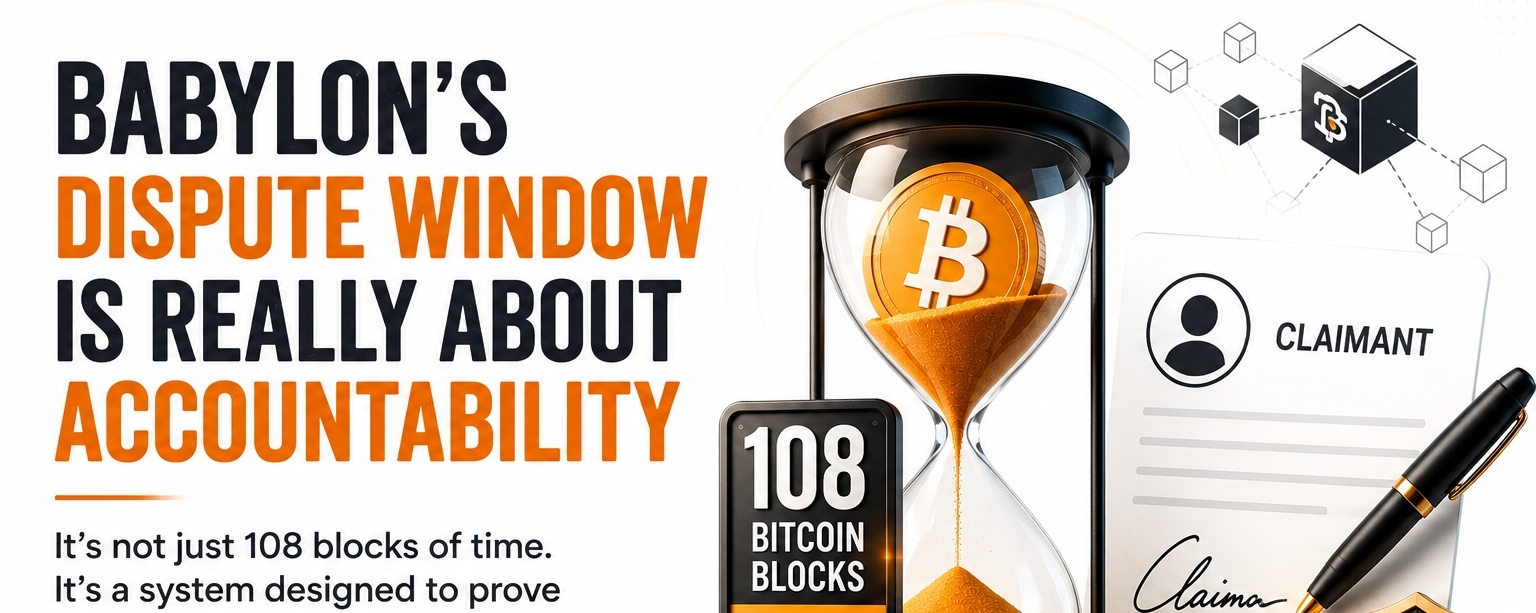
When I first read about Babylon's dispute window, I assumed the countdown was there simply to give claimants enough time to react.
After looking deeper, I realized the timer is only one part of the story.
The detail that caught my attention is that a claimant doesn't just submit a proof. They cryptographically sign it before anyone else broadcasts it. That signature creates a clear record of who actually stands behind the claim.
To me, that's a subtle but important design choice.
A relayer can carry the proof across the network, but the relayer isn't the one accepting responsibility for its accuracy. If the claim is later proven false, accountability points back to the signer instead of every participant who helped propagate the message.
That distinction feels easy to overlook, yet it strengthens the protocol in a practical way. Trust isn't built by assuming everyone behaves honestly. It's built by making dishonest behavior traceable to a specific actor.
The 108-block dispute window also changes how I think about security. It's not only a period for submitting a response. It's a race against Bitcoin's block production, where a valid defense has to reach the chain before the deadline expires.
And that's where an interesting question comes to mind.
Imagine the claimant has legitimate evidence, but network congestion, high fees, or unexpected delays prevent that defense from being confirmed in time. The protocol still follows its rules, but the final outcome may depend as much on timing as on the quality of the evidence itself.
For me, that's what makes Babylon's design worth studying. The dispute window isn't just about catching invalid claims. It's about balancing cryptographic accountability with the practical realities of getting information onto Bitcoin before the clock runs out.
Sometimes the strongest security mechanisms aren't the loudest features. They're the small design decisions that quietly determine who is responsible when things go wrong.
