

What Is an Order Book? How Are Crypto Prices Actually Determined?
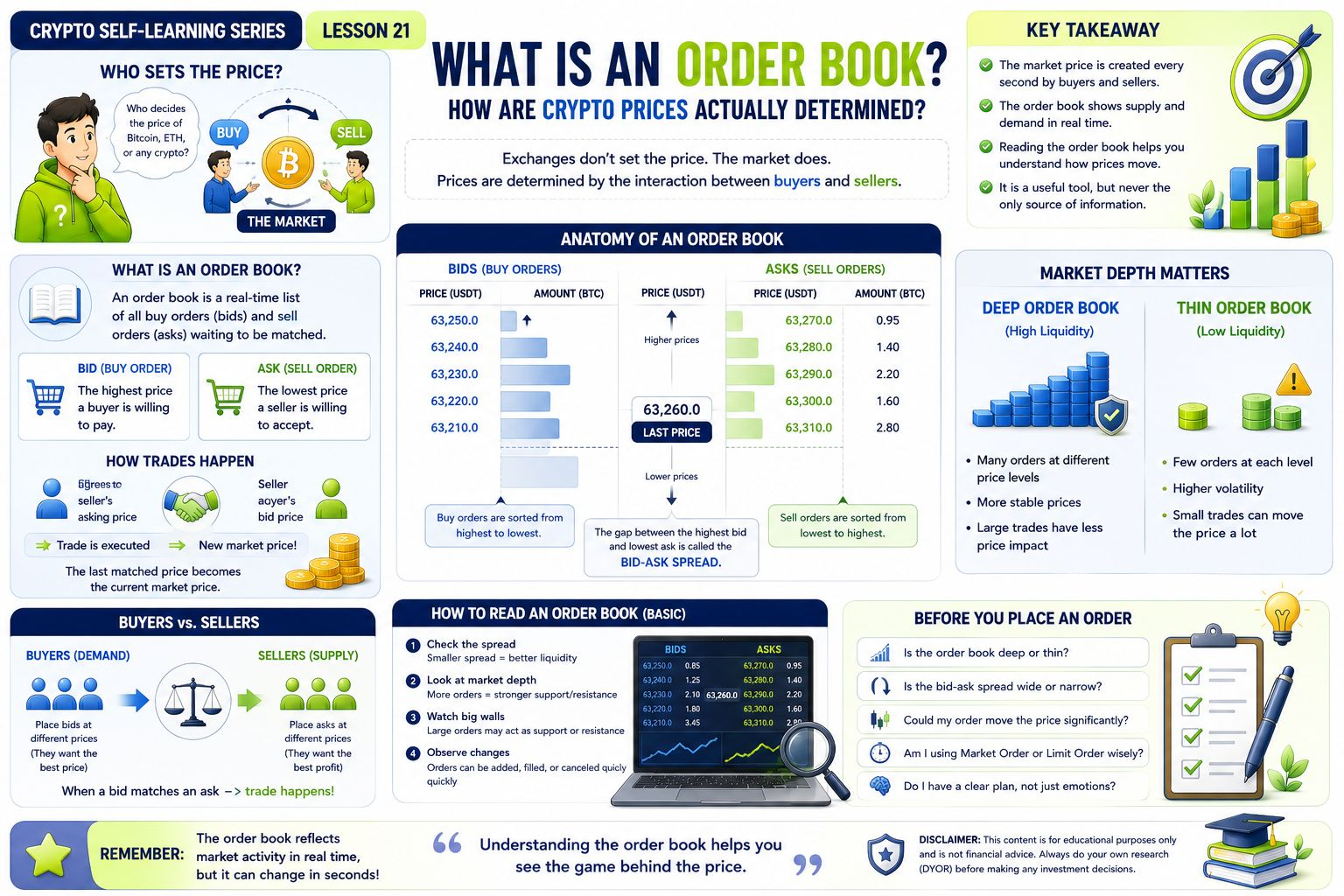
When you open a crypto exchange, you see a number on the screen, the current price.
But have you ever wondered who decides that price?
Contrary to what many beginners think, exchanges don't set the price of #Bitcoin , Ethereum, or any other cryptocurrency.
The market does.
Every second, thousands of buyers and sellers submit orders. These orders are organized into a system called the Order Book.
An order book is a real-time list of all buy orders (bids) and sell orders (asks) waiting to be matched.
Bid: The highest price a buyer is willing to pay.
Ask: The lowest price a seller is willing to accept.
When a buyer agrees to pay the seller's asking price, or a seller accepts the buyer's bid, a trade is executed.
That transaction becomes the latest market price.
The order book also reveals market depth.
A deep order book contains many buy and sell orders across different price levels, making prices more stable.
A thin order book has fewer orders, so even a relatively small trade can move the market significantly.
Professional traders often analyze the order book to identify areas of strong buying or selling interest. However, it's important to remember that visible orders can change quickly, and some may be canceled before execution.
The order book is a helpful tool, but it should never be your only source of information.
Key Takeaway
The market price isn't decided by an exchange.
It is created every second through the interaction between buyers and sellers.
Learning how to read an order book helps you understand how prices move, rather than simply reacting to them.
🧠 Think Like an Investor
Before placing an order, consider:
Is the order book deep or thin?
Is there a large gap between bids and asks?
Could my order significantly affect the market price?
Am I buying because of market emotion, or because I have a plan?
Should I use a Market Order or a Limit Order?
Remember:
The order book reflects market activity in real time—but successful investing requires both observation and patience.
Discussion
Have you ever looked at an order book before making a trade?
Or do you usually focus only on the price chart?
Which do you think provides more useful information for beginners?
I'd love to hear your thoughts!
Disclaimer: This content is for self-educational purposes only and should not be considered financial, legal, or investment advice. Always do your own research (#dyor ) before making any investment decisions.
Community Note: This series reflects my self-learning journey. If you notice anything inaccurate or have additional insights, please share them in the comments. Constructive discussions help us all improve together.
Content Principle: This series focuses exclusively on blockchain technology, crypto education, and responsible investing. It intentionally avoids political, religious, or other sensitive topics and aims to respect the community guidelines of Binance Square and applicable laws and regulations.
📚 Series Progress
✅ Lesson 1 — What Is Money? Why Was Bitcoin Created?
✅ Lesson 2 — What Is Cryptocurrency?
✅ Lesson 3 — What Is Blockchain?
✅ Lesson 4 — Why Does Bitcoin Have Value?
✅ Lesson 5 — What Is a Crypto Wallet?
✅ Lesson 6 — What Is a Blockchain Transaction?
✅ Lesson 7 — What Are Gas Fees?
✅ Lesson 8 — Coin vs. Token
✅ Lesson 9 — What Are Smart Contracts?
✅ Lesson 10 — What Is DeFi?
✅ Lesson 11 — What Is Staking?
✅ Lesson 12 — What Are Liquidity Pools?
✅ Lesson 13 — What Is Yield Farming?
✅ Lesson 14 — What Are Stablecoins?
✅ Lesson 15 — Layer 1 vs. Layer 2
✅ Lesson 16 — What Is Tokenomics?
✅ Lesson 17 — What Is Market Capitalization?
✅ Lesson 18 — What Is Fully Diluted Valuation (FDV)?
✅ Lesson 19 — What Are Token Unlocks?
✅ Lesson 21 — What Is an Order Book?
🔜 Next Lesson
Lesson 22 — Market Order vs. Limit Order: Which One Should You Use?
In the next lesson, we'll explore the two most common order types, their advantages and disadvantages, and when each is the better choice. This is one of the most practical skills every crypto investor should master before placing trades.