
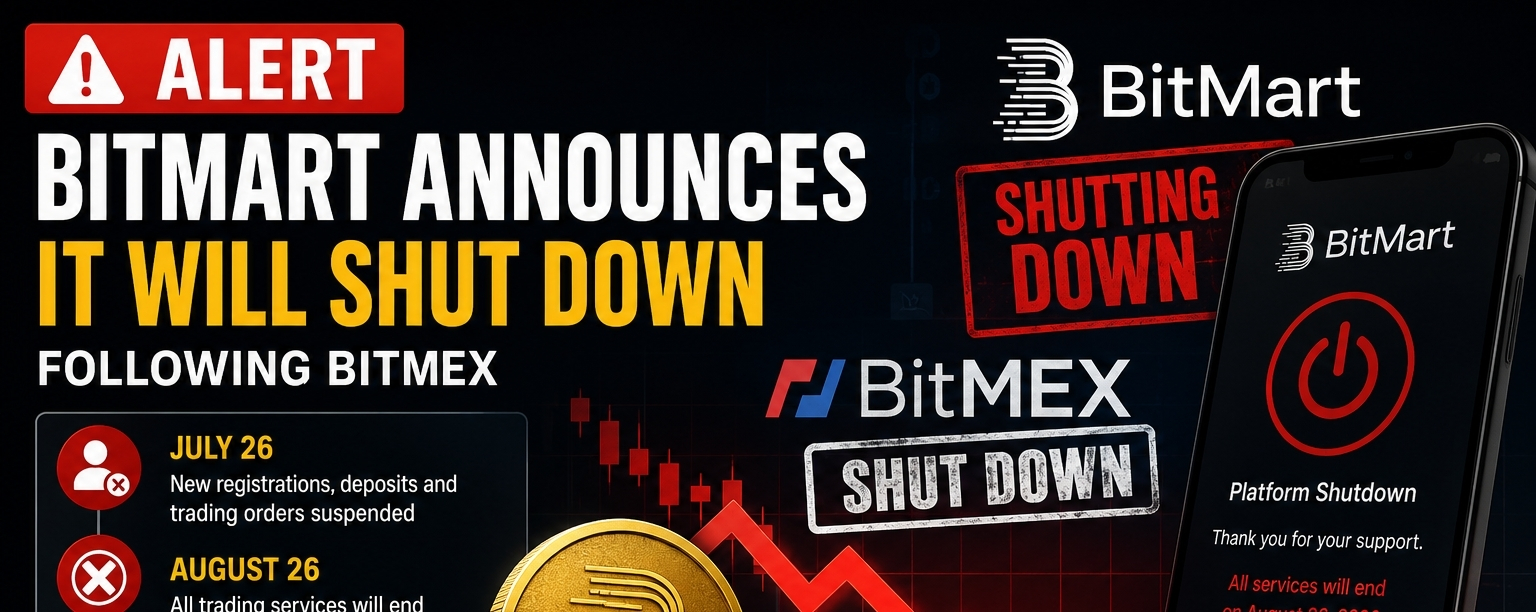

The crypto industry has been hit by another major shock.
Just days after BitMEX announced it would permanently shut down, BitMart has now confirmed that it is also winding down its trading platform. The back-to-back announcements have sparked fresh debate across the crypto community: Is this the beginning of a wider trend, or simply the end of two exchanges that could no longer compete?
What Happened?
BitMart announced an orderly cessation of operations after evaluating its business conditions, the current market environment, and its future strategic direction.
According to the company's timeline:
New user registrations stopped on 26 July.
Cryptocurrency and fiat deposits have been suspended.
Spot trading, futures, copy trading, grid trading and API trading are being phased out.
All trading services are scheduled to end on 26 August 2026.
The platform itself is expected to cease operations by 31 January 2027, although withdrawals will remain available during the wind-down period.
The market reacted immediately.
BitMart's native token, BMX, lost roughly 63% of its value within 24 hours, reflecting investors' concerns over the exchange's future.
Why Is BitMart Closing?
The company did not point to a single cause.
Instead, it cited a combination of operating conditions, market challenges and strategic considerations. While no insolvency has been announced, the decision highlights how difficult it has become for mid-sized exchanges to survive in an increasingly competitive market.
Today's crypto exchange industry is dominated by a handful of global platforms with deep liquidity, strong regulatory positions and massive user bases. Smaller exchanges often struggle to attract enough trading volume to remain profitable.
The BitMEX Connection
The timing makes the news even more significant.
Only days earlier, BitMEX, one of crypto's earliest derivatives exchanges and the creator of the perpetual futures contract, announced it would also shut down following a strategic review of its business. The exchange plans to close in September after asking users to withdraw their assets.
Although the two companies have different histories, both closures point to the same reality:
Being an established exchange is no longer enough.
Competition has become fierce, regulations are tightening, and users increasingly prefer platforms offering better liquidity, security, compliance and product ecosystems.
Should Crypto Investors Be Concerned?
Not necessarily.
These announcements do not automatically signal a collapse of the broader crypto industry.
Instead, they show that crypto is maturing.
Just as traditional businesses close when they cannot compete, crypto companies face the same market forces. Exchanges that fail to innovate, expand or adapt to changing regulations may eventually disappear.
For users, however, the events are a timely reminder of an old crypto principle:
"Not your keys, not your coins."
If you hold long-term investments, relying solely on any centralised exchange carries risk. Self-custody through a secure wallet remains the safest option for assets you don't actively trade.
The Bigger Picture
The closure of BitMart and BitMEX is less about crypto failing and more about the industry evolving.
As institutional adoption grows and regulation becomes clearer, the market is likely to consolidate around exchanges that can offer stronger security, deeper liquidity and global compliance.
✓ Some exchanges will disappear.
✓ Others will become even larger.
That's a normal part of any rapidly growing industry.
Final Thoughts
BitMart's shutdown is a reminder that no crypto exchange is guaranteed to exist forever. Whether you're trading or investing, always have a withdrawal plan, diversify where you keep your assets, and avoid leaving funds on an exchange longer than necessary.
The crypto market isn't dying.
It's becoming more competitive and only the strongest platforms are likely to survive the next phase.
