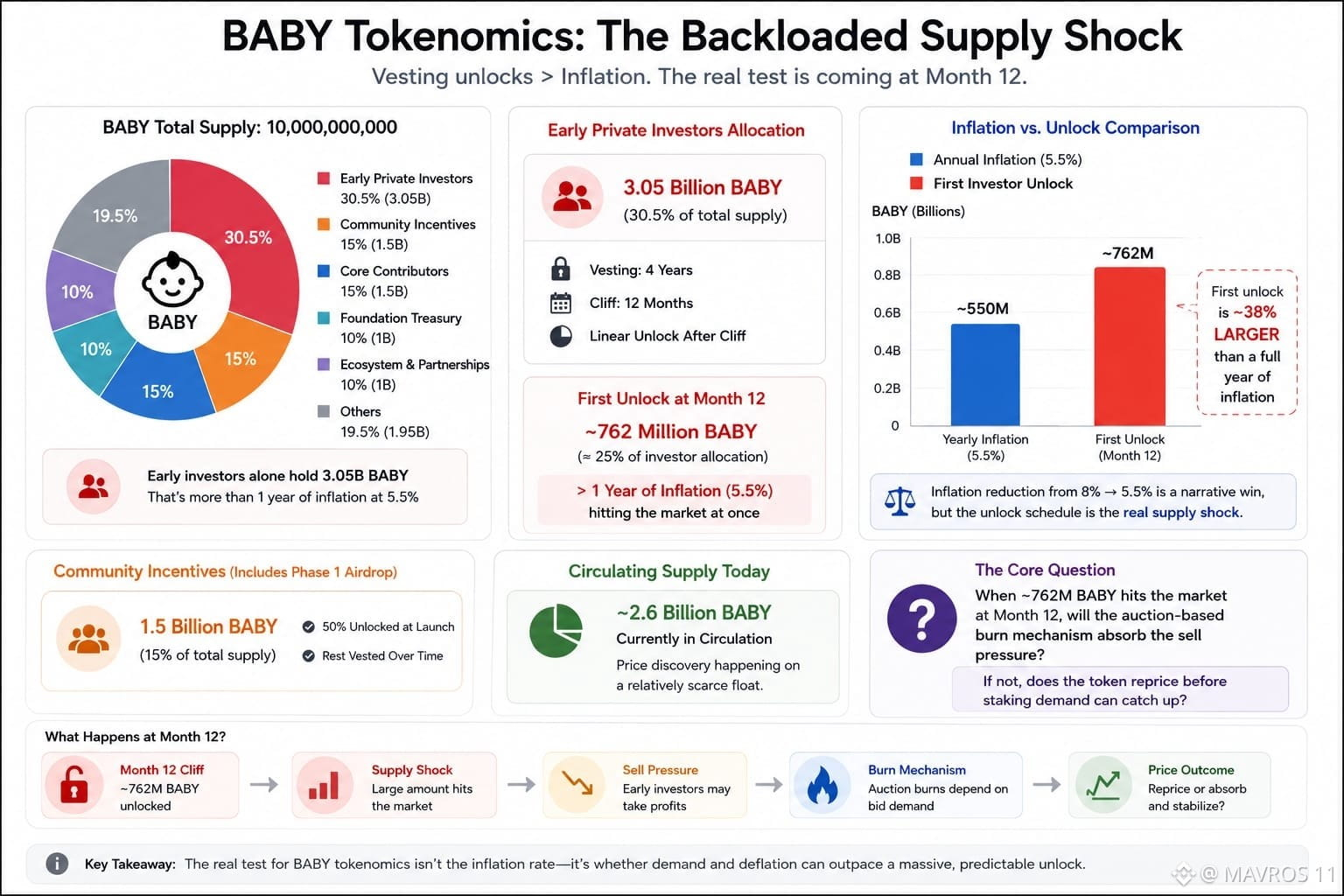
Pulling the $BABY distribution schedule, one number jumps out: 30.5% allocated to early private investors with a 4-year vesting and the first unlock at month 12. At 10 billion total supply, that's ~3.05 billion BABY waiting to enter circulation. By contrast, the community incentives pool—which includes the Phase 1 airdrop—is only 15% (1.5 billion), and half of that was already unlocked at launch.
hmm.. Here's the tension. The protocol just reduced inflation from 8% to 5.5% annually, but that's ~550 million new BABY per year. Meanwhile, the early investor cliff alone dwarfs that inflation figure when it hits. The circulating supply today is roughly 2.6 billion. The first investor unlock could add another ~762 million (assuming 25% of their allocation) in a single event—more than an entire year's worth of inflationary issuance hitting at once.
Price discovery so far has happened on a relatively scarce float. Early stakers and NFT holders received their airdrops, but the real weight of the tokenomics is backloaded. The governance token that secures network decisions has a supply schedule that's heavily tilted toward insiders getting liquidity before the protocol's long-term adoption curve becomes clear.
The inflation reduction is a narrative win, hmm.. but does it actually matter when the vesting schedule creates a much larger and more predictable supply shock? If the first unlock floods the market, does the burn mechanism's auction-based deflation move fast enough to absorb it, or does the token simply reprice before the staking demand catches up?
@BabylonLabs_io #baby $BABY
hmm.. Here's the tension. The protocol just reduced inflation from 8% to 5.5% annually, but that's ~550 million new BABY per year. Meanwhile, the early investor cliff alone dwarfs that inflation figure when it hits. The circulating supply today is roughly 2.6 billion. The first investor unlock could add another ~762 million (assuming 25% of their allocation) in a single event—more than an entire year's worth of inflationary issuance hitting at once.
Price discovery so far has happened on a relatively scarce float. Early stakers and NFT holders received their airdrops, but the real weight of the tokenomics is backloaded. The governance token that secures network decisions has a supply schedule that's heavily tilted toward insiders getting liquidity before the protocol's long-term adoption curve becomes clear.
The inflation reduction is a narrative win, hmm.. but does it actually matter when the vesting schedule creates a much larger and more predictable supply shock? If the first unlock floods the market, does the burn mechanism's auction-based deflation move fast enough to absorb it, or does the token simply reprice before the staking demand catches up?
@BabylonLabs_io #baby $BABY