

The artificial intelligence boom is running into a massive physical barrier. For the last few years, tech companies focused entirely on building smarter models and faster computer chips. Now, they are facing a completely different kind of limit. The power grid cannot keep up with the sheer amount of electricity required to run modern data centers. The latest projections show that the energy crunch is becoming the single biggest bottleneck for the tech industry.
❍ The 194 Gigawatt Power Surge
The scale of upcoming energy consumption is breaking every historical precedent for industrial power demand.
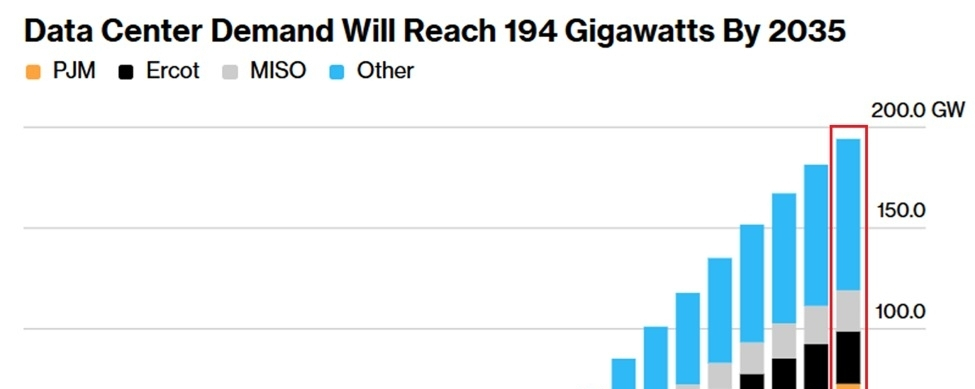
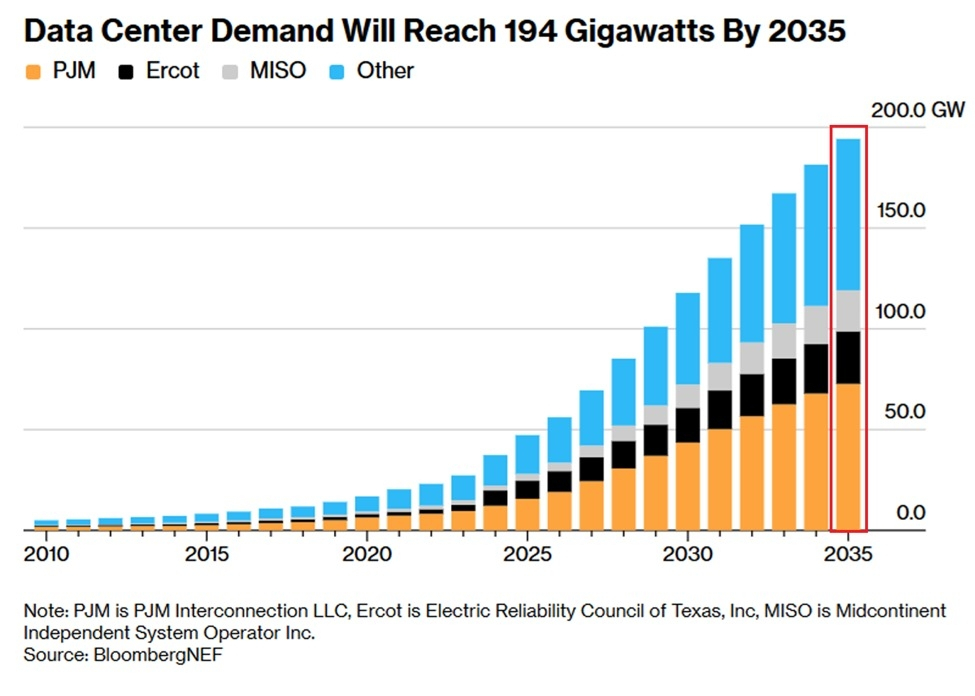
Data center power demand in the United States is projected to surge by 253 percent from 2026 levels. This will push total consumption to a record 194 gigawatts by 2035.
To put that number into perspective, a single gigawatt is roughly equivalent to the entire electrical capacity of a traditional nuclear reactor.
As a result of this rapid growth, data centers are expected to account for roughly 20 percent of total US electricity consumption by 2035, climbing significantly from about 6 percent today.
The growth curve is accelerating fast. Industry estimates show that data centers will consume roughly 12 percent of the country's electricity by 2030 alone.
❍ Bottlenecks in Key Grid Regions
This massive surge in energy demand is not spreading evenly across the country. It is hyper-focused in specific regions with existing infrastructure.
Much of this growth is concentrated in a handful of major grid regions.
The PJM Interconnection grid is taking the heaviest load. This system serves the District of Columbia alongside 13 states, including industrial and tech heavyweights like Virginia, Pennsylvania, and Ohio.
Local utility providers in these specific areas are scrambling to secure long term power purchase agreements because local grids simply lack the excess capacity to handle incoming tech facilities.
Some Random Thoughts 💬
We spent years believing that software and algorithms would scale infinitely without touching the physical world. This data proves that digital innovation requires massive amounts of heavy industry. When data centers demand as much power as dozens of nuclear reactors, the entire energy sector becomes a critical part of the tech trade.
In the crypto and blockchain space, we already understand this dynamic deeply because proof of work mining faced the exact same power constraints years ago. Traditional technology giants are now competing directly with heavy manufacturers and local households for grid access. If energy infrastructure cannot expand at the same speed as artificial intelligence, the entire software boom will hit a hard ceiling. Investors need to watch utility companies and nuclear energy providers just as closely as they watch semiconductor stocks.