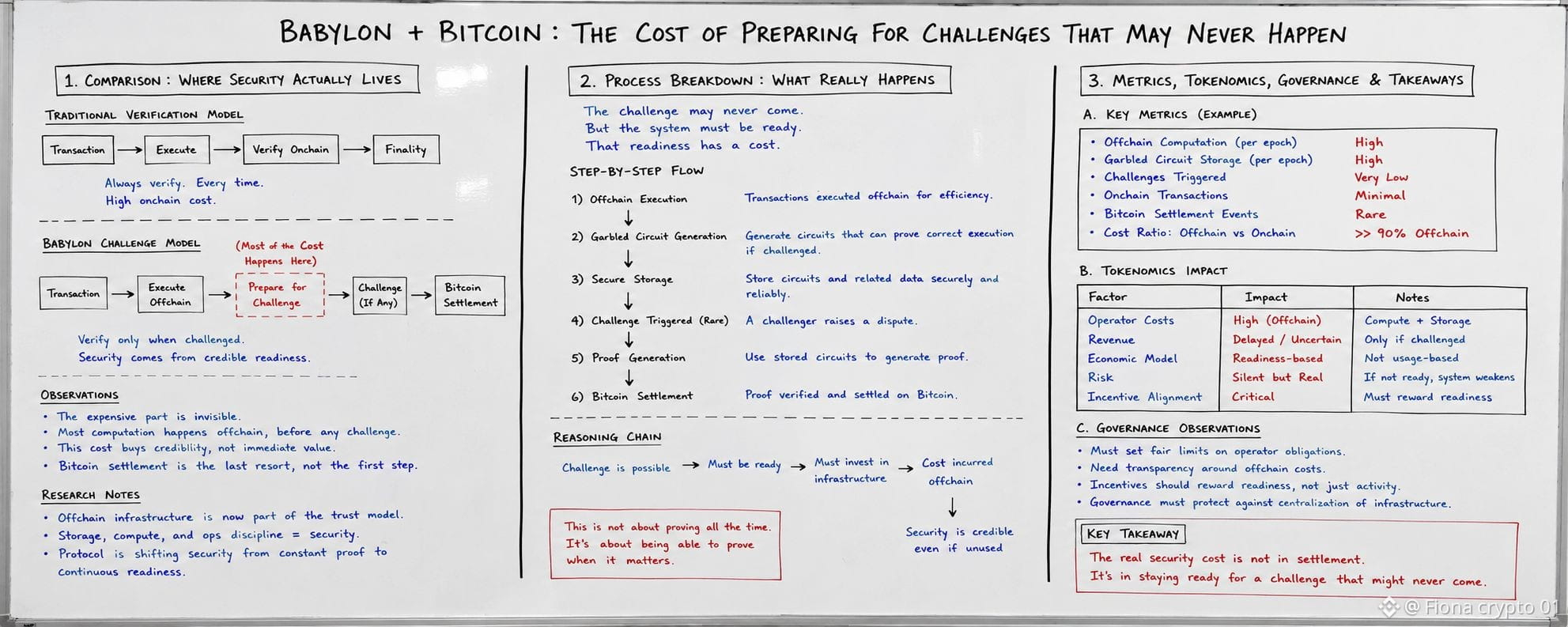
I thought the interesting part would be the challenge protocol. It turned out to be the cost of preparing for challenges that almost never happen.
I kept coming back to the note that the primary off chain cost is generating and storing garbled circuits for possible disputes. At first that sounded like an implementation detail. The longer I sat with it, the more it felt like the protocol is shifting where security actually lives.
Most people look at Bitcoin settlement because that is the visible part. What caught my attention was everything that exists before settlement even becomes necessary. Operators have to spend computation and storage to stay ready for a challenge that may never arrive. Those resources produce no immediate revenue, yet without them the threat of verification becomes less credible.
That changes the economics in a subtle way. The protocol is not asking participants to prove everything all the time. It is asking them to continuously invest in the ability to prove something if questioned. Read alongside Babylon's challenge mechanism and Bitcoin final settlement, the security model starts looking less like constant verification and more like maintaining credible readiness.
It also explains why off chain infrastructure deserves as much attention as onchain activity. Efficient storage, reliable data management, and operational discipline quietly become part of the trust model, even though none of them appear in a block explorer.
After reading through it a few times, I stopped thinking about proof generation as a cryptographic feature. It looked more like the ongoing operational cost of keeping the option to verify alive.
@BabylonLabs_io
#baby $BABY
I kept coming back to the note that the primary off chain cost is generating and storing garbled circuits for possible disputes. At first that sounded like an implementation detail. The longer I sat with it, the more it felt like the protocol is shifting where security actually lives.
Most people look at Bitcoin settlement because that is the visible part. What caught my attention was everything that exists before settlement even becomes necessary. Operators have to spend computation and storage to stay ready for a challenge that may never arrive. Those resources produce no immediate revenue, yet without them the threat of verification becomes less credible.
That changes the economics in a subtle way. The protocol is not asking participants to prove everything all the time. It is asking them to continuously invest in the ability to prove something if questioned. Read alongside Babylon's challenge mechanism and Bitcoin final settlement, the security model starts looking less like constant verification and more like maintaining credible readiness.
It also explains why off chain infrastructure deserves as much attention as onchain activity. Efficient storage, reliable data management, and operational discipline quietly become part of the trust model, even though none of them appear in a block explorer.
After reading through it a few times, I stopped thinking about proof generation as a cryptographic feature. It looked more like the ongoing operational cost of keeping the option to verify alive.
@BabylonLabs_io
#baby $BABY