Policy Rules Blocking Legit Trades Is The Risk Nobody Mentions
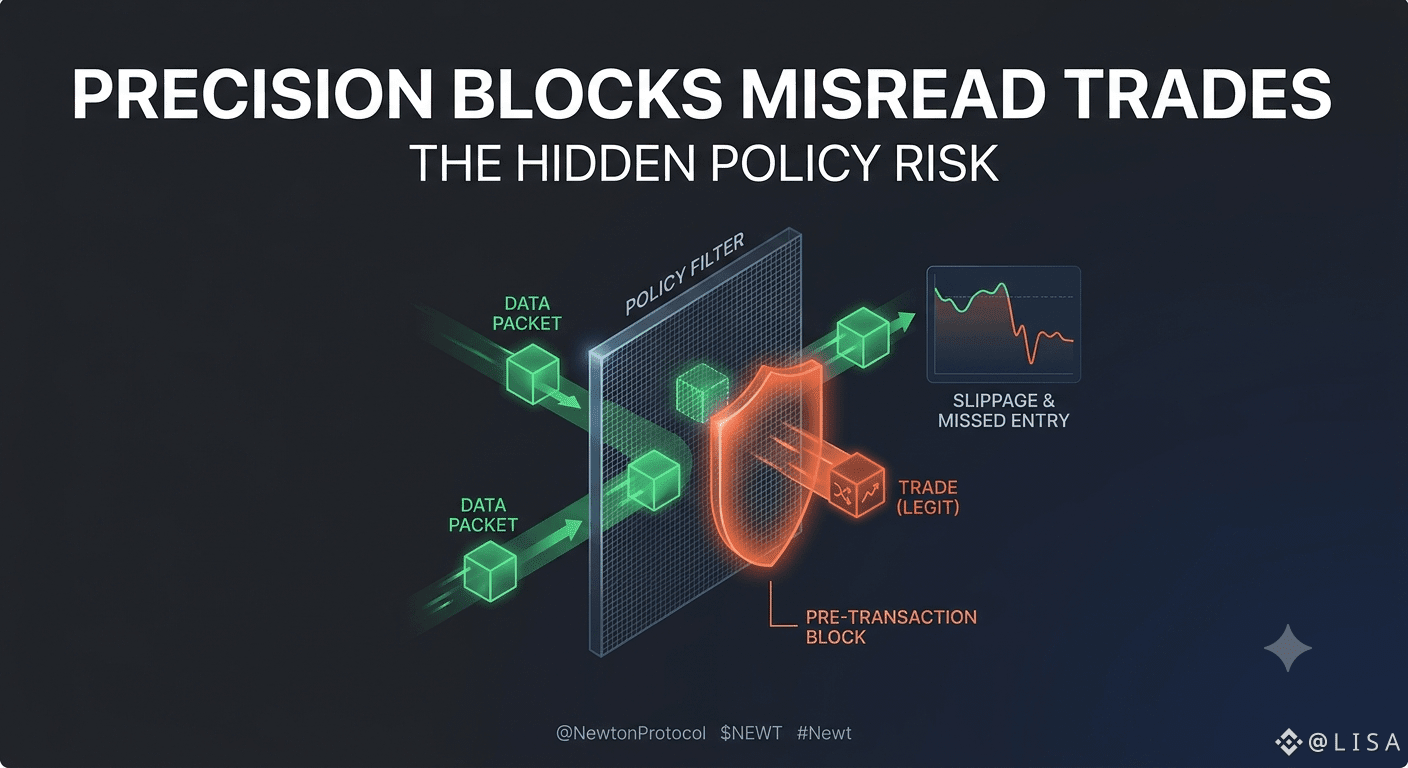
Everyone talks about Newton $NEWT stopping malicious settlement but flip that logic around for a second. A policy engine strict enough to catch bad actors is also strict enough to misfire on legitimate agent strategies that just look unusual on paper. If my automated strategy gets flagged and blocked because it doesn't match some predefined rule set, I'm eating slippage and missed entries while the system protects me from a threat that was never there. False positives in a pre transaction enforcement layer are a real cost, not just a theoretical one. Nobody's published data yet on how often legitimate trades get denied versus actual malicious ones.
I want false positive rates before I trust this with real size. My strategies can't afford getting blocked mid execution over an overly cautious rule set. Precision matters as much as protection here.
@NewtonProtocol
$NEWT
#Newt
Everyone talks about Newton $NEWT stopping malicious settlement but flip that logic around for a second. A policy engine strict enough to catch bad actors is also strict enough to misfire on legitimate agent strategies that just look unusual on paper. If my automated strategy gets flagged and blocked because it doesn't match some predefined rule set, I'm eating slippage and missed entries while the system protects me from a threat that was never there. False positives in a pre transaction enforcement layer are a real cost, not just a theoretical one. Nobody's published data yet on how often legitimate trades get denied versus actual malicious ones.
I want false positive rates before I trust this with real size. My strategies can't afford getting blocked mid execution over an overly cautious rule set. Precision matters as much as protection here.
@NewtonProtocol
$NEWT
#Newt