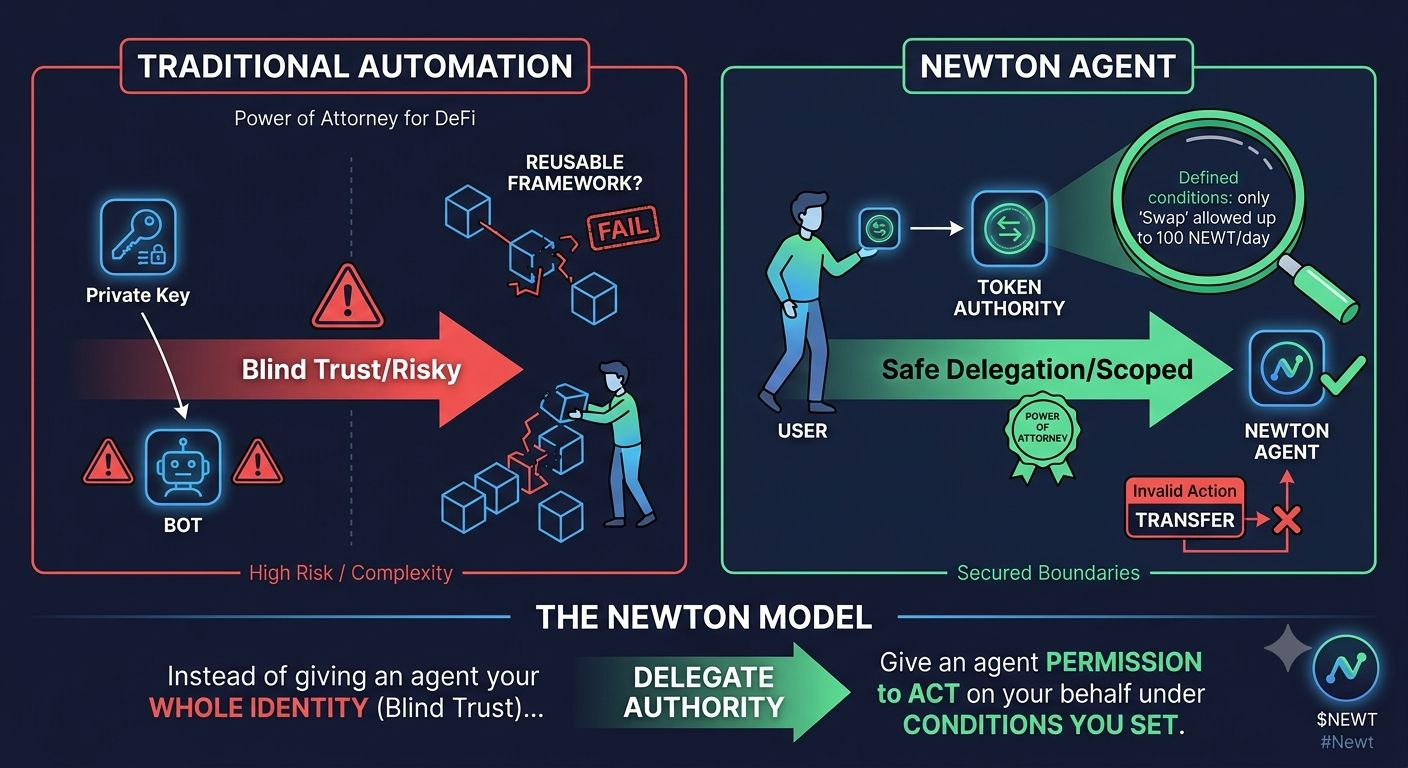
Sean Li describes what Newton lets you do as basically granting power of attorney to an AI agent, and honestly that's the clearest way I've heard this explained.
Think about power of attorney in real life. You don't hand someone your identity, you give them specific permission to act on your behalf under conditions you set, and if they step outside those conditions, it doesn't count. That's exactly the model here. You're not handing an agent your private key or full control over your funds, you're defining what it's allowed to do and Newton enforces those boundaries before anything executes.
That distinction matters more than it sounds. Most automation in crypto today either means trusting a centralized bot completely or writing custom permission logic yourself from scratch. Newton turns that into a standard, reusable framework, scoped authority instead of blind trust or none at all.
It's a simple analogy for a genuinely complicated technical problem, and simple analogies are usually the ones that actually stick.
@NewtonProtocol $NEWT #Newt
Think about power of attorney in real life. You don't hand someone your identity, you give them specific permission to act on your behalf under conditions you set, and if they step outside those conditions, it doesn't count. That's exactly the model here. You're not handing an agent your private key or full control over your funds, you're defining what it's allowed to do and Newton enforces those boundaries before anything executes.
That distinction matters more than it sounds. Most automation in crypto today either means trusting a centralized bot completely or writing custom permission logic yourself from scratch. Newton turns that into a standard, reusable framework, scoped authority instead of blind trust or none at all.
It's a simple analogy for a genuinely complicated technical problem, and simple analogies are usually the ones that actually stick.
@NewtonProtocol $NEWT #Newt