I Stopped Looking at Newton as a Protocol. It Started Making More Sense as a Standard.
I think we've been looking at projects like this through the wrong lens.
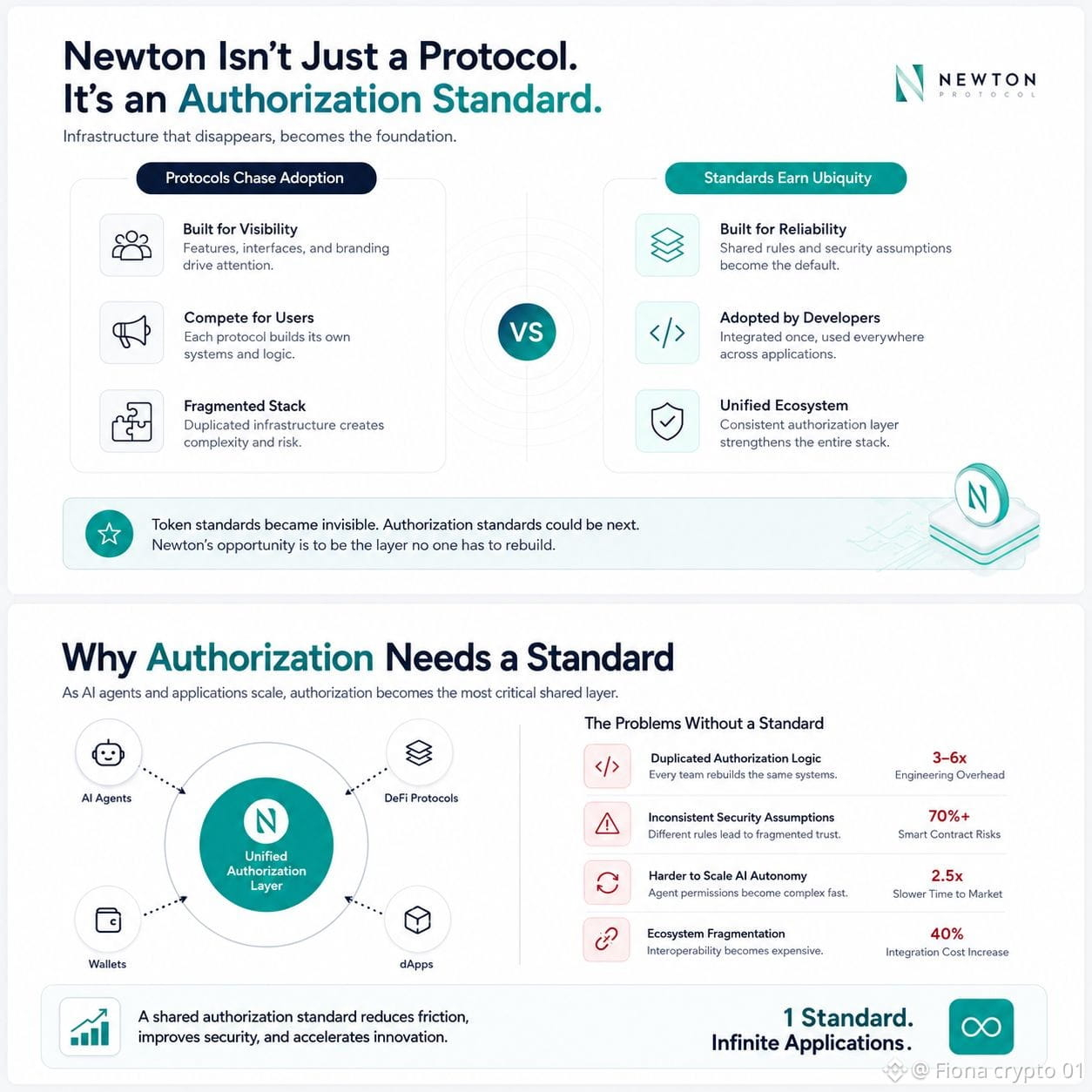
Every new blockchain, wallet, and DeFi app wants adoption.
But standards don't chase adoption.
They quietly spread until everyone builds around them.
That's the distinction I keep coming back to with Newton.
Its long-term value may have very little to do with whether people recognize its name.
The bigger question is whether developers eventually reach a point where building without a shared authorization layer feels outdated.
Think about what happened with token standards.
Nobody asks whether an application "uses" a token standard anymore.
It's simply expected.
The standard became part of the foundation.
I wonder if authorization is heading in the same direction.
As AI agents become more common, every protocol will face the same challenge.
How do you define what an autonomous system is allowed to do?
How do you update those rules without rebuilding everything?
How do different applications rely on the same security assumptions?
If every team solves those questions independently, the ecosystem becomes fragmented.
If they share the same authorization framework, the entire stack becomes more consistent.
That's why I don't see Newton's opportunity as creating another feature.
I see it as reducing the amount of infrastructure every future application has to invent for itself.
The interesting part is that success would make Newton less visible, not more.
Developers would stop talking about the authorization layer because it would simply be there.
History shows that the strongest infrastructure rarely becomes famous.
It becomes expected.
If Newton reaches that point, its biggest achievement won't be attracting attention.
It will be making authorization feel so ordinary that nobody thinks about building it from scratch anymore.
@NewtonProtocol
#newt $NEWT
I think we've been looking at projects like this through the wrong lens.
Every new blockchain, wallet, and DeFi app wants adoption.
But standards don't chase adoption.
They quietly spread until everyone builds around them.
That's the distinction I keep coming back to with Newton.
Its long-term value may have very little to do with whether people recognize its name.
The bigger question is whether developers eventually reach a point where building without a shared authorization layer feels outdated.
Think about what happened with token standards.
Nobody asks whether an application "uses" a token standard anymore.
It's simply expected.
The standard became part of the foundation.
I wonder if authorization is heading in the same direction.
As AI agents become more common, every protocol will face the same challenge.
How do you define what an autonomous system is allowed to do?
How do you update those rules without rebuilding everything?
How do different applications rely on the same security assumptions?
If every team solves those questions independently, the ecosystem becomes fragmented.
If they share the same authorization framework, the entire stack becomes more consistent.
That's why I don't see Newton's opportunity as creating another feature.
I see it as reducing the amount of infrastructure every future application has to invent for itself.
The interesting part is that success would make Newton less visible, not more.
Developers would stop talking about the authorization layer because it would simply be there.
History shows that the strongest infrastructure rarely becomes famous.
It becomes expected.
If Newton reaches that point, its biggest achievement won't be attracting attention.
It will be making authorization feel so ordinary that nobody thinks about building it from scratch anymore.
@NewtonProtocol
#newt $NEWT