I went into Newton Protocol expecting another conversation about faster AI automation. I came out thinking about something completely different.
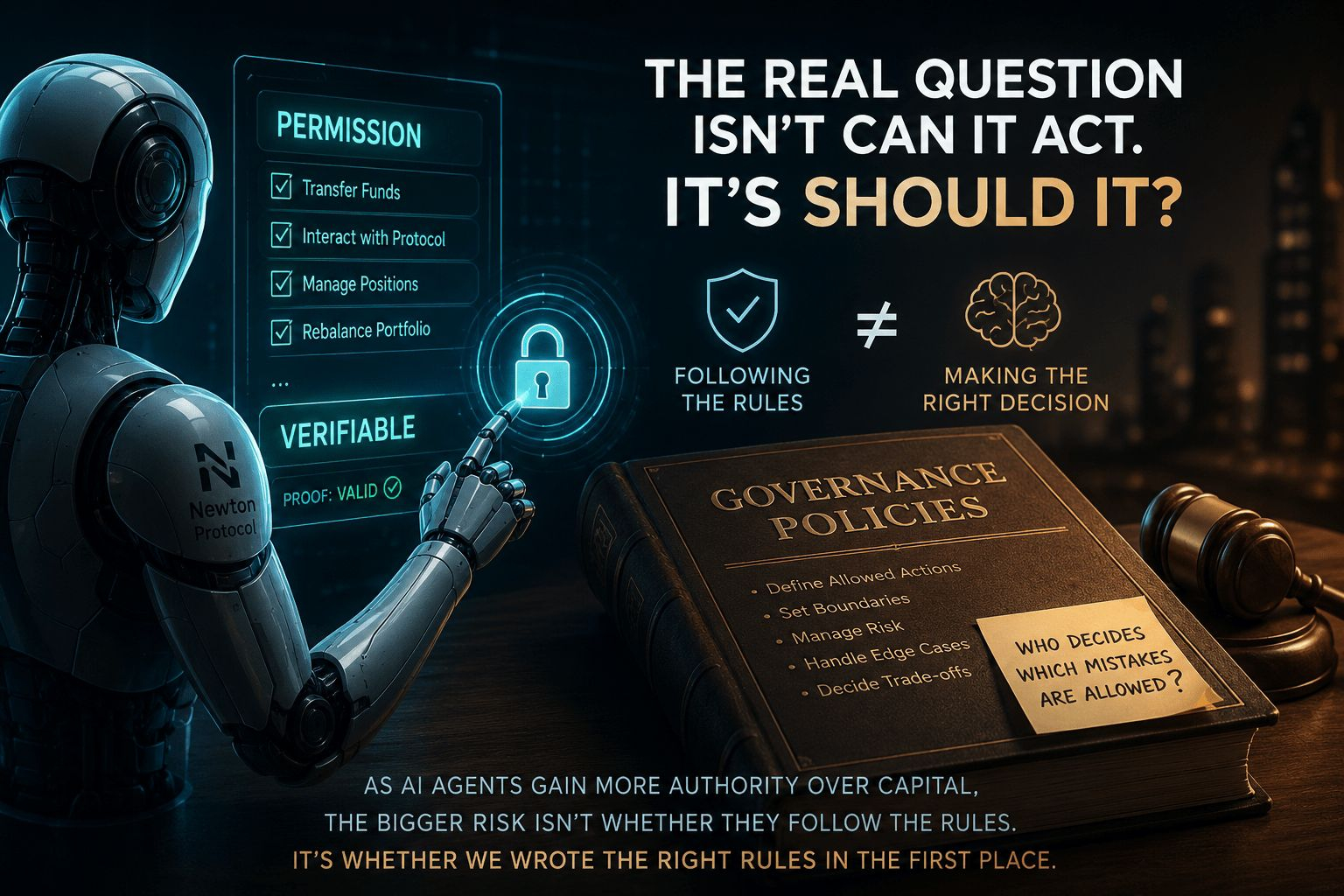
The more I read, the more I realized that Newton isn't really asking, "Can an AI agent act?" It's asking, "What should an AI agent be allowed to do before it acts?"
That distinction matters.I think the industry has become too comfortable treating "verifiable" as if it automatically means "correct." It doesn't.
A cryptographic proof can show that an agent followed its permissions exactly as written. It cannot prove that the underlying judgment was smart or that the policy itself captured every edge case.
To me, that's where the real challenge begins.
If trust is being moved from humans into policies, then those policies become one of the most important parts of the system. And if governance is responsible for shaping those policies, then governance isn't just about voting anymore. It's about deciding which mistakes the system is allowed to make.
That's why Newton Protocol caught my attention. Not because it promises perfect automation, but because it exposes a deeper question that I think the industry is only starting to confront.
As AI agents gain more authority over capital, I don't think the biggest risk will be whether they follow the rules.
I think the bigger question is whether we wrote the right rules in the first place.
$EVAA
$OGN
$NEWT
@NewtonProtocol #Newt #newt
The more I read, the more I realized that Newton isn't really asking, "Can an AI agent act?" It's asking, "What should an AI agent be allowed to do before it acts?"
That distinction matters.I think the industry has become too comfortable treating "verifiable" as if it automatically means "correct." It doesn't.
A cryptographic proof can show that an agent followed its permissions exactly as written. It cannot prove that the underlying judgment was smart or that the policy itself captured every edge case.
To me, that's where the real challenge begins.
If trust is being moved from humans into policies, then those policies become one of the most important parts of the system. And if governance is responsible for shaping those policies, then governance isn't just about voting anymore. It's about deciding which mistakes the system is allowed to make.
That's why Newton Protocol caught my attention. Not because it promises perfect automation, but because it exposes a deeper question that I think the industry is only starting to confront.
As AI agents gain more authority over capital, I don't think the biggest risk will be whether they follow the rules.
I think the bigger question is whether we wrote the right rules in the first place.
$EVAA
$OGN
$NEWT
@NewtonProtocol #Newt #newt