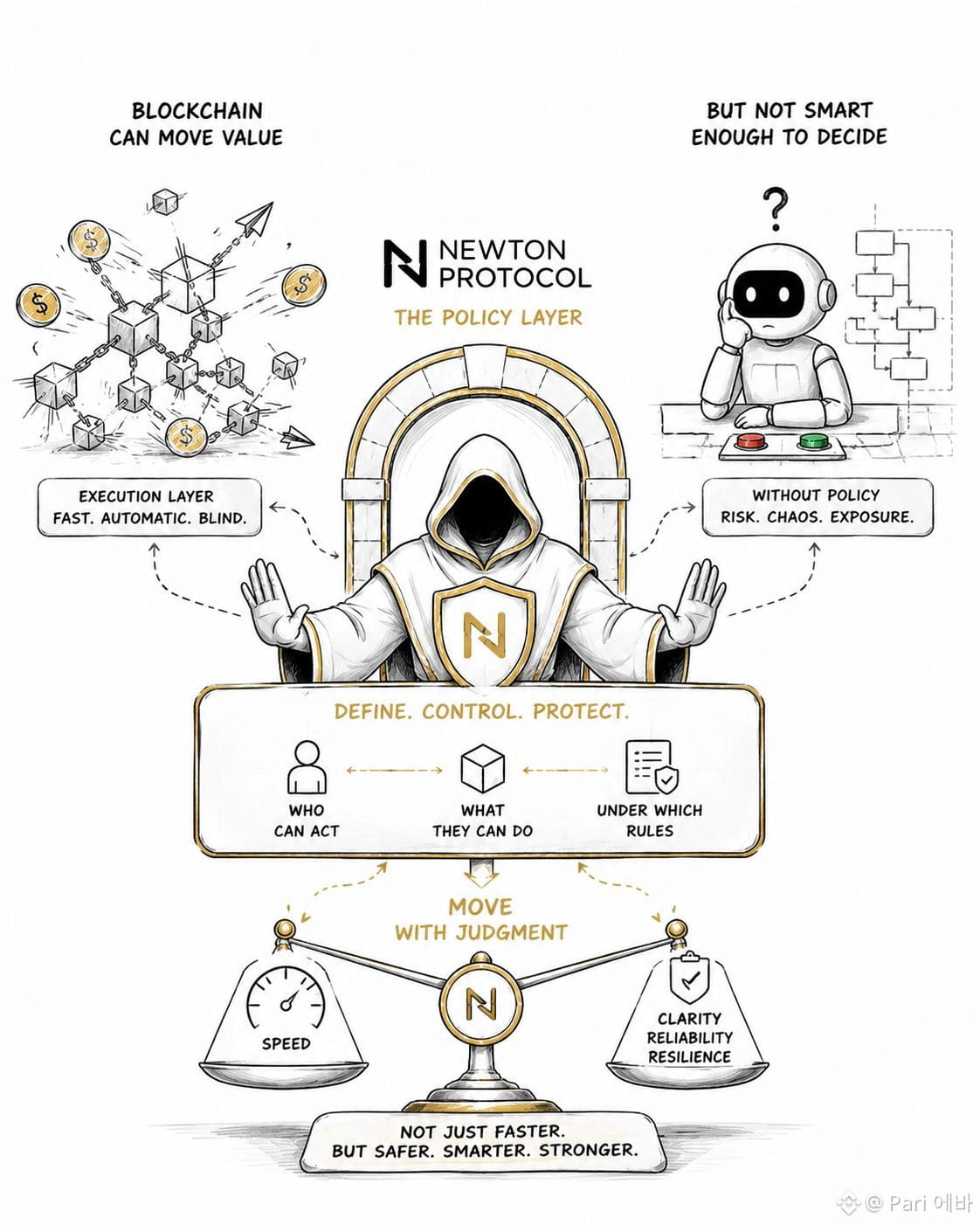
#newt I keep coming back to one simple question: what happens when blockchain systems become good enough to move value, but not smart enough to decide whether they should?
That is why Newton Protocol stands out to me. It is not trying to be loud or flashy.
It is trying to sit in front of onchain actions and add a policy layer, so execution is not just automatic, but controlled.
In plain terms, it wants to help define who can act, what they can do, and under which rules the system should allow it.
That sounds useful, but it also changes the problem.
Once policy becomes part of the flow, the system is no longer judged only by speed.
It is judged by clarity, reliability, and how well it handles real-world pressure.
A good design can reduce chaos.
A weak one can create new points of failure that are harder to notice because they look like normal process.
That is the part I find most interesting. Newton Protocol is not just asking how to move faster. It is asking how to move with judgment.
$NEWT $HUMA $TRX @NewtonProtocol #Newt
That is why Newton Protocol stands out to me. It is not trying to be loud or flashy.
It is trying to sit in front of onchain actions and add a policy layer, so execution is not just automatic, but controlled.
In plain terms, it wants to help define who can act, what they can do, and under which rules the system should allow it.
That sounds useful, but it also changes the problem.
Once policy becomes part of the flow, the system is no longer judged only by speed.
It is judged by clarity, reliability, and how well it handles real-world pressure.
A good design can reduce chaos.
A weak one can create new points of failure that are harder to notice because they look like normal process.
That is the part I find most interesting. Newton Protocol is not just asking how to move faster. It is asking how to move with judgment.
$NEWT $HUMA $TRX @NewtonProtocol #Newt