A while back, I relied on a bot that pulled external data to open a trade, the signal came in 18 seconds late and the position was filled off target before a strong candle. The result was a loss of 82 USDC because the input had already gone stale.
After several moments like that, my trust in systems that talk at length about AI but rush past the ingestion layer started to thin out. In most cases, the error begins where data crosses into the system.
It feels similar to keeping rent money, emergency cash, and living expenses in three separate places. Once the time comes to bring them back together, the first thing that drains away is the time needed to verify whether the money followed the right route, then the fees arrive.
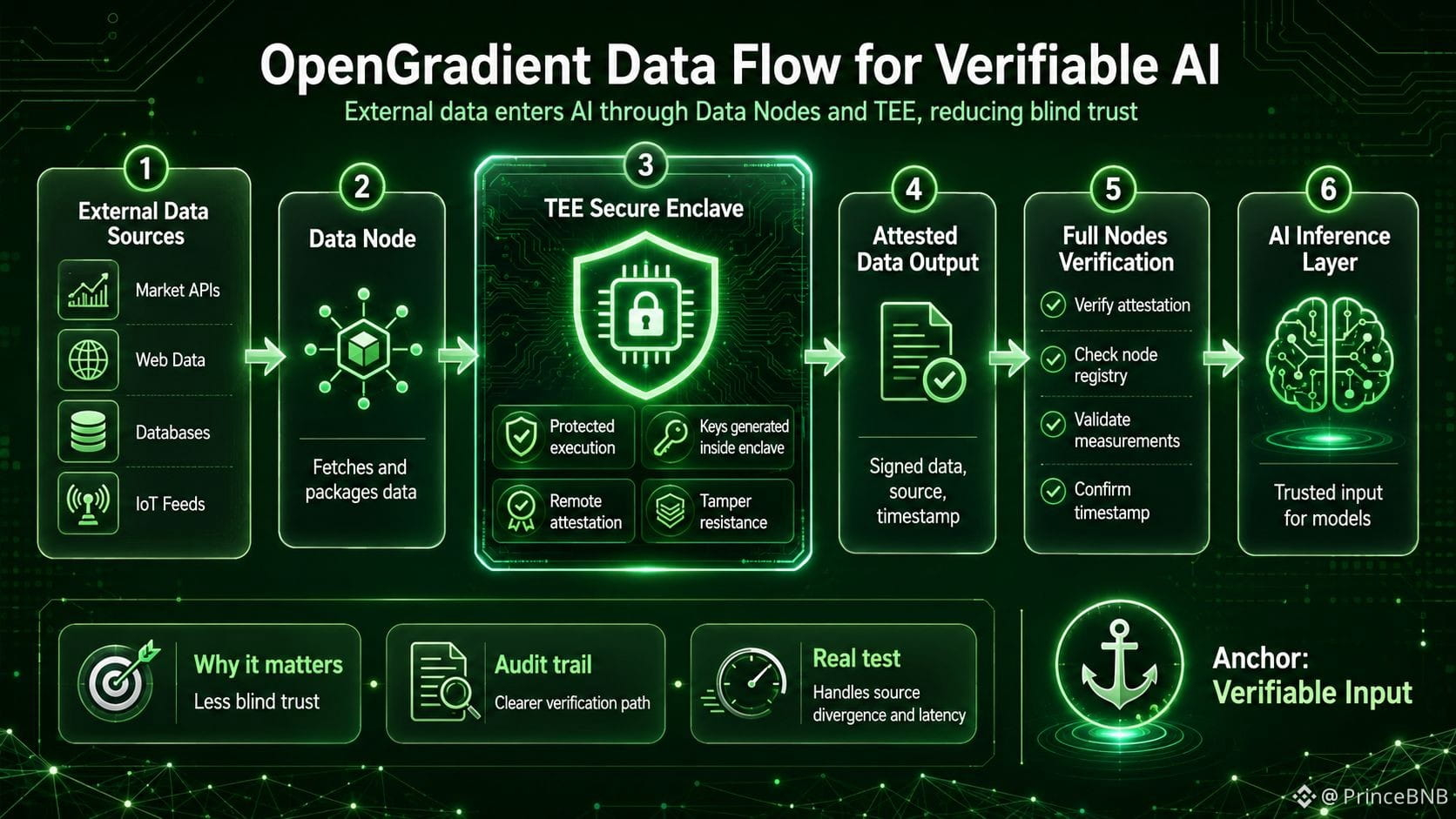
The part I examine most closely is OpenGradient’s Data Node layer, where external data is brought into an enclave before it reaches inference. OpenGradient keeps the signing keys inside an attested TEE, then exposes the registration state so full nodes can cross check what happened.
I picture that structure as a counting desk with a sealed glass box. My anchor rests on 2 points, the data must enter a sealed zone, and the verification marks must stay clear enough for the network to trace them back.
The real test lies in whether full nodes can cross check PCR, attestation, the node registry, and the retrieval timestamp, and whether OpenGradient reveals divergence between two outside sources instead of merely confirming that the data moved through an enclave. I would also judge OpenGradient under 1000 consecutive calls, because a design that appears clean on paper can still fracture once latency gets pushed into verification.
To me, this is not a case of dressing trust up in fresher vocabulary. OpenGradient only holds weight when external data, the enclave, and the verification layer lock together tightly enough that users no longer have to extend trust before the evidence appears.
@OpenGradient #OPG $OPG $BR $H
After several moments like that, my trust in systems that talk at length about AI but rush past the ingestion layer started to thin out. In most cases, the error begins where data crosses into the system.
It feels similar to keeping rent money, emergency cash, and living expenses in three separate places. Once the time comes to bring them back together, the first thing that drains away is the time needed to verify whether the money followed the right route, then the fees arrive.
The part I examine most closely is OpenGradient’s Data Node layer, where external data is brought into an enclave before it reaches inference. OpenGradient keeps the signing keys inside an attested TEE, then exposes the registration state so full nodes can cross check what happened.
I picture that structure as a counting desk with a sealed glass box. My anchor rests on 2 points, the data must enter a sealed zone, and the verification marks must stay clear enough for the network to trace them back.
The real test lies in whether full nodes can cross check PCR, attestation, the node registry, and the retrieval timestamp, and whether OpenGradient reveals divergence between two outside sources instead of merely confirming that the data moved through an enclave. I would also judge OpenGradient under 1000 consecutive calls, because a design that appears clean on paper can still fracture once latency gets pushed into verification.
To me, this is not a case of dressing trust up in fresher vocabulary. OpenGradient only holds weight when external data, the enclave, and the verification layer lock together tightly enough that users no longer have to extend trust before the evidence appears.
@OpenGradient #OPG $OPG $BR $H