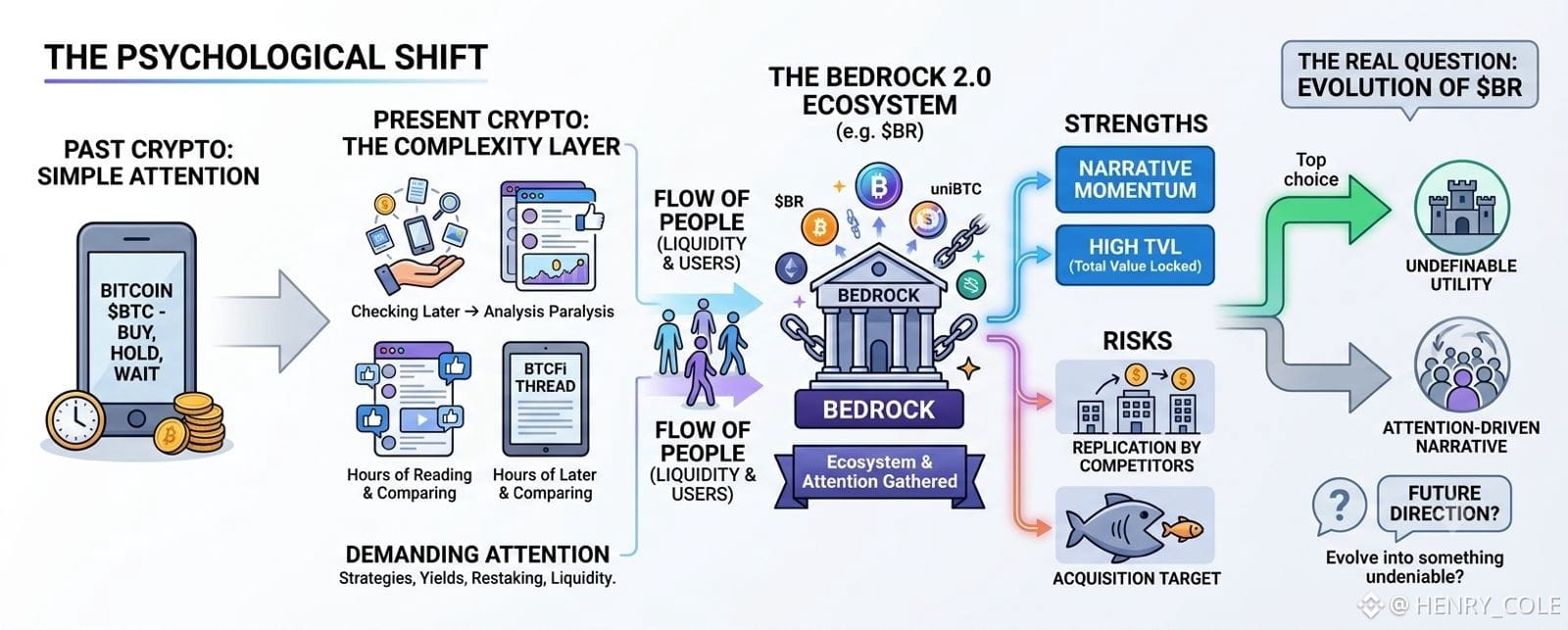
Last night I saved a BTCFi thread with no real intention of acting on it. I wasn’t looking for a new strategy or a position. I wasn’t even particularly interested. It just felt like something I should “check later.”
But that’s where things get interesting — “checking later” slowly turns into hours of reading, comparing, and analyzing things you never planned to engage with. Before I knew it, I was deep into threads, dashboards, and discussions around ideas I never actually wanted to use. I wasn’t searching for opportunity anymore. I was trying to make sure I wasn’t missing one.
That feeling has become very familiar in crypto today.
Bitcoin used to be simple: buy, hold, wait. Not because it was easy, but because there wasn’t much else demanding your attention. Now it’s an entire ecosystem — yield strategies, restaking, liquidity layers, BTCFi experiments — and every month adds another layer of complexity.
Bedrock 2.0 fits right into this shift. Not because it created it, but because it reflects it.
The real change isn’t just financial anymore — it’s psychological. Attention itself has become the real currency. Projects don’t only compete for capital; they compete for your awareness.
There’s an old analogy that fits well: a small food shop with a constant crowd outside. The real value isn’t the shop itself — it’s the flow of people. In crypto, that “flow” is liquidity, users, and narrative momentum.
From that perspective, Bedrock’s strength isn’t just its products, but the ecosystem and attention it has gathered. At the same time, that also becomes its risk — because anything driven heavily by narrative and TVL can eventually be replicated by better-funded competitors.
The real question for $BR isn’t just growth or price. It’s whether it evolves from an attention-driven narrative into something with undeniable utility.
And maybe the biggest risk isn’t failure at all — it’s becoming so successful that it quietly turns into an acquisition target for someone stronger. @Bedrock $BR #Bedrock
But that’s where things get interesting — “checking later” slowly turns into hours of reading, comparing, and analyzing things you never planned to engage with. Before I knew it, I was deep into threads, dashboards, and discussions around ideas I never actually wanted to use. I wasn’t searching for opportunity anymore. I was trying to make sure I wasn’t missing one.
That feeling has become very familiar in crypto today.
Bitcoin used to be simple: buy, hold, wait. Not because it was easy, but because there wasn’t much else demanding your attention. Now it’s an entire ecosystem — yield strategies, restaking, liquidity layers, BTCFi experiments — and every month adds another layer of complexity.
Bedrock 2.0 fits right into this shift. Not because it created it, but because it reflects it.
The real change isn’t just financial anymore — it’s psychological. Attention itself has become the real currency. Projects don’t only compete for capital; they compete for your awareness.
There’s an old analogy that fits well: a small food shop with a constant crowd outside. The real value isn’t the shop itself — it’s the flow of people. In crypto, that “flow” is liquidity, users, and narrative momentum.
From that perspective, Bedrock’s strength isn’t just its products, but the ecosystem and attention it has gathered. At the same time, that also becomes its risk — because anything driven heavily by narrative and TVL can eventually be replicated by better-funded competitors.
The real question for $BR isn’t just growth or price. It’s whether it evolves from an attention-driven narrative into something with undeniable utility.
And maybe the biggest risk isn’t failure at all — it’s becoming so successful that it quietly turns into an acquisition target for someone stronger. @Bedrock $BR #Bedrock