Was going through Bedrock's four yield layers for a task today. $BR , #Bedrock , @Bedrock . Layer one, two, three — Babylon restaking, brBTC routing across Kernel and Symbiotic, Pendle composability. Clean architecture. Calls itself an Intelligent Yield Engine for Bitcoin capital and it mostly earns that framing at the base layers.
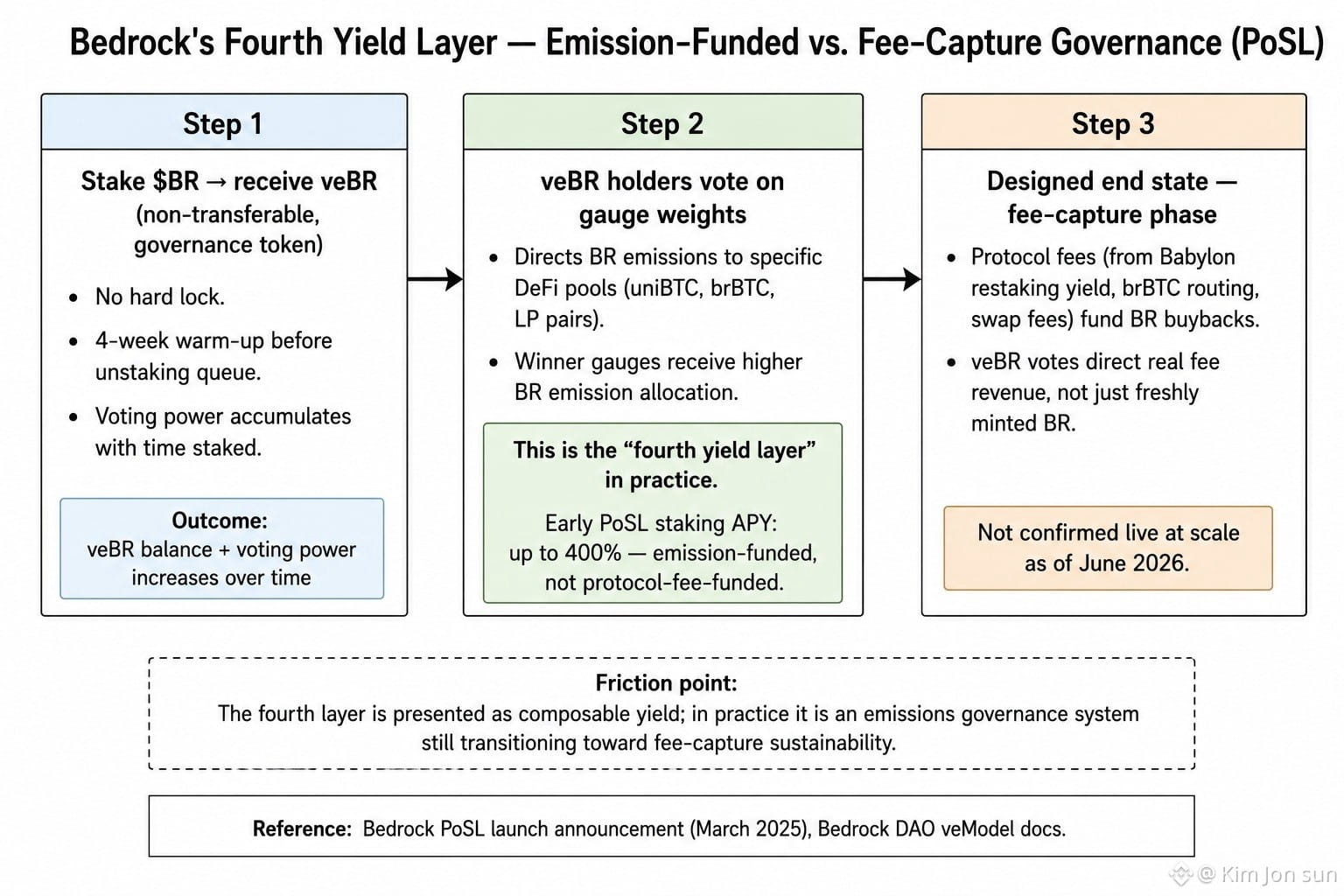
The fourth layer is where I stopped. The narrative describes it as DeFi composability — lending, liquidity provisioning, yield-on-yield. But the actual mechanism powering the engine is PoSL: stake $BR , receive veBR, vote on gauge weights, direct BR emissions to specific pools. When PoSL launched in March 2025, early staking APY hit 400%. That number is emissions-funded, not protocol-revenue-funded.
So the "capital engine" framing assumes the gauge system eventually runs on fee capture — protocol revenue backing BR buybacks, veBR holders directing real yield rather than freshly minted BR. The design is there. The flywheel logic is there on paper. But right now the fourth layer is still largely in the emissions phase, not the fee-capture phase.
I don't think that's fatal. Curve did the same thing for years before it mattered. But it does change what you're actually participating in when you lock $BR today.
Does the protocol fee revenue today justify the veBR governance premium — or is that still being borrowed from future emissions?
The fourth layer is where I stopped. The narrative describes it as DeFi composability — lending, liquidity provisioning, yield-on-yield. But the actual mechanism powering the engine is PoSL: stake $BR , receive veBR, vote on gauge weights, direct BR emissions to specific pools. When PoSL launched in March 2025, early staking APY hit 400%. That number is emissions-funded, not protocol-revenue-funded.
So the "capital engine" framing assumes the gauge system eventually runs on fee capture — protocol revenue backing BR buybacks, veBR holders directing real yield rather than freshly minted BR. The design is there. The flywheel logic is there on paper. But right now the fourth layer is still largely in the emissions phase, not the fee-capture phase.
I don't think that's fatal. Curve did the same thing for years before it mattered. But it does change what you're actually participating in when you lock $BR today.
Does the protocol fee revenue today justify the veBR governance premium — or is that still being borrowed from future emissions?