

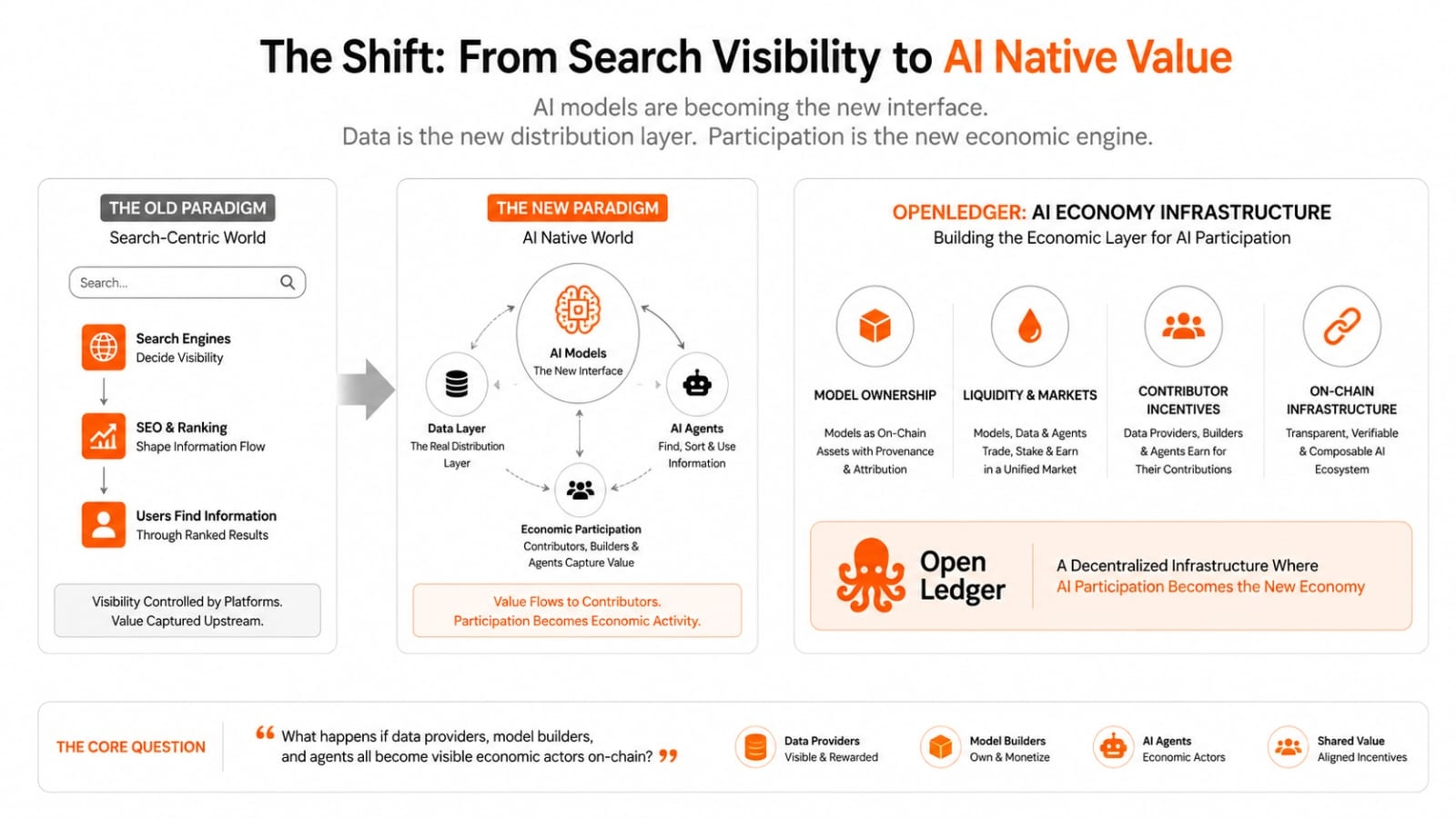
There is a small shift I keep noticing around AI that feels easy to miss. Search used to decide visibility. SEO shaped how information moved. Now it feels like models are slowly becoming the new interface and data is becoming the real distribution layer behind them.
That changes incentives more than people think. If AI agents become the ones finding, sorting and using information, then ranking on search pages matters less. What matters more is who owns the data, who trained the models and who captures value when those models are used.
This is where I started looking at OpenLedger differently. Not as another AI chain. More like infrastructure being built around a future where AI participation itself becomes economic activity.
@OpenLedger keeps pulling attention toward data monetization and contributor incentives. I think that part matters because AI keeps consuming human input while contributors usually stay invisible. The system seems to ask a different question what happens if data providers, model builders and agents all become visible economic actors on chain?
Its architecture feels designed around that assumption. On-chain AI infrastructure is not only about hosting models. OpenLedger keeps linking model ownership, liquidity and participation into the network itself. Models are treated more like assets with economic movement instead of static outputs.
I also find the Ethereum compatibility important even if people ignore it. Wallet integration and smart contract support sound normal today. But inside OpenLedger it feels less about convenience and more about making AI activity programmable. Agents can interact with ownership systems and network incentives without building isolated environments.
The agent deployment side is probably where the post SEO idea becomes more visible to me. If AI agents increasingly become users of information and services, then networks may need native environments where agents participate directly. OpenLedger seems to prepare for that possibility instead of waiting for it.
Still, I keep questioning the incentive layer. OpenLedger rewards contributors and tries to align participation through economics. But incentive systems always attract optimization behavior. People follow rewards before ideals. The challenge is whether useful data stays valuable when incentives scale.
I also wonder how data quality survives long term. Putting contribution value on chain sounds good. Maintaining quality is harder. If AI participation grows inside the network, OpenLedger will probably face the same pressure every incentive economy faces: quantity rising faster than quality.
The model ownership narrative also deserves skepticism. I am not fully convinced users care deeply about owning AI assets today. Many still chase rewards first. OpenLedger may be betting that ownership matters later, after AI becomes more embedded in everyday systems.
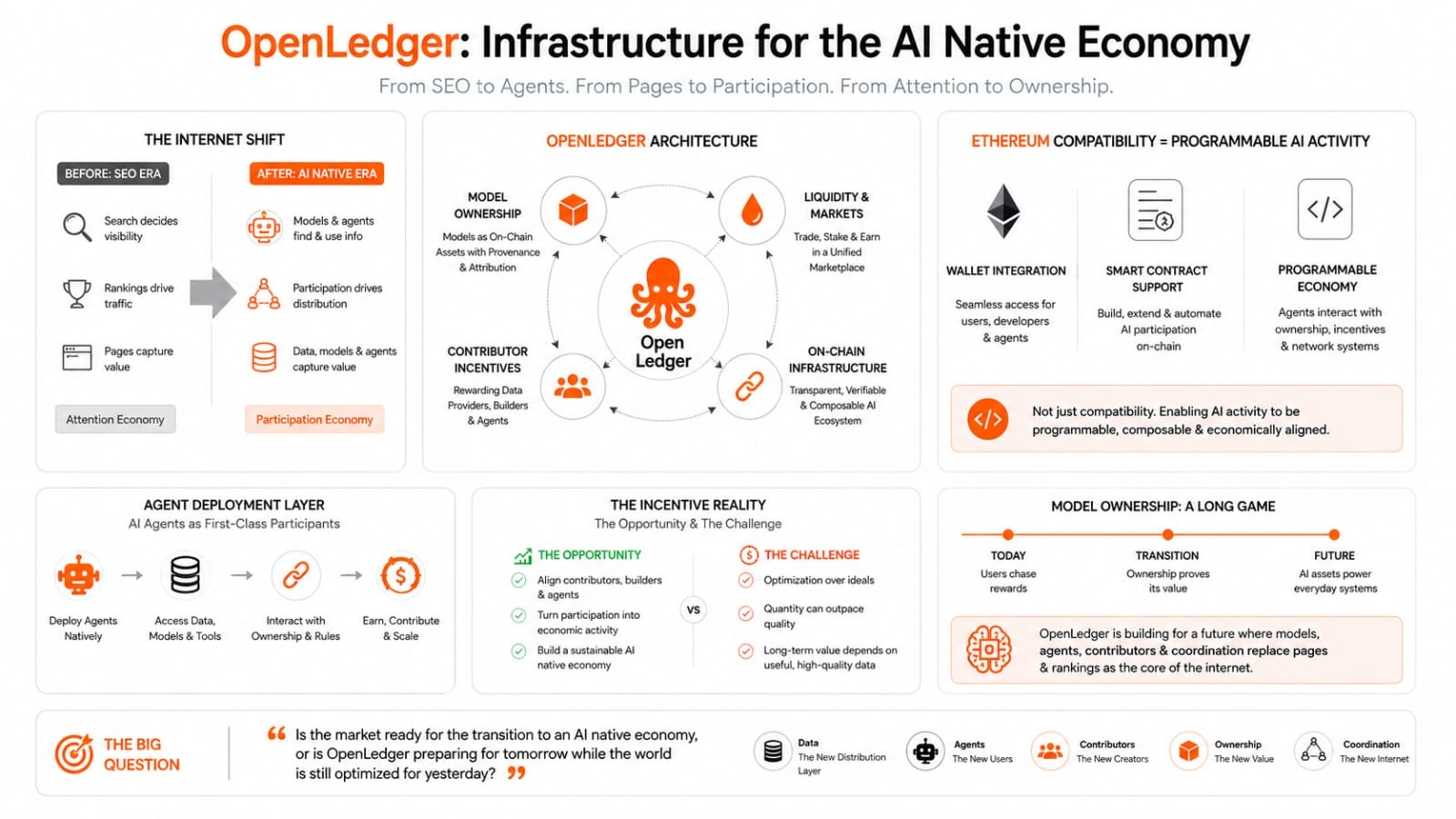
That is why the project feels interesting now. Not because AI is trending again. More because OpenLedger seems built around a quiet assumption that the internet after SEO may revolve around models, agents, contributors and coordination instead of pages and rankings.
I keep thinking about whether the market is actually ready for that transition. OpenLedger might be preparing for an AI native economy before people fully realize the old internet incentives are already starting to move.
