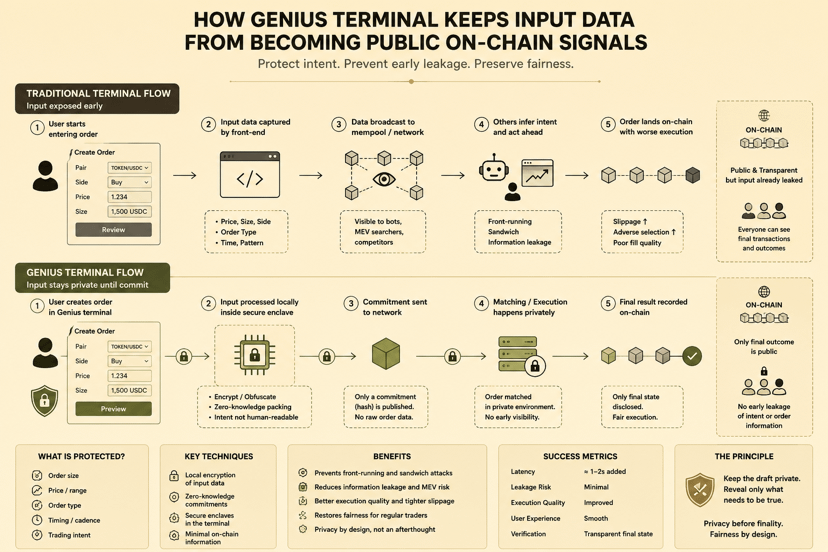
There was a time I lined up a small buy order, around 1,300 dollars, on a thin liquidity pair. I had only entered the price range and had not hit the final confirm yet, but in less than 90 seconds the order book had already drifted away, with a spread of nearly 1.6 percent.
That was enough to change how I looked at it. In crypto, input data is often exposed earlier than the trade itself, and once intent gets read, the edge has already thinned out.
It feels like opening a banking app to rearrange rent money and reserve cash, then having someone next to you immediately see where your month is getting tight, before any transfer is even finished. The preparation phase often says more than people think.
The most important point sits at the terminal layer. Genius puts its focus on the moment when users are still entering order size, the expected price range, and the timing of execution. Genius is right to try to keep that immature data from being pushed straight into a public onchain signal.
My anchor is a very simple idea. Any system that lets the draft phase light up too early is still exposed.
The standard I use is fairly strict. Genius is only durable if the terminal can protect input data without making the flow materially heavier, and latency should stay around 1 to 2 seconds. Genius also has to leave the final verification step clear enough that users know exactly what they are signing.
I would judge it through a few concrete signs. The order flow has to stay smooth, traces of intent cannot leak too early, the privacy cost cannot turn into a hidden tax, and Genius has to prove that protecting input data is a real usability advantage.
@GeniusOfficial #genius $GENIUS $PLAY $PHA
That was enough to change how I looked at it. In crypto, input data is often exposed earlier than the trade itself, and once intent gets read, the edge has already thinned out.
It feels like opening a banking app to rearrange rent money and reserve cash, then having someone next to you immediately see where your month is getting tight, before any transfer is even finished. The preparation phase often says more than people think.
The most important point sits at the terminal layer. Genius puts its focus on the moment when users are still entering order size, the expected price range, and the timing of execution. Genius is right to try to keep that immature data from being pushed straight into a public onchain signal.
My anchor is a very simple idea. Any system that lets the draft phase light up too early is still exposed.
The standard I use is fairly strict. Genius is only durable if the terminal can protect input data without making the flow materially heavier, and latency should stay around 1 to 2 seconds. Genius also has to leave the final verification step clear enough that users know exactly what they are signing.
I would judge it through a few concrete signs. The order flow has to stay smooth, traces of intent cannot leak too early, the privacy cost cannot turn into a hidden tax, and Genius has to prove that protecting input data is a real usability advantage.
@GeniusOfficial #genius $GENIUS $PLAY $PHA