

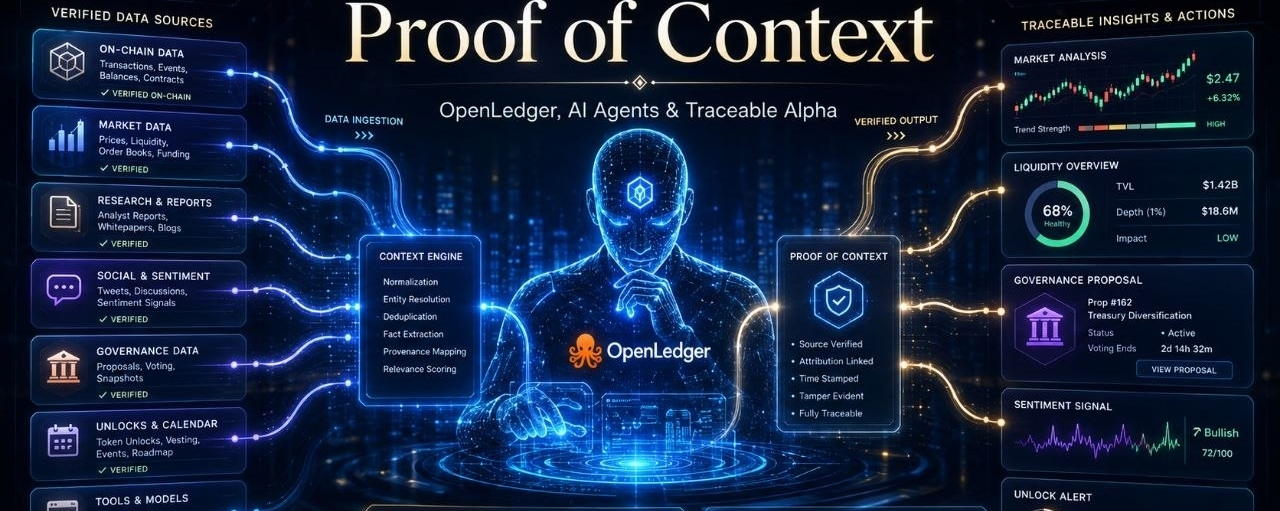

One thing I’ve learned from trading crypto is that raw intelligence isn’t enough. Speed matters, sure. Better models matter too. But context is what usually separates a decent call from a wrecked trade. A model can say “this token looks strong,” but if it misses an unlock, a governance vote, thin liquidity, bad data, or a sudden sentiment shift, that “strong” signal can turn into exit liquidity real quick 😅
That’s why OpenLedger’s AI-agent direction is interesting to me. @OpenLedger describes itself as AI-blockchain infrastructure for training and deploying specialized models with community-owned datasets called Datanets, while actions like dataset uploads, model training, rewards, and governance happen on-chain. That matters because AI agents need more than prompts. They need trusted context, traceable data, and a reason for people to keep improving the knowledge layer behind them. 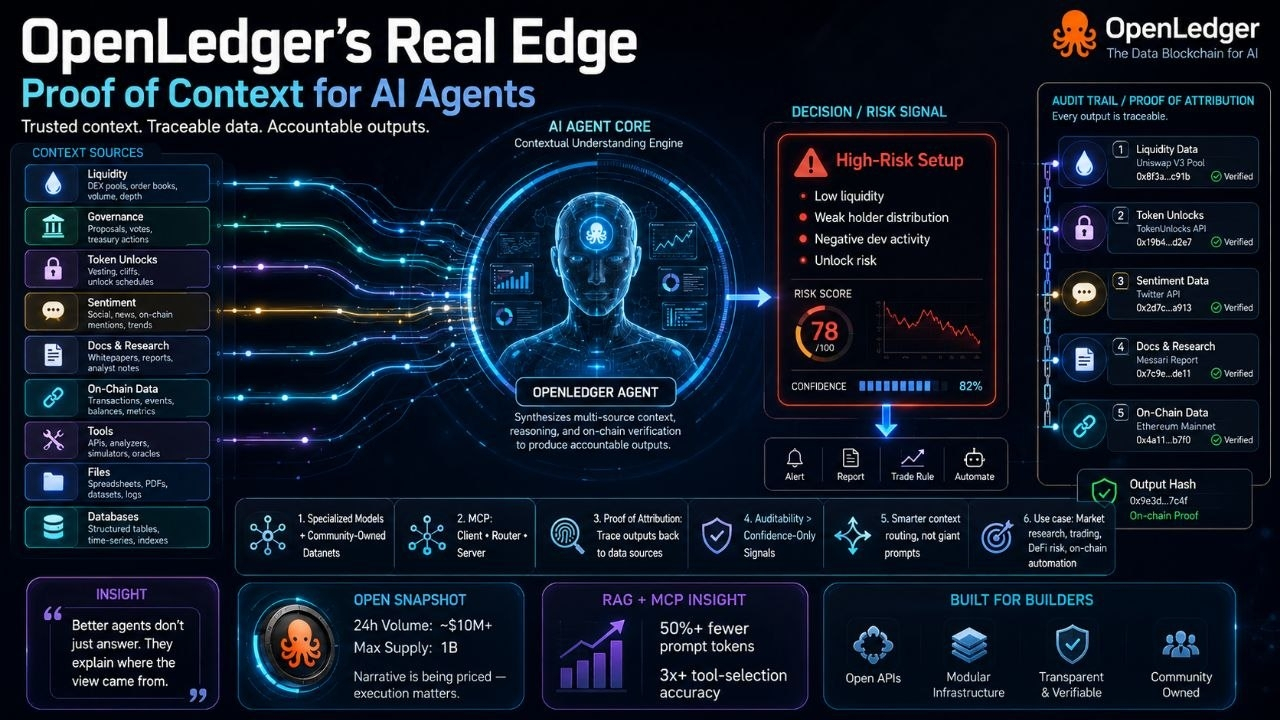
The topic I’m watching now is OpenLedger’s Model Context Protocol angle. In its agent-focused materials, OpenLedger explains MCP as a structure for giving models access to external state, tools, files, databases, and executable responses. It uses a client, server, and router flow so models can receive context and interact with tools in a more organized way.
For builders, that’s not just nerdy infrastructure. It’s the difference between a chatbot and a useful agent.
Imagine building a market research agent on OpenLedger. A basic bot might summarize token news. A better bot might pull liquidity data, compare it with social momentum, scan docs, check governance proposals, and flag unlock risk. But the real alpha comes when the agent can explain where its view came from and which data sources shaped the output. That’s where OpenLedger’s Proof of Attribution becomes powerful. OpenLedger positions Proof of Attribution as a way to trace AI outputs back to data sources and contributors, which means contributors can be credited and rewarded instead of disappearing into a black-box training pipeline.
My trading logic here is simple: I don’t want an AI agent that only gives me confidence. I want one that gives me auditability. If an agent says, “high-risk setup,” I want to see whether that came from low liquidity, weak holder distribution, negative dev activity, or a previous pattern in contributed Datanets. Confidence without traceability is just vibes. Traceable confidence is a tool.
There’s also a scalability point. Recent RAG-MCP research found that retrieval-based tool selection can cut prompt tokens by over 50% and more than triple tool-selection accuracy in benchmark tests, which supports the broader idea that agents need smarter context routing, not giant overloaded prompts. OpenLedger’s agent stack fits that direction: specialized datasets, specialized models, context routing, and attribution mechanics all working together.
And market-wise, OPEN is already liquid enough to be watched seriously, with CoinGecko showing roughly $10M+ in 24-hour volume and a 1B max supply at the time of checking. That doesn’t mean “buy.” It means the market is actively pricing the narrative, so builders and traders should evaluate execution, not just hype.
The bigger picture? OpenLedger could make AI agents less like mysterious prediction machines and more like accountable market operators. For trading, research, DeFi risk, and on-chain automation, that’s a huge shift. In crypto, everyone loves alpha. But the next wave may be about proving where the alpha came from. $OPEN #OpenLedger