

I made a dumb little trading mistake today. I had $OPEN on my screen, saw it dipping near the $0.20–$0.21 range, and instead of waiting for clean confirmation, I tried to “catch the discount.” Yeah… classic impatient trader behavior. It didn’t wreck my PNL, but it reminded me of something important: with projects like @OpenLedger , I shouldn’t only trade candles. I should trade the logic behind demand.
What I’m seeing with OpenLedger is bigger than a normal AI narrative. The project describes itself as an AI blockchain focused on monetizing data, models, and agents, which sounds simple until you think about the actual problem. AI apps need data. Models need tuning. Agents need real-time context. But in most systems, the people who create useful data don’t get proper ownership or rewards. OpenLedger is trying to turn that invisible contribution layer into something trackable and liquid. That’s the part I keep coming back to.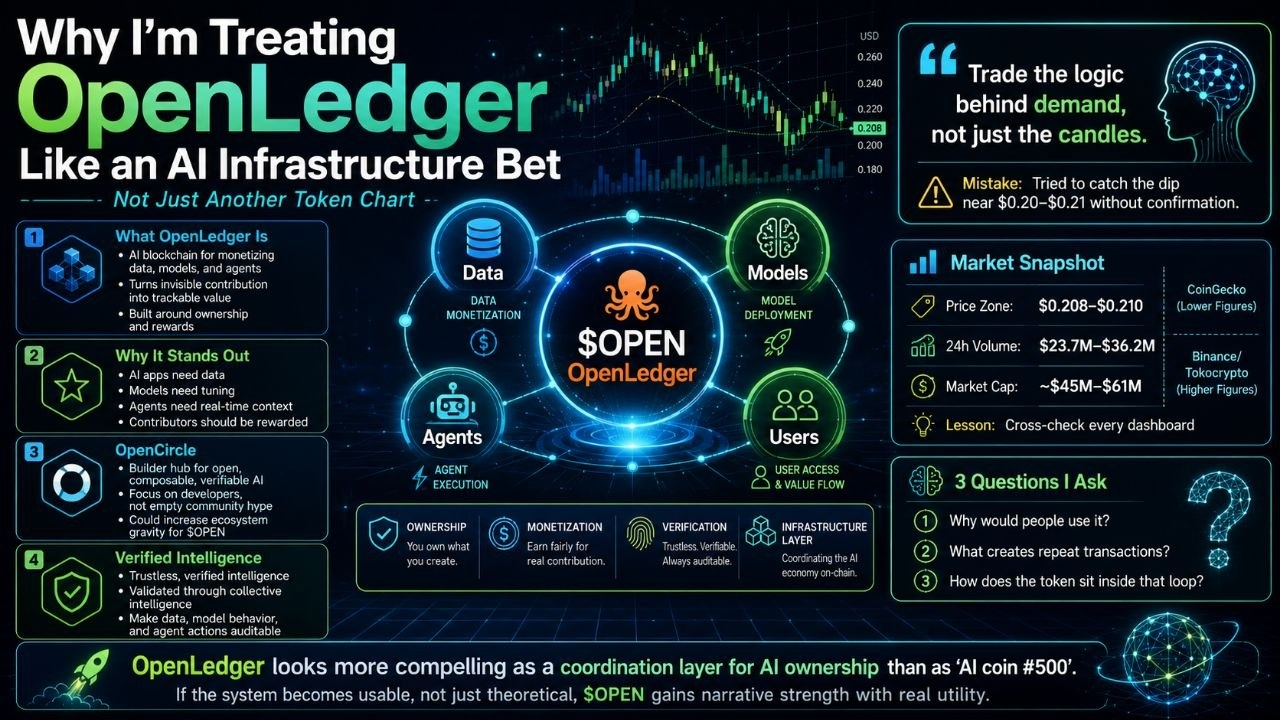
The fresh angle for me today is OpenCircle. It’s not just a random community page. OpenCircle is positioned as a builder hub for AI systems that are open, composable, and verifiable from the start. That matters because crypto doesn’t need another empty “community.” It needs developers building things people can use. If OpenCircle can bring builders into OpenLedger’s stack, then the value of $OPEN becomes less about hype cycles and more about ecosystem gravity.
I also looked at the ecosystem page, and one line stood out: OpenLedger talks about trustless, verified intelligence, validated through collective intelligence. That’s a spicy idea because AI outputs are becoming harder to trust. We already see fake research, low-quality summaries, hallucinated answers, and bots pretending to know markets better than humans. So the question is: how do we verify intelligence before we rely on it? OpenLedger’s answer is to make data, model behavior, and agent actions more auditable.
From a trading perspective, I like asking three boring but useful questions: why would people use it, what creates repeat transactions, and how does the token sit inside that loop? For OPEN, the answer seems tied to AI app creation, data monetization, model deployment, and agent execution. That’s much better than a project where the token exists only because the team needed a ticker.
The market data is also worth respecting, not worshipping. Today, trackers showed OPEN around the $0.208–$0.210 area, with 24h volume reported roughly between $23M and $36M depending on the exchange/data source. CoinGecko showed about $23.7M daily volume and a market cap near $45M, while Binance/Tokocrypto showed around $36.2M volume and about $61M market cap using a higher circulating supply figure. That difference tells me one thing: don’t blindly trust one dashboard. Cross-check everything.
My hot take: #OpenLedger becomes more interesting when you stop viewing it as “AI coin number 500” and start viewing it as a coordination layer for AI ownership. Data contributors, model builders, agent creators, and users all need a fairer system. If @OpenLedger can make that system usable, not just theoretical, then $OPEN has a real narrative with teeth.
I’m not calling it easy money. I’m saying it’s one of the few AI-crypto ideas where the infrastructure logic actually makes me pause, zoom out, and think deeper before clicking buy or sell.
Disclaimer: This is not financial advice or a buy/sell recommendation. I’m sharing my personal research framework and watchlist reasoning. Crypto assets are volatile, so always verify live data and DYOR.