welcome

نشر

--


krizwar
·
--
Understanding OpenLedger – A New Era of AI + Blockchain Fusion
OpenLedger presents itself as something more ambitious than a typical blockchain or AI project. At its core, it is trying to design a decentralized AI economy where data, models, and computation are not controlled by a single company but instead distributed across a network of participants. When I first explored this concept, what stood out was not just the technical structure, but the economic philosophy behind it.
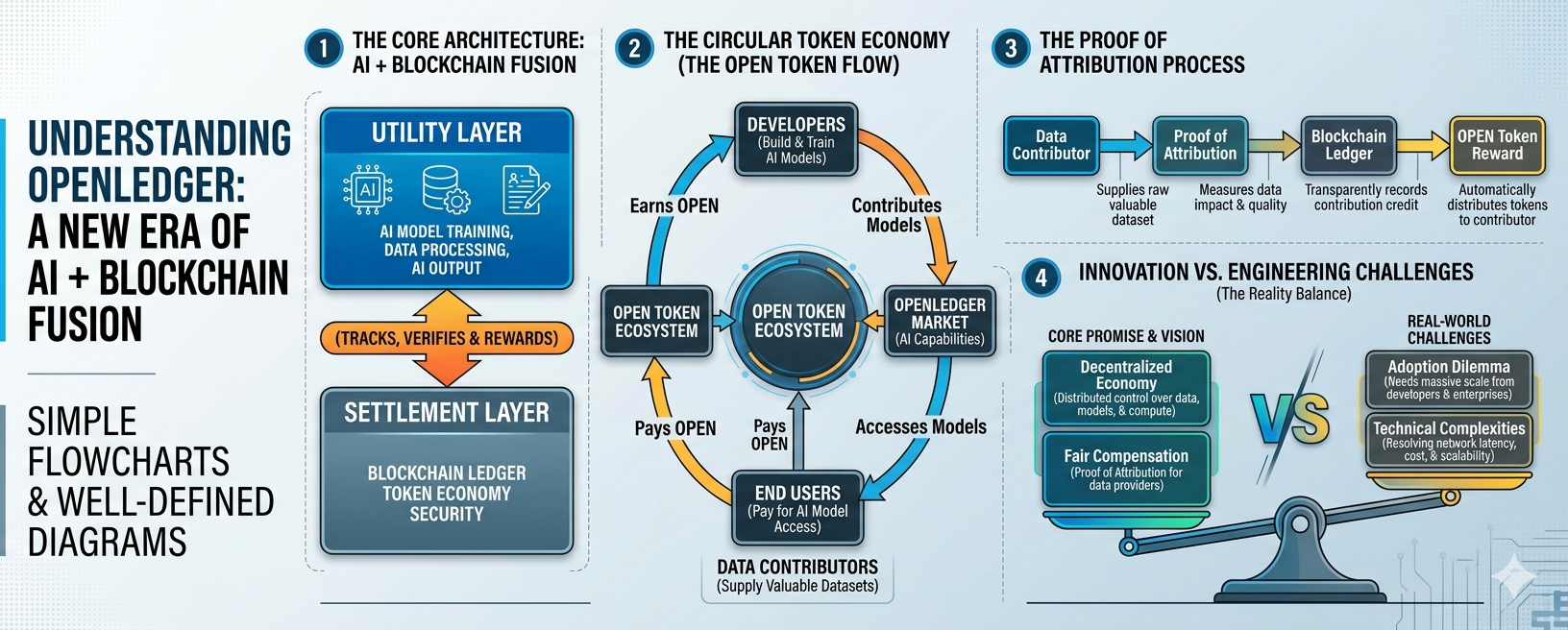
The idea is simple on the surface but complex in execution: every contribution to the AI system whether it is data, computing power, or model training should be tracked and rewarded transparently. This is where blockchain comes in. It acts as the settlement layer that records contributions, while AI acts as the utility layer that generates value.
At the center of this system is the OPEN token. It is designed to function as the internal currency of the ecosystem. Users pay it to access AI models, developers earn it for building models, and data contributors receive it for supplying valuable datasets. In theory, this creates a circular economy where value is constantly flowing between participants rather than being extracted by a central authority.
From my perspective, the most interesting part of OpenLedger is its attempt to solve a long-standing problem in AI: the unfair distribution of value. In today’s AI industry, large companies collect massive amounts of data and generate powerful models, but the people who contribute data rarely receive recognition or compensation. OpenLedger tries to flip this structure by introducing “Proof of Attribution,” a system that attempts to measure and reward contribution impact.
However, I also see the challenges clearly. Building a decentralized AI economy is not just a technical problem it is an adoption problem. Even if the system is perfectly designed, it still needs developers, users, and enterprises to actually use it at scale. Without real adoption, even the most elegant architecture becomes theoretical.
Another concern is complexity. AI systems already require massive infrastructure, and combining them with blockchain introduces latency, cost, and scalability issues. These are not small challenges; they are fundamental engineering barriers.
Still, despite the risks, I find the concept intellectually strong. OpenLedger is essentially asking a big question: what if AI development worked like an open financial system instead of a closed corporate pipeline? If even part of this vision works, it could reshape how we think about ownership in AI.
In summary, OpenLedger is not just a project it is an experiment in rebuilding AI economics. Whether it succeeds or fails will depend less on its whitepaper and more on real-world usage, incentive design, and long-term ecosystem growth.@OpenLedger #OpenLedger #openledger $OPEN $BILL $BSB
The idea is simple on the surface but complex in execution: every contribution to the AI system whether it is data, computing power, or model training should be tracked and rewarded transparently. This is where blockchain comes in. It acts as the settlement layer that records contributions, while AI acts as the utility layer that generates value.
At the center of this system is the OPEN token. It is designed to function as the internal currency of the ecosystem. Users pay it to access AI models, developers earn it for building models, and data contributors receive it for supplying valuable datasets. In theory, this creates a circular economy where value is constantly flowing between participants rather than being extracted by a central authority.
From my perspective, the most interesting part of OpenLedger is its attempt to solve a long-standing problem in AI: the unfair distribution of value. In today’s AI industry, large companies collect massive amounts of data and generate powerful models, but the people who contribute data rarely receive recognition or compensation. OpenLedger tries to flip this structure by introducing “Proof of Attribution,” a system that attempts to measure and reward contribution impact.
However, I also see the challenges clearly. Building a decentralized AI economy is not just a technical problem it is an adoption problem. Even if the system is perfectly designed, it still needs developers, users, and enterprises to actually use it at scale. Without real adoption, even the most elegant architecture becomes theoretical.
Another concern is complexity. AI systems already require massive infrastructure, and combining them with blockchain introduces latency, cost, and scalability issues. These are not small challenges; they are fundamental engineering barriers.
Still, despite the risks, I find the concept intellectually strong. OpenLedger is essentially asking a big question: what if AI development worked like an open financial system instead of a closed corporate pipeline? If even part of this vision works, it could reshape how we think about ownership in AI.
In summary, OpenLedger is not just a project it is an experiment in rebuilding AI economics. Whether it succeeds or fails will depend less on its whitepaper and more on real-world usage, incentive design, and long-term ecosystem growth.@OpenLedger #OpenLedger #openledger $OPEN $BILL $BSB
إخلاء مسؤولية: يتضمن آراء جهات خارجية. لا تُعدّ نصيحة. يُمكن استخدام Binance AI دون أي ضمان. اطلع على الشروط والأحكام.