


🚀 Decoding the Crypto Frontier: Trading Secrets, Trend Analysis, and the Path to Profit
Author: Shahid Alex
Welcome, future financial architects and curious minds! I'm Shahid Alex, and I'm thrilled to guide you through the exhilarating world of cryptocurrency. This is more than just an investment; it's a financial revolution built on groundbreaking technology. Our goal today is clear: to equip you with the knowledge—the tips, the tricks, and the market analysis secrets—that will help you move from a curious observer to a confident, profit-making trader. Based on the latest market trends, including the renewed institutional interest in assets like $BTC and the growing focus on Web3 security, let's dive into the core of what makes the crypto market tick.
The Institutional Tide and the Stability of Digital Gold
One of the most viral and important trends shaping the crypto landscape right now is the significant shift in institutional acceptance. Big financial players, once skeptical, are now actively integrating crypto. JPMorgan's recent bullish stance on $BTC, with price targets pushing towards $170,000, is a strong signal that the market is maturing and stabilizing after past periods of major sell-offs.
Bitcoin's New Role: $BTC is increasingly being viewed not just as a speculative asset, but as a "digital gold"—a hedge against traditional financial risks and inflation. Its fixed supply (21 million coins) and strong security make it an essential reserve asset for both corporations and forward-thinking governments.
The Deleverage Factor: The recent deleveraging (the reduction of borrowed funds used to trade) across the market, especially in $BTC and $ETH futures, suggests a healthier, less volatile market environment. This "calmer" state is exactly what institutional investors look for.
The Altcoin Landscape: While $BTC and $ETH dominate, the focus is also on faster, scalable networks like $SOL, and research-driven platforms like $ADA. Decentralized exchanges (DEXs) like Uniswap and PancakeSwap are also major players, though they require familiarity with personal blockchain wallets.
Mastering Market Analysis: Your Roadmap to Profit
To make a profit in this dynamic market, you need a disciplined approach built on technical analysis (TA) and a solid understanding of market psychology. Think of me as your college lecturer, breaking down complex concepts into simple, actionable steps.
Trading Tips and Tricks: The Golden Rules
Risk Management is Paramount: In crypto, volatility is a feature, not a bug. Never invest more than you can afford to lose.Use Stop-Loss Orders: This is your safety net. A stop-loss automatically sells your asset if the price drops to a specific level, limiting your potential losses. This removes emotion from the trade.
Position Sizing: Allocate only a small percentage (e.g., 1-3%) of your total trading capital to any single trade.
.
Embrace Dollar-Cost Averaging (DCA): For long-term goals (HODLing), DCA is your friend. It means investing a fixed amount of money at regular intervals, regardless of the price. This mitigates the risk of buying at a market peak and smooths out your average entry price.
Combine Signals: Do not rely on one indicator alone. Use chart patterns in combination with momentum indicators like the Relative Strength Index (RSI) and trend indicators like Moving Averages (MA) to confirm your trade decisions.
Decoding Candlesticks: The Language of the Market
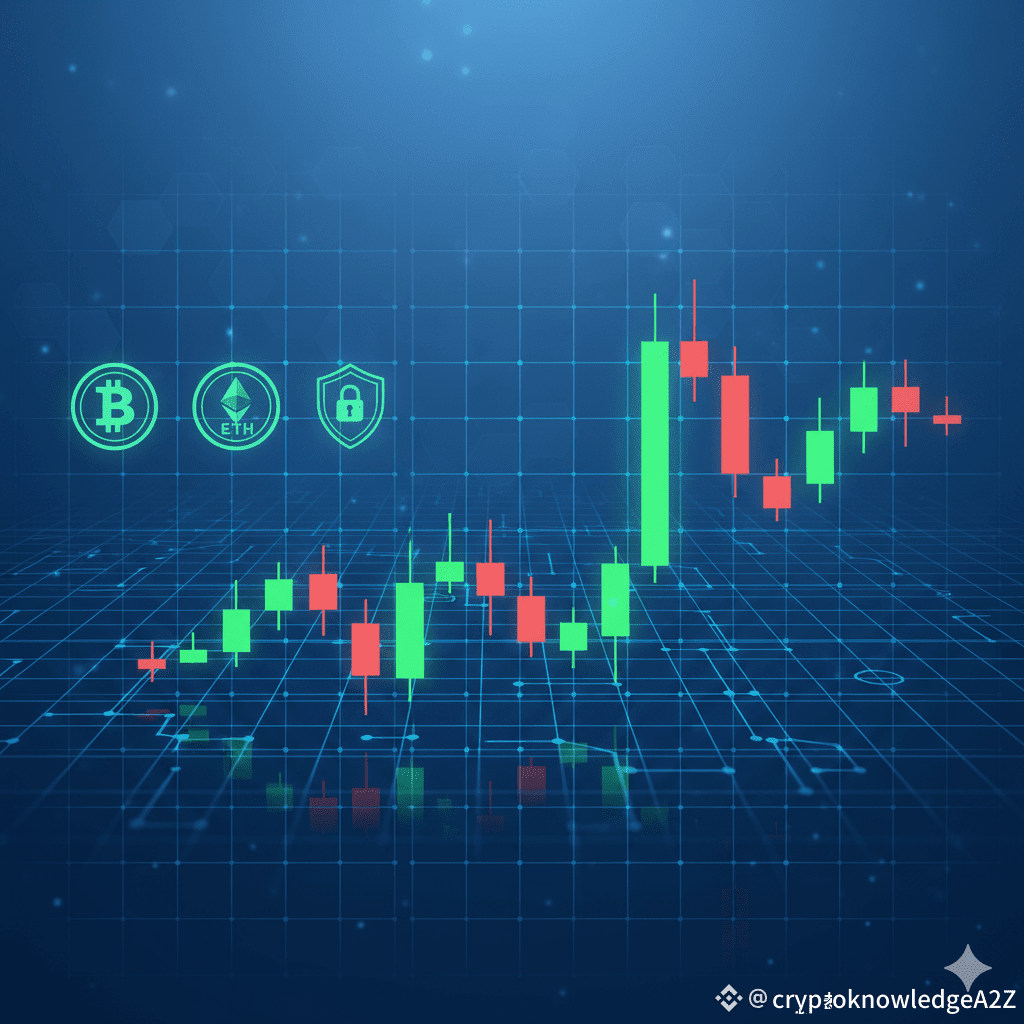
Candlesticks are the visual language of price action. Each one tells a story about the battle between buyers (bulls) and sellers (bears). Understanding them is a secret to effective trading.
Candlestick Component Interpretation
Body (Thick Part) The difference between the open and close price. A long green body shows strong buying pressure; a long red body shows strong selling pressure.
Wick/Shadow (Thin Lines) The highest (top wick) and lowest (bottom wick) prices reached during that period. Long wicks indicate significant price rejection.
Color (Green/Red) Green: The closing price was higher than the opening price (price went up). Red: The closing price was lower than the opening price (price went down).