


99% of crypto games die because they can’t solve the "Sybil Attack" problem. they release a token, and within forty-eight hours, ten thousand scripts are farming it into the ground.
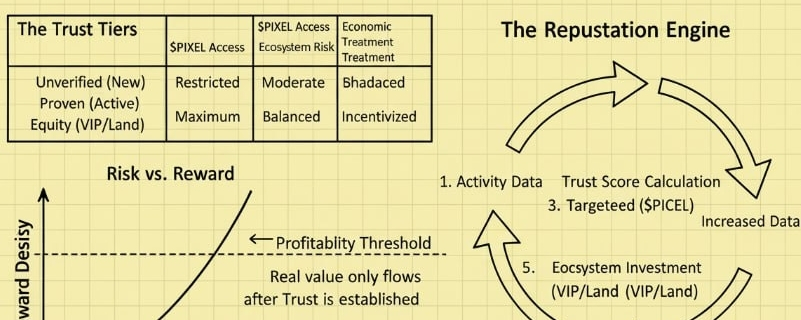
pixels didn't just add a captcha. they built an entire economy around the Trust Score.
in Chapter 2, the "Liquidity of Trust" is the most important mechanic.
the system is constantly running a calculation on every single player. it’s not just "is this a bot?" it’s "what is the Return on Reward Spend (RORS) for this specific user?"
if you have a low Trust Score, the system sees you as a high-risk liability.
it won't ban you - that’s too easy to bypass. instead, it just reduces the "Reward Density" of your experience.
your Task Board won't surface $PIXEL. your resource nodes will give you the bare minimum. you are effectively shadow-gated from the premium economy until you prove your value.
this creates a fascinating incentive for $PIXEL.
one of the fastest ways to boost that Trust Score? VIP status and Land ownership.
by spending $PIXEL to get VIP, you are essentially posting "collateral." you are telling the system: "i am invested in this ecosystem."
the system rewards that investment by opening the "Reward Pipe."
on the Ronin Network, this data is becoming the "Credit Score" of gaming.
your behavior in Pixels doesn't just stay in Pixels. it’s proof that you are a high-value user.
and as the ecosystem grows, that Trust Score will be what gets you into the next big project on Ronin.
so, when you see people complaining that the game is "too hard" or the rewards are "too slow," remember - that friction is the only thing keeping your tokens from going to zero.
the "Time-Tax" and the "Reputation-Gate" are the defense mechanisms of a sustainable economy.
pixels isn't just a game you play.
it’s a system you convince.
and the more $PIXEL you reinvest into your reputation, the more the system opens up for you.
stop looking at the harvest. start looking at the score.