
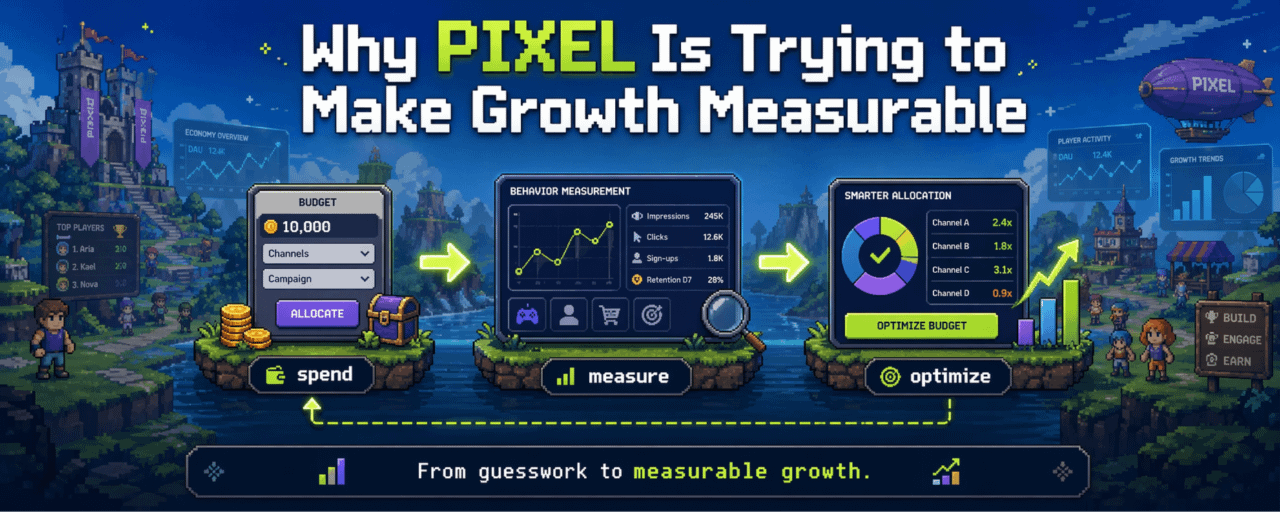
User growth in gaming usually gets treated like an input cost.
Spend the budget. Buy the traffic. Hope enough players stay to justify what went out.
The problem is that this model hides almost everything that matters.
It tells you how much was spent.
It rarely tells you what kind of users arrived, which incentives actually worked, or whether the next dollar should be deployed the same way again.
That is where PIXEL starts to look more interesting.
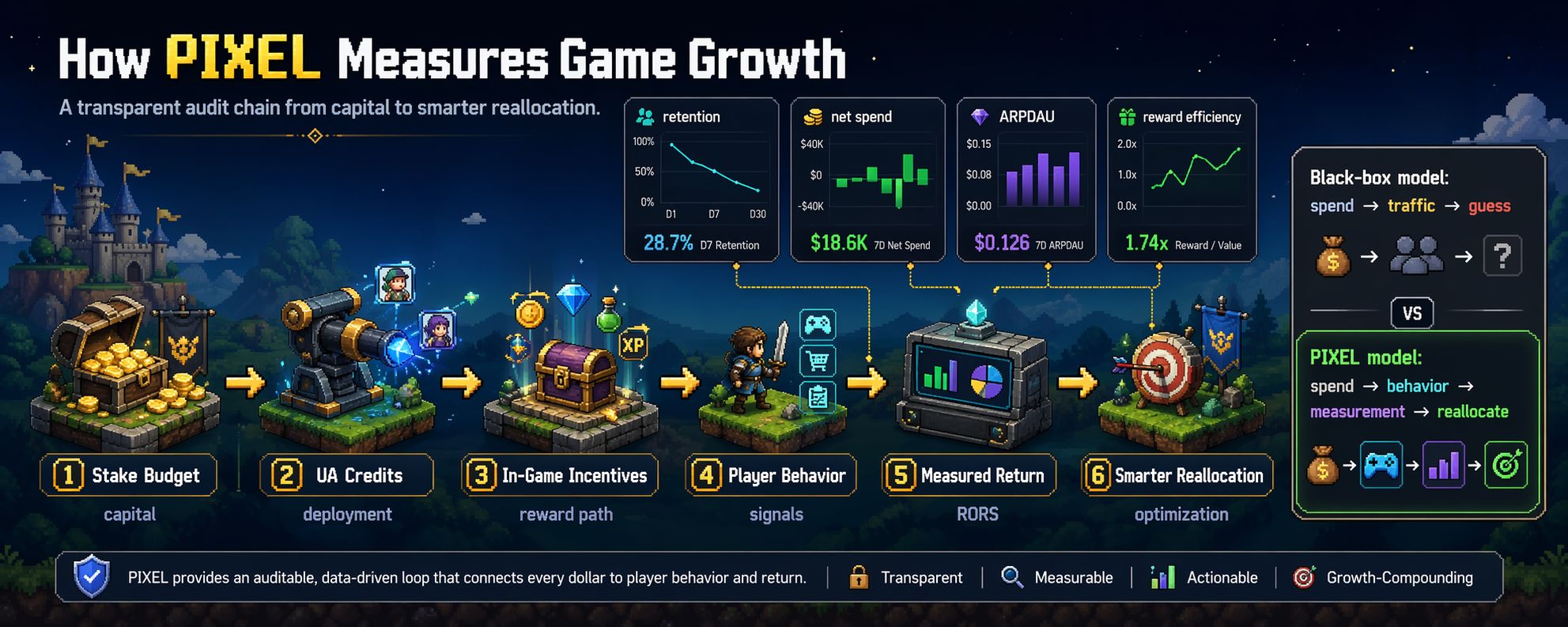
The docs describe a system that tries to pull growth spending inside the ecosystem itself. Staking can translate into UA credits, those credits can be deployed through incentives, player actions can be measured, and the resulting data can improve the next round of targeting and allocation. In the revised vision, Pixels even frames part of its ambition as becoming something closer to decentralized AppsFlyer or AppLovin rails for games.
That changes the role of growth.
It stops being just a marketing expense.
It starts becoming an observable economic process.
And that is a major difference.
In a normal model, incentives are often judged by surface outcomes: installs, sessions, top-line activity. But the Pixels stack points toward a more demanding framework. The flywheel in the litepaper links staking, UA credits, player spend, revenue share, richer data, and smarter targeting into one loop, while the project’s metrics emphasize retention, ARPDAU, and Return on Reward Spend rather than raw activity alone.
That means the real question is no longer:
Did the campaign create users?
The harder question becomes:
What kind of behavior did those users create after they arrived?
That is a much better question for an economy.
Because cheap traffic is not necessarily useful traffic.
Short-term activity is not necessarily productive activity.
And rewards that generate clicks but not reinvestment usually end up behaving like leakage, not growth.
Pixels appears to be designing against that problem. The revised thesis explicitly moves away from broad, weakly targeted incentives and toward higher-quality DAU, behavior-backed reward allocation, and more measurable return from reward spend.
This is also why the data layer matters so much.
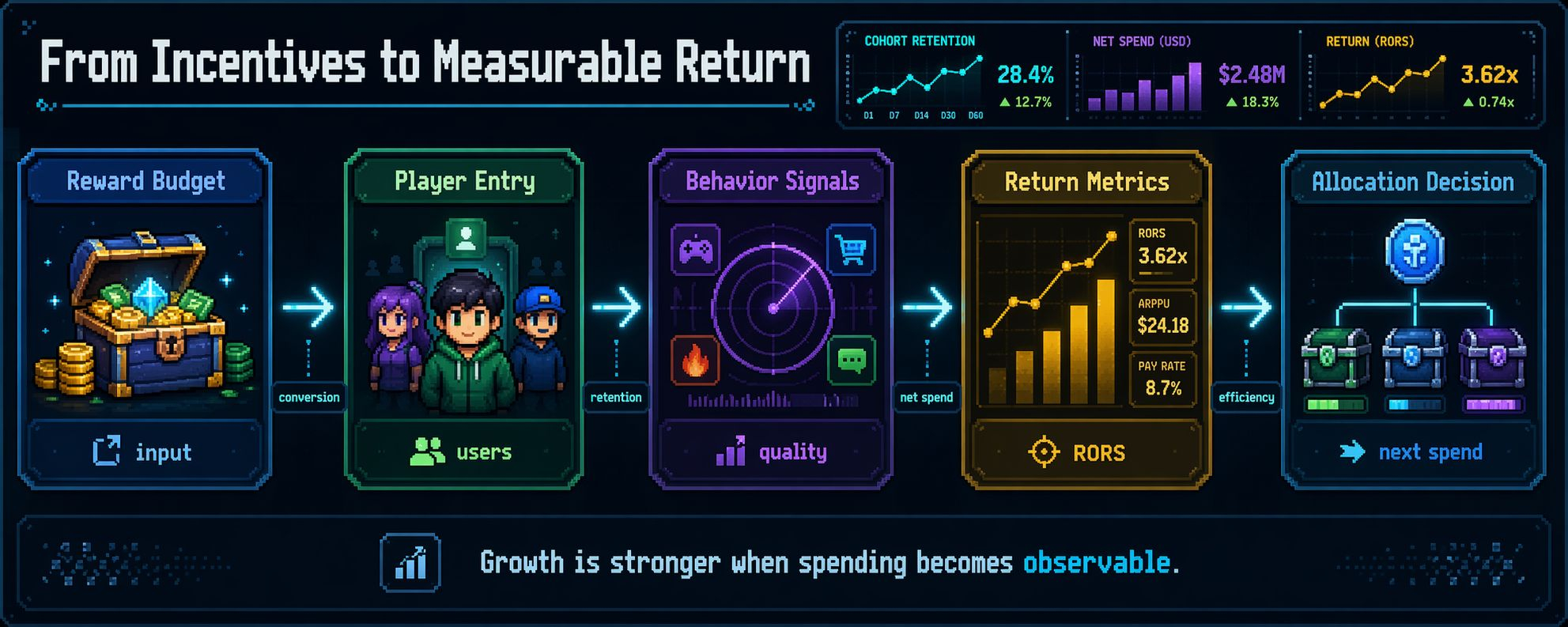
In the docs, player actions are not just treated as gameplay events. They become economic signals. Purchases, quests, trades, and withdrawals feed into a larger system that can be used to understand which users are worth retaining, which games deserve more support, and which reward paths actually improve the ecosystem instead of draining it. That is the logic behind smarter targeting and better allocation in the Pixels model.
Once you see that, the growth story starts to read differently.
PIXEL is not only trying to attract users.
It is trying to audit growth.
To measure whether spend produced value.
To identify whether incentives created retention or just temporary motion.
To make future deployment less dependent on guesswork.
That is a stronger narrative than “rewards bring players.”
Because plenty of systems can buy attention for a while.
Far fewer can learn from the attention they bought.
And that may be the more important ambition here.
The project is gradually moving growth away from the old black-box model and toward something more like performance infrastructure: budget enters the system, incentives are deployed, player behavior is observed, return is measured, and the next round gets adjusted with better information. That interpretation follows closely from the litepaper’s flywheel and the revised vision’s emphasis on data-backed incentives and RORS.
If that works, then PIXEL becomes easier to understand.
Not just as a token.
Not just as a game economy.
But as a framework for asking a more serious question:
Can game growth become measurable enough that the system gets better every time it spends?
That is a much harder model to build.
But it is also a much more durable one than simply paying for activity and hoping the chart looks good.