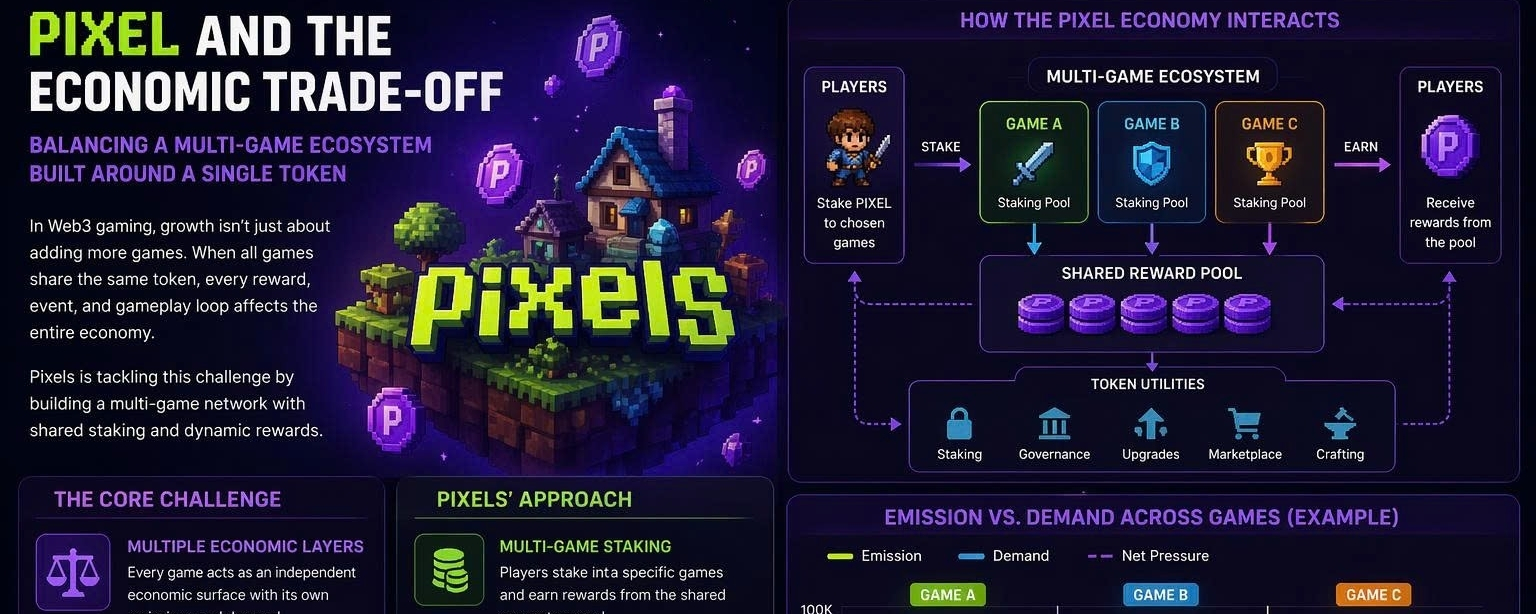

In the world of Web3 gaming, expansion often sounds like a guaranteed win: more games, more players, more value. But when multiple games share a single token, growth stops being just a content problem—it becomes an economic balancing act.
This is exactly where PIXEL stands out.
At first glance, the idea behind Pixels’ ecosystem feels intuitive. Expanding into a multi-game environment should naturally increase utility for the PIXEL token. More games mean more ways to earn, spend, and interact. However, the deeper issue is not how many games exist, but how each one interacts with the shared token economy.
Each game is not just a piece of content—it is an independent economic layer. Every reward system, event, or gameplay loop introduces new token emissions and new forms of demand. When all of these layers feed into the same token pool, the system becomes highly sensitive.
Pixels seems aware of this challenge.
Instead of relying purely on adding use cases, they are introducing a multi-game staking system. Players can stake into specific games, and rewards are distributed based on participation and allocation. In theory, this creates a feedback loop where value flows toward the most active parts of the ecosystem.
It’s a smart idea—but not without risks.
The biggest concern lies in imbalance. If one game becomes significantly more attractive—due to better rewards, stronger growth, or viral adoption—it may attract a disproportionate amount of stake. This leads to higher emissions directed into that game, potentially creating a “winner-takes-most” scenario.
At that point, the system is no longer balanced—it is optimized for efficiency.
And in crypto, users tend to chase efficiency.
This creates a familiar pattern: capital flows toward the highest yield, regardless of long-term sustainability. If left unchecked, even a well-designed multi-game system can drift toward the same cycle seen in earlier GameFi models—farm, sell, repeat.
Still, Pixels is attempting something different.
Rather than operating a single emission loop, they are building a multi-layered economic network. In this structure, token flows are distributed across multiple games, potentially reducing concentrated sell pressure. Staking is not just about locking supply—it becomes a mechanism for shaping user behavior across the ecosystem.
Below is a simple illustration of how emission and demand might vary across games:
Pixel Chart
In this example, you can see how different games may generate different levels of emission and demand. The challenge is ensuring that these differences do not destabilize the overall system.
Because in reality, no economic model is perfectly self-balancing—especially when financial incentives are involved.To make this work, Pixels will need more than just good design. They need continuous data monitoring, adaptive reward mechanisms, and transparent metrics around token supply pressure. Without clear visibility, it becomes difficult to tell whether the system is truly balanced or simply appears stable on the surface.
Ultimately, the shift from a single game to a multi-game ecosystem is not just a content expansion—it is a structural transformation.
Pixels is no longer managing a token inside a game. They are managing an interconnected economy, where every decision in one game can ripple across the entire network.
That is both the opportunity and the risk.
From a conceptual standpoint, the direction is promising. From an execution standpoint, it is complex and uncertain. The success of PIXEL will depend on whether they can maintain economic consistency across multiple layers—not just in theory, but in real-world conditions.
Because in the end, building games is one challenge.
Building a sustainable economic network is something entirely different.