Fogo feels less like a typical crypto launch and more like a reaction to frustration. Anyone who has traded on-chain long enough knows the feeling — waiting for confirmation, refreshing explorers, watching price move while your transaction lingers in limbo. That small delay creates friction, and friction changes outcomes. Fogo is built around the belief that blockchains should not feel slower than the systems they aim to replace. Instead of optimizing for balance across dozens of competing priorities, it narrows its focus to one obsession: latency.
At its foundation, Fogo is fully compatible with the Solana Virtual Machine. That choice is strategic rather than symbolic. By aligning with SVM architecture, Fogo inherits a mature developer ecosystem — smart contracts written in Anchor, SPL token standards, wallet integrations, and parallelized execution logic. Builders who understand Solana’s execution environment do not need to start from zero. They can migrate, extend, and experiment without abandoning familiar tooling. Compatibility here is not about imitation; it is about acceleration.
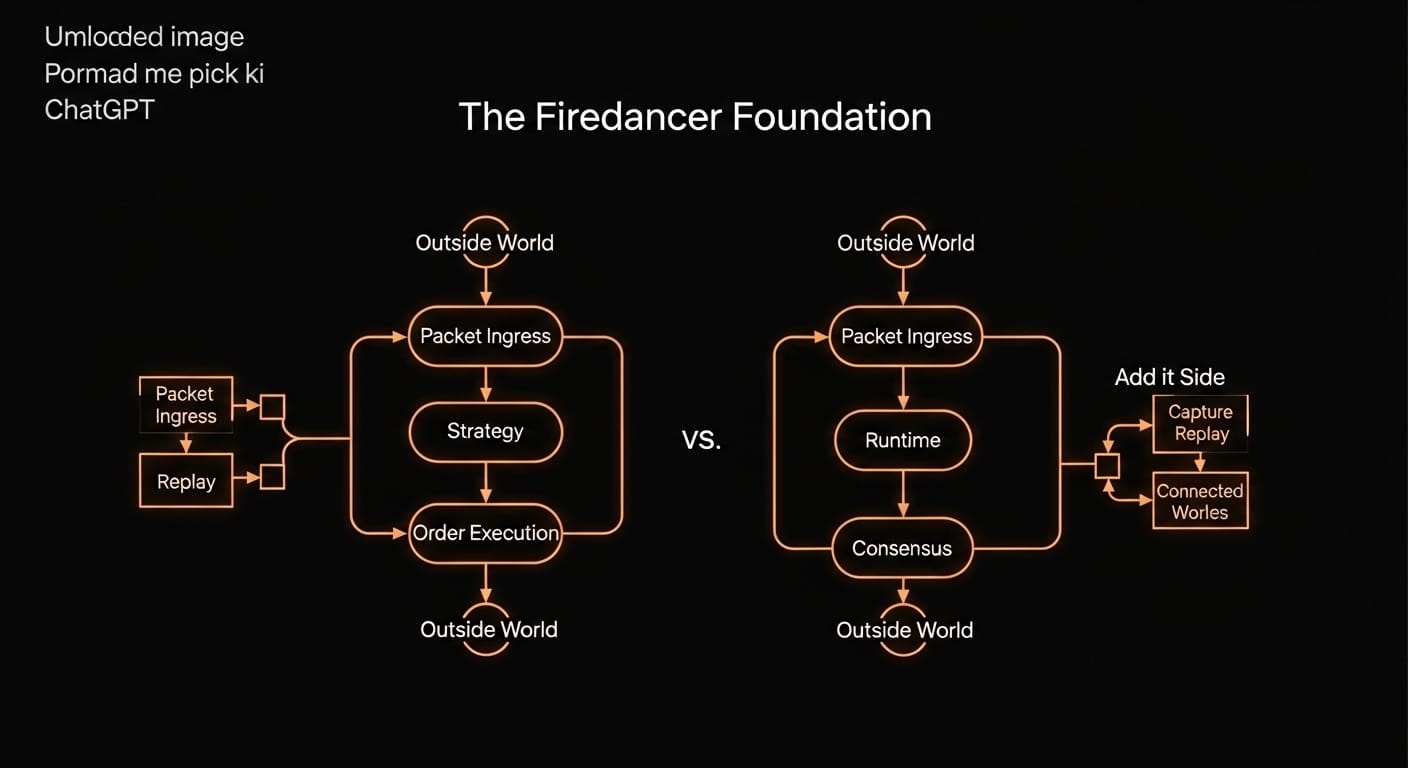
What distinguishes Fogo technically is its aggressive approach to performance engineering. Blocks are targeted at roughly 40 milliseconds, a figure that moves faster than human reaction time. Throughput is engineered at levels that rival the most ambitious Layer-1 claims, and finality is designed to settle transactions in near real time. These metrics are not presented as marketing spectacle but as the result of careful architectural decisions. The network leverages a customized implementation inspired by the Firedancer validator client, focusing on predictable block production, hardware-optimized networking, and highly efficient parallel transaction processing. By standardizing around a single high-performance client rather than juggling multiple heterogeneous implementations, Fogo reduces variability and tightens coordination across validators.
The network design also reflects lessons from traditional finance. Instead of scattering validators randomly across continents in the early stages, infrastructure is strategically colocated near financial hubs and exchange endpoints, particularly across Asia. This approach minimizes communication lag between nodes and aligns the physical network topology with real trading flows. Redundancy exists, but proximity becomes a performance feature. It mirrors how centralized exchanges design their matching engines: speed is achieved not only in software but in geography.
Liquidity strategy reinforces this trading-centric identity. Following its market debut, FOGO expanded across major exchanges including Binance, OKX, Bybit, Bitget, Gate.io, and MEXC. Coordinated listings and liquidity campaigns were not merely about exposure; they were about depth. High-performance infrastructure only matters if capital can flow efficiently through it. To avoid isolation, the mainnet integrated with Wormhole, allowing assets like USDC, SOL, and ETH to move into its ecosystem without friction. This cross-chain connectivity ensures that traders and liquidity providers are not confined to a single-native asset economy.
The implications for decentralized finance are substantial. When execution latency shrinks, entire categories of applications become viable. Real-time decentralized order books begin to feel practical rather than experimental. Liquidations can execute with precision rather than lag-induced slippage. High-frequency market-making strategies, once considered unrealistic on-chain, start to look plausible. The difference between 400 milliseconds and 40 milliseconds may appear trivial in casual use, but in competitive markets it can define profitability. Fogo is built with that reality in mind.
Beyond numbers and benchmarks, there is a philosophical undertone. Many blockchain projects aim to improve incrementally; Fogo attempts to reimagine baseline expectations. It draws from the mindset of engineers who remember how legacy trading engines perform and question why decentralized systems should accept slower standards. That impatience shapes its design decisions. The ambition is not simply to be another Layer-1 with higher theoretical TPS, but to make on-chain finance feel immediate, responsive, and competitive with centralized counterparts.
Challenges remain inevitable. Incentive-driven liquidity must mature into organic usage. Developers must commit long term rather than experiment briefly. Performance under laboratory benchmarks must withstand real economic volatility and congestion. Decentralization trade-offs must evolve responsibly as the network scales. Every high-speed system eventually faces stress, and resilience is measured not in quiet conditions but during turbulence.
Even so, Fogo signals a shift in narrative. It suggests that the future of decentralized infrastructure may not be about adding more features, but about refining execution until the technology disappears into the experience. When users no longer think about confirmation times and traders stop worrying about microsecond disadvantages, the blockchain has done its job. In that sense, Fogo is not merely chasing speed; it is chasing a feeling — the sense that on-chain systems can finally move at the pace of modern markets.