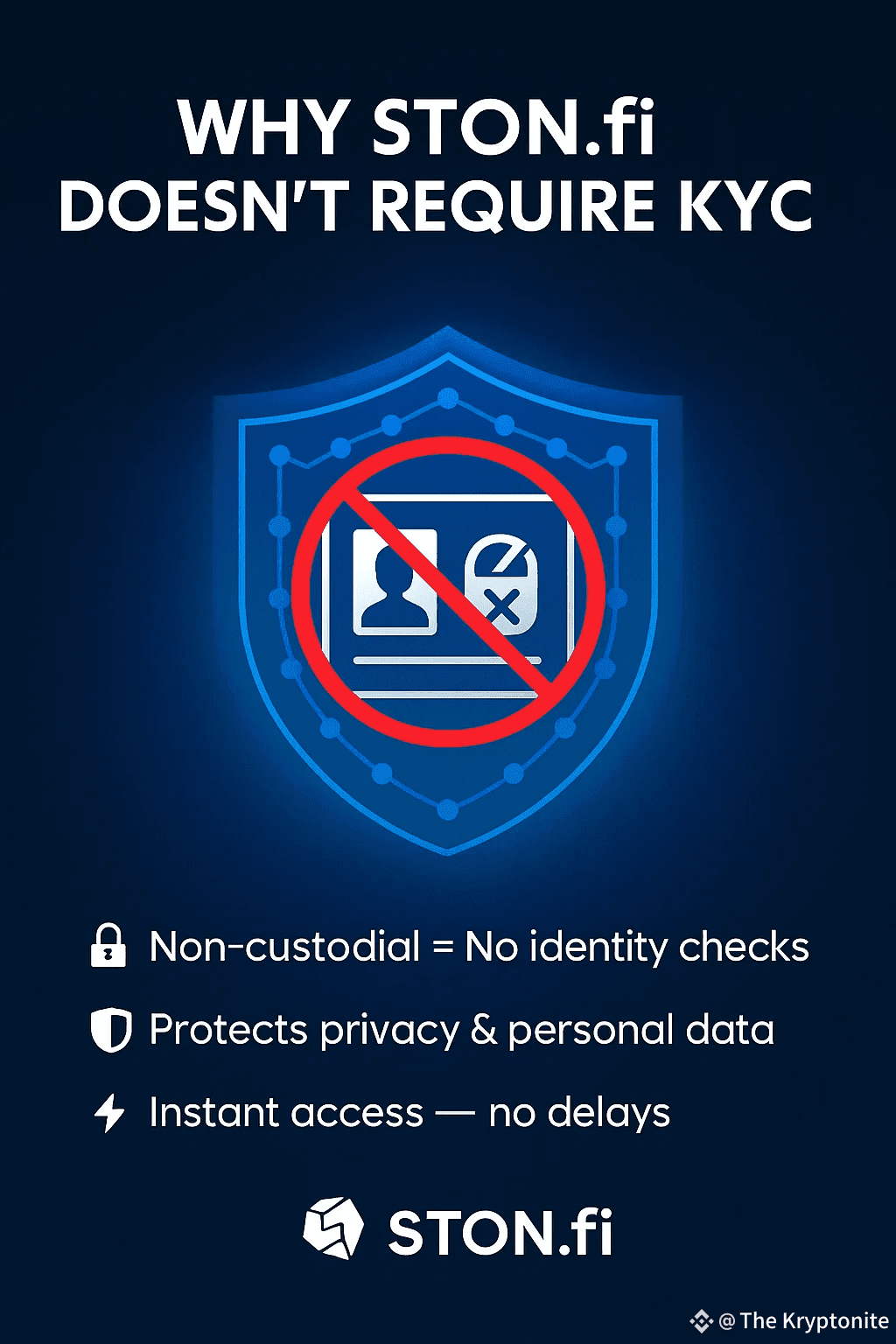
In traditional finance, Know Your Customer (KYC) is everywhere.
Upload your passport, submit a utility bill, wait days to get verified.
Even many crypto platforms now enforce it.
But STON.fi is different.
Here’s why it doesn’t require KYC — and what that means.
1. Trustless by Design
KYC exists to protect custodians.
Banks, CEXs, and custodial services hold your money — which means regulators require them to know who you are.
STON.fi never holds your funds.
Swaps happen peer-to-peer using cryptographic proofs. No custody, no need for identity verification.
2. Legal Positioning
Because STON.fi is non-custodial, it falls outside the same legal frameworks that govern centralized entities.
It’s infrastructure, not an intermediary.
This doesn’t mean it’s lawless — it means it’s architected to avoid the need for invasive data collection in the first place.
3. Privacy as a Feature
KYC exposes users to risk — centralized databases full of personal data are prime targets for hacks.
By not requiring KYC, STON.fi protects users not just financially but also personally.
Your trades are secured on-chain. Your identity stays with you.
4. Implications for the Future
As regulators catch up with DeFi, protocols like STON.fi highlight an important reality:
Security doesn’t come from knowing names and passports, It comes from removing trust points altogether
STON.fi’s model may well become the blueprint for how compliant yet privacy-preserving DeFi evolves. #MarketPullback