
AbdullRauf
8.2k منشورات

AbdullRauf
 تم التحقُّق من Square
Hi Guys i am Spot trader specialist in Intra Daytrade, DCA and Swing trade. Follow me tostay updated about market and Binance reward Campaigns.
فتح تداول
مُتداول بمُعدّل مرتفع
1.3 سنوات
1.1K+ تتابع
30.5K+ المتابعون
27.3K+ إعجاب
منشورات
الحافظة الاستثمارية
الكل
اقتباسات
مقاطع فيديو
Live
PINNED
GIVEAWAY ALERT 🧧
We're giving away 2000 gifts to our Square Family as a huge thank you for your support!
To Enter:
✅ Follow
✅ Share this post
✅ Comment "666 !"
Random winners will be selected. Good luck, everyone! 🚀
We're giving away 2000 gifts to our Square Family as a huge thank you for your support!
To Enter:
✅ Follow
✅ Share this post
✅ Comment "666 !"
Random winners will be selected. Good luck, everyone! 🚀

PINNED
تمّ التحقق
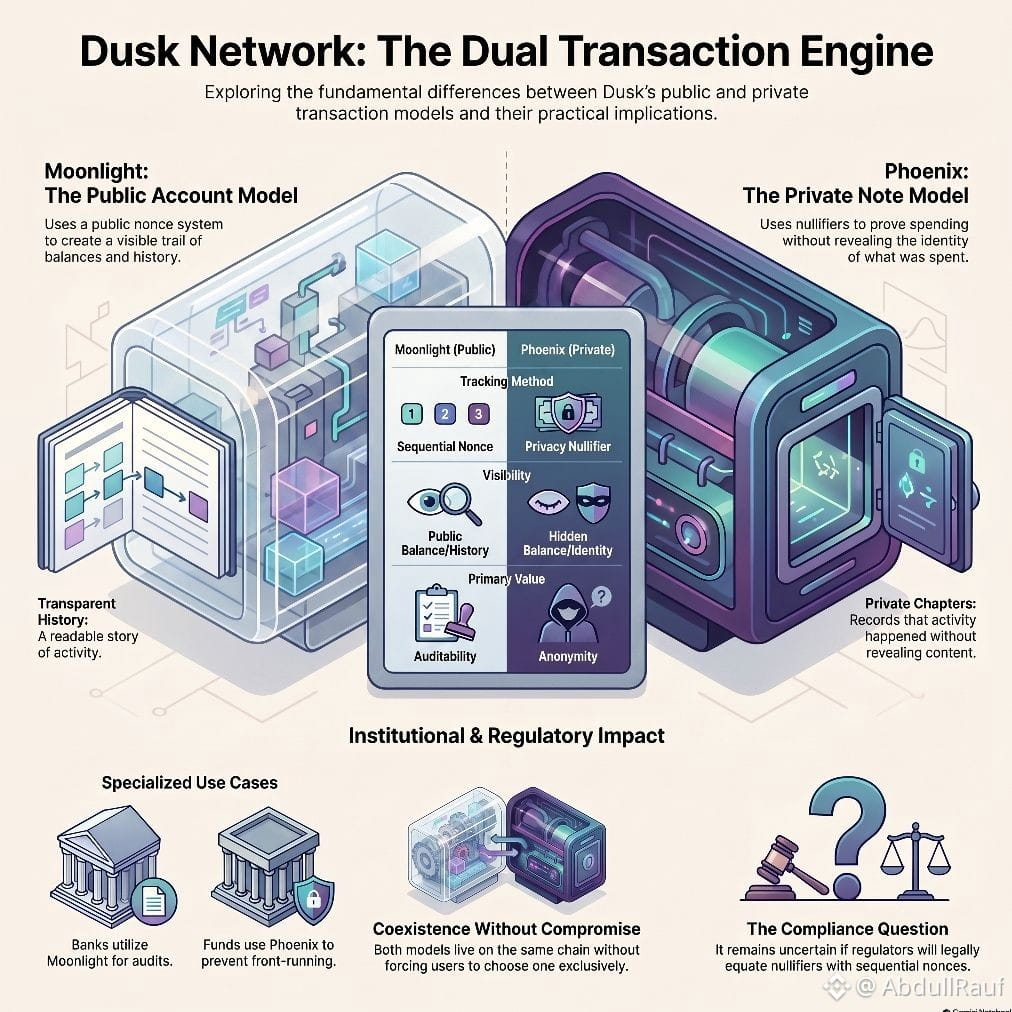
At first I assumed the two transaction models on Dusk were just a privacy toggle. Public or private. One switch. Simple choice.
The actual difference runs deeper than that.
Moonlight works like Ethereum. Your account has a nonce. Every transaction increments it publicly. Anyone can see your balance, your history, your sequence. The nonce is a counter. It is also a trail.
Phoenix works differently. There is no account. No visible balance. No sequential counter. Instead, when you spend a note, you produce a nullifier. The network records that nullifier and knows the note is gone. But it cannot link the nullifier back to the note it came from. The spending is provable. The identity of what was spent is not.
That distinction matters more than it sounds. In Moonlight, your transaction history is a readable story. In Phoenix, the network knows chapters are being written without knowing what they say.
What I keep thinking about is which institutions actually want which model. A bank processing a settlement might need Moonlight for audit trails. A fund executing a strategy might need Phoenix to avoid front-running. Both can live on the same chain. Neither forces the other to compromise.
What I cannot find in the documentation is how regulators treat nullifiers as evidence. A nonce proves sequence. A nullifier proves spending without revealing the note. Are those legally equivalent in a compliance context?
What do you think — when a regulator asks for proof of transaction, does a nullifier satisfy the requirement or does it just raise a harder question?
#dusk $DUSK @Dusk
The actual difference runs deeper than that.
Moonlight works like Ethereum. Your account has a nonce. Every transaction increments it publicly. Anyone can see your balance, your history, your sequence. The nonce is a counter. It is also a trail.
Phoenix works differently. There is no account. No visible balance. No sequential counter. Instead, when you spend a note, you produce a nullifier. The network records that nullifier and knows the note is gone. But it cannot link the nullifier back to the note it came from. The spending is provable. The identity of what was spent is not.
That distinction matters more than it sounds. In Moonlight, your transaction history is a readable story. In Phoenix, the network knows chapters are being written without knowing what they say.
What I keep thinking about is which institutions actually want which model. A bank processing a settlement might need Moonlight for audit trails. A fund executing a strategy might need Phoenix to avoid front-running. Both can live on the same chain. Neither forces the other to compromise.
What I cannot find in the documentation is how regulators treat nullifiers as evidence. A nonce proves sequence. A nullifier proves spending without revealing the note. Are those legally equivalent in a compliance context?
What do you think — when a regulator asks for proof of transaction, does a nullifier satisfy the requirement or does it just raise a harder question?
#dusk $DUSK @Dusk
bilverse
Bilverse
·
--
🚨 WHO WANTS TO WAKE UP TO FREE ETH? 👀
One community. One mission. One chance to be part of the ETH giveaway. 💎🚀
#Bilverse is making noise — and your ETH reward could be waiting. 👀
👇 Want to claim a portion of ETH?
💬 Comment “ETH” below to claim your reward! 🎁
The Bilverse Army is growing. 🟡
Click here to DOUBLE your Rewards! 🧧🚀
Are you in?
#ETH #RedPacketMission #CryptoGiveaway #CryptoCommunity
One community. One mission. One chance to be part of the ETH giveaway. 💎🚀
#Bilverse is making noise — and your ETH reward could be waiting. 👀
👇 Want to claim a portion of ETH?
💬 Comment “ETH” below to claim your reward! 🎁
The Bilverse Army is growing. 🟡
Click here to DOUBLE your Rewards! 🧧🚀
Are you in?
#ETH #RedPacketMission #CryptoGiveaway #CryptoCommunity

go

阿尔法灰
·
--
صاعدHello guys let's share some🎁🎁🫂 reward to grab the reward you just need to hit the like and comment button go go before it's too late 🎉🎉😻😻
$BMT $TMX $EDEN
#USIranReportedlyReachCeasefireConsensus
#HKJulyGoldNetExportsToMainland56.193Tons
#JapanNoAdditionalOilReserveReleaseInSepOct
#Binance
$BMT $TMX $EDEN
#USIranReportedlyReachCeasefireConsensus
#HKJulyGoldNetExportsToMainland56.193Tons
#JapanNoAdditionalOilReserveReleaseInSepOct
#Binance
Ayan

Ayan -X
·
--
🔥 Engage & Claim Your Reward!
Like ❤️ Comment 💬 Repost 🔄
Complete the tasks and claim your reward 🎁
Don’t miss out. Let’s support each other and grow together! 🚀
Like ❤️ Comment 💬 Repost 🔄
Complete the tasks and claim your reward 🎁
Don’t miss out. Let’s support each other and grow together! 🚀
1688

静心1688
·
--
💥祸兮福之所倚,福兮祸之所伏。
💥祸福互相依存、可以转化,低谷不必绝望,顺境不可骄纵。
#美比特币ETF连续六日净流入 #加密恐惧贪婪指数升至74
💥祸福互相依存、可以转化,低谷不必绝望,顺境不可骄纵。
#美比特币ETF连续六日净流入 #加密恐惧贪婪指数升至74

rain

幸运雨Rain
·
--
☕午后慢叙,在喧嚣行情里寻一份内心的松弛🍃。
交易不是不停歇的来回出击📈,
学会适度停下,也是一种高级的取舍🕯️。
看多不代表就要进场,看好不必急于重仓🧭。
外界的喧嚣起伏,不该左右自己的判断🌿。
守住认知边界,拒绝被情绪推着做决定✨。
把心态稳住,把节奏放慢,好机会值得耐心等候💫。
愿我们沉心蓄力,从容应对市场的起起落落🕊️。
#比特币64亿美元期权将到期
交易不是不停歇的来回出击📈,
学会适度停下,也是一种高级的取舍🕯️。
看多不代表就要进场,看好不必急于重仓🧭。
外界的喧嚣起伏,不该左右自己的判断🌿。
守住认知边界,拒绝被情绪推着做决定✨。
把心态稳住,把节奏放慢,好机会值得耐心等候💫。
愿我们沉心蓄力,从容应对市场的起起落落🕊️。
#比特币64亿美元期权将到期

Sara

Sara_ k
·
--
click here 👈
.
.
$BNB $GIGGLE $AMZN
Join & claim web3 benefits 🌹👈
.
.
$BNB $GIGGLE $AMZN
Join & claim web3 benefits 🌹👈
leo

Leo - F0
·
--
صاعد🔥🧧🧧RED PACKAGE SEASON🧧🧧🔥
"Throw your worries from the highest floor,
Chasing the empire that is opening the door."
$BTC 🔥🔥🧧🧧 #Dubai_Crypto_Group
#金价升破4400美元创两月高
$BNB $ETH
#1688家族family 💚 @周周1688
#IranSaysHormuzOmanDealNotFinalized #XRPRallies44%InAWeek
"Throw your worries from the highest floor,
Chasing the empire that is opening the door."
$BTC 🔥🔥🧧🧧 #Dubai_Crypto_Group
#金价升破4400美元创两月高
$BNB $ETH
#1688家族family 💚 @周周1688
#IranSaysHormuzOmanDealNotFinalized #XRPRallies44%InAWeek

tapu13

Tapu13
·
--
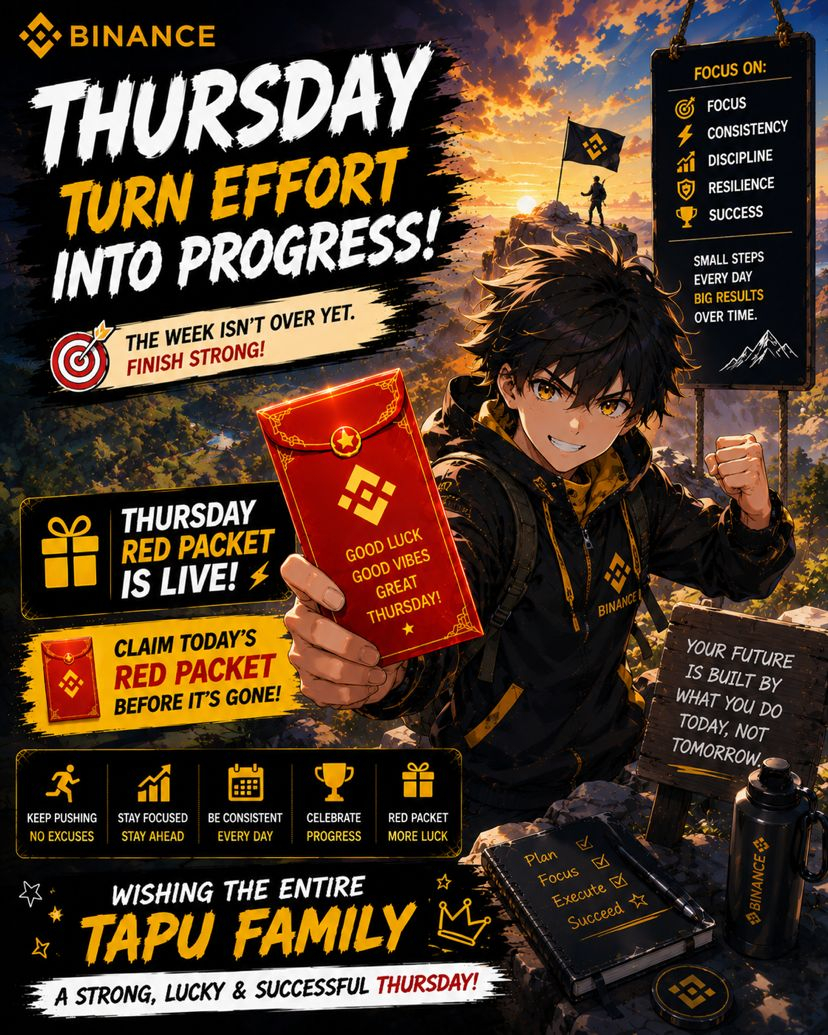
🏆 THURSDAY — TURN EFFORT INTO PROGRESS⚡
The weekend is getting closer, but the mission isn’t over. Keep your focus, stay consistent, and make today’s effort count.
🎁 Thursday Red Packet is LIVE
Claim today’s Red Packet before it’s gone and carry that winning energy into the final stretch of the week. 🧧🍀
Keep pushing. Keep growing. Keep moving forward. 💛
Wishing the entire Tapu Family a strong, lucky & successful Thursday 🚀
The weekend is getting closer, but the mission isn’t over. Keep your focus, stay consistent, and make today’s effort count.
🎁 Thursday Red Packet is LIVE
Claim today’s Red Packet before it’s gone and carry that winning energy into the final stretch of the week. 🧧🍀
Keep pushing. Keep growing. Keep moving forward. 💛
Wishing the entire Tapu Family a strong, lucky & successful Thursday 🚀
go

凯哥的进击
·
--
هابط🎁🎁关注我,回复领红包🎁🎁$SOL
🌹转发分享发大财🌹
🌹转发分享发大财🌹

DK

DK短线复刻
·
--
关注回复领取红包🎁🎁

RCB

RCB signal
·
--
Join & claim Web3 benefits 👈🎁
.
$SUI $ADA $XRP
.
$SUI $ADA $XRP

Ahmed

Ahmed Ali Nizamani
·
--
454 + 444 = 🎁🎁🎁🎁🎁✅

chu

CHU CHU 53
·
--
🎁 RED PACKET GIVEAWAY! 🧧
A little surprise for the Binance community! ❤️
I’m giving away Red Packets to a few lucky people. 🧧✨
How to join: 👉 Like ❤️ 👉 Follow me 👉 Drop a comment below: “ hi 🧧”
Good luck everyone! 🍀
May the red packet find you! 🚀
A little surprise for the Binance community! ❤️
I’m giving away Red Packets to a few lucky people. 🧧✨
How to join: 👉 Like ❤️ 👉 Follow me 👉 Drop a comment below: “ hi 🧧”
Good luck everyone! 🍀
May the red packet find you! 🚀

syco

Syco 疯子
·
--
💖😘 𝐌𝐀𝐆𝐈𝐂 𝐒𝐔𝐑𝐏𝐑𝐈𝐒𝐄 😘💖
𝐖𝐚𝐫𝐦𝐥𝐲✨
𝐒𝐲𝐜𝐨 😘💖
$BNB
𝐖𝐚𝐫𝐦𝐥𝐲✨
𝐒𝐲𝐜𝐨 😘💖
$BNB

suadagar

Suadagar Ali
·
--
#BNB $
follow ☘️🥀🌹like
comments repost
follow ☘️🥀🌹like
comments repost

Privacy bolted onto EVM is not the same as privacy built in from day one.#dusk
AbdullRauf
·
--
At first I assumed adding privacy to an EVM environment was the same as building privacy from the start. From the outside the two look similar. On the inside they are not.
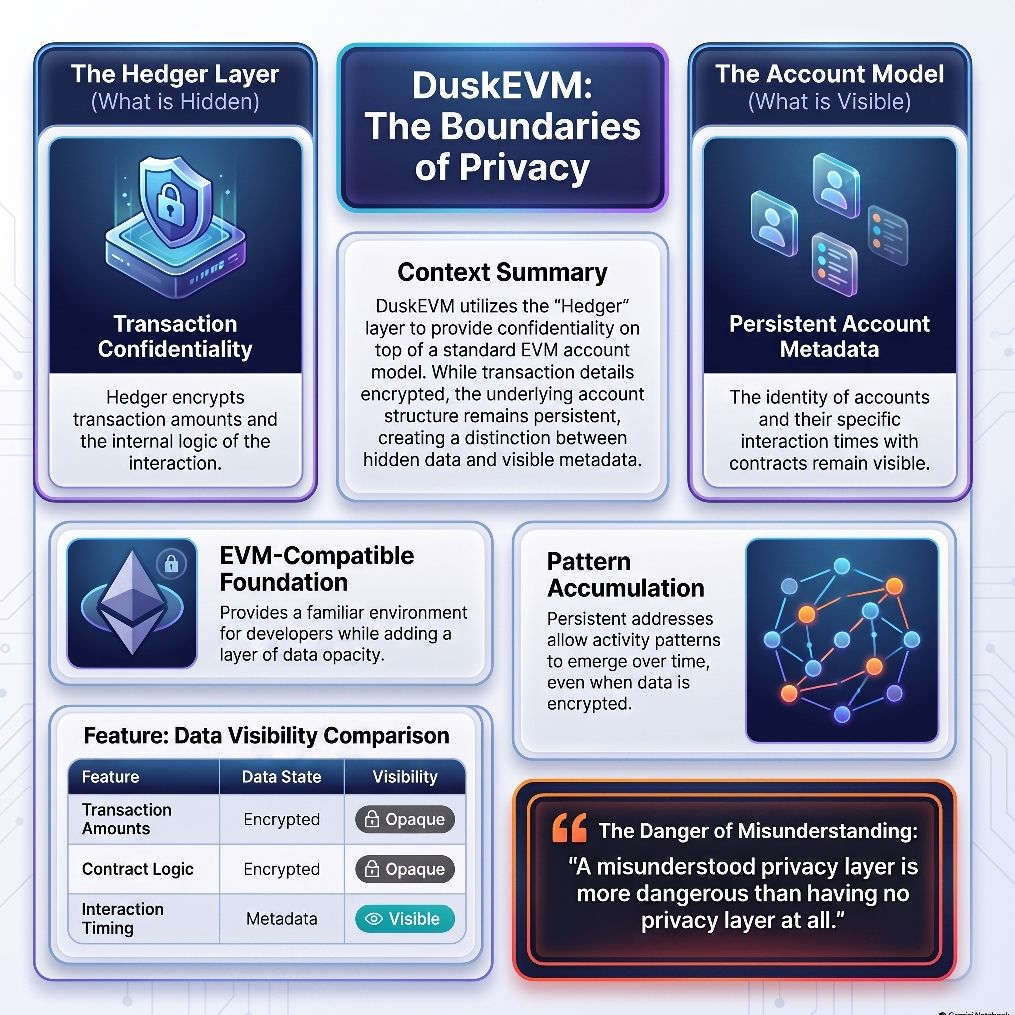
The EVM account model carries a structural assumption. Addresses persist. Activity accumulates. Even when individual transactions are encrypted, the account itself becomes a pattern over time. Hedger adds confidentiality on top of that model. Transaction data can become opaque. The account structure remains visible.
So the real question is narrower. When Hedger encrypts a transaction, what exactly is hidden and what is not? Amounts and internal logic may stay private. The fact that this account interacted with this contract at this time is often still visible. In regulated finance, who traded with whom and when can matter as much as what they traded.
This is not a flaw in the design. Account-based EVM is practical for developers. Hedger is a real privacy layer. The risk is misunderstanding. A privacy layer that people overestimate can be more dangerous than no privacy layer at all.
Does transaction-level confidentiality give institutions enough protection, or does the account model underneath quietly limit the whole promise?
#dusk $DUSK @Dusk
The EVM account model carries a structural assumption. Addresses persist. Activity accumulates. Even when individual transactions are encrypted, the account itself becomes a pattern over time. Hedger adds confidentiality on top of that model. Transaction data can become opaque. The account structure remains visible.
So the real question is narrower. When Hedger encrypts a transaction, what exactly is hidden and what is not? Amounts and internal logic may stay private. The fact that this account interacted with this contract at this time is often still visible. In regulated finance, who traded with whom and when can matter as much as what they traded.
This is not a flaw in the design. Account-based EVM is practical for developers. Hedger is a real privacy layer. The risk is misunderstanding. A privacy layer that people overestimate can be more dangerous than no privacy layer at all.
Does transaction-level confidentiality give institutions enough protection, or does the account model underneath quietly limit the whole promise?
#dusk $DUSK @Dusk
تمّ التحقق
I used to look at a new consensus design and ask one question first. How does an attacker break this?
Studying Dusk changed that habit. With Succinct Attestation, a different scenario appears. Imagine you are already selected to generate a block in a later iteration. You are also voting on the current one. Do you help the current block succeed and take the voter reward, or stay quiet so the iteration fails and your future generator position improves?
That is the Future Generator Incentive Problem. It does not come from outside. It comes from the incentives available to a legitimate participant.
Dusk’s response was to reshape those incentives. Separate generator and voter rewards. Exclude the next-iteration generator from current voting. Limit how many iterations can run.
There is a trade-off. Every extra incentive rule adds another assumption that still needs to hold under pressure.
The real game underneath the cryptography is whether the most rational move stays the honest one.
#dusk $DUSK @Dusk
Studying Dusk changed that habit. With Succinct Attestation, a different scenario appears. Imagine you are already selected to generate a block in a later iteration. You are also voting on the current one. Do you help the current block succeed and take the voter reward, or stay quiet so the iteration fails and your future generator position improves?
That is the Future Generator Incentive Problem. It does not come from outside. It comes from the incentives available to a legitimate participant.
Dusk’s response was to reshape those incentives. Separate generator and voter rewards. Exclude the next-iteration generator from current voting. Limit how many iterations can run.
There is a trade-off. Every extra incentive rule adds another assumption that still needs to hold under pressure.
The real game underneath the cryptography is whether the most rational move stays the honest one.
#dusk $DUSK @Dusk

$DUSK Is Down 93%… Yet Holding Partnerships and a €200M+ Issuance Pipeline Most Protocols at This Price Don’t Have
AbdullRauf
·
--
Spent time trying to read two signals that point in different directions. The price is down ninety-three percent from its all-time high. The NPEX partnership is live. A confirmed issuance pipeline of over two hundred million euros exists. The Boreas upgrade shipped in May. Those two pictures do not belong to the same narrative. One suggests a project that failed to hold its launch momentum. The other suggests a project that kept building while the price declined. Infrastructure tokens have a timing problem that equity markets do not. A company's stock price and its revenue usually move in the same direction over time. A protocol's token price and its actual usage can diverge for years. The price reflects what traders think today. The usage reflects what institutions decided months ago. What I cannot reconcile is the gap between the confirmed issuance number and the daily trading volume. Two hundred million euros in pipeline against three and a half million in daily volume is a wide distance. Either the issuance has not reached the chain yet or volume is not the right measure. @Dusk has partnerships that most protocols at this price would not. Whether that eventually shows up in the price or just in the history books is the question price charts were never designed to answer. When price and adoption diverge this far, which one is lying?
#dusk $DUSK @Dusk
#dusk $DUSK @Dusk
سجّل الدخول لاستكشاف المزيد من المُحتوى