
@Yield Guild Games (YGG) has emerged as one of the most resilient and evolving projects in the Web3 gaming ecosystem. Founded as a decentralized gaming guild, YGG initially gained attention for its play-to-earn model, where players could earn income through NFT-backed gaming assets. Over time, the project has transformed into a hybrid of a gaming publisher, developer, and decentralized guild — a shift that positions it for long-term growth in 2025 and beyond.
1. Evolution of YGG: From NFT Guild to Game Developer
YGG originally functioned like a decentralized autonomous organization (DAO) that acquired NFT assets across blockchain games. These assets were lent to players (“scholars”) who generated yield for the guild.
But the model has expanded significantly. Today, YGG operates as:
A guild that still supports Web3 players
A game publisher launching titles for crypto-native communities
A developer building its own Web3 games
A creator ecosystem supporting artists, builders, and contributors
This evolution gives YGG complete control over gameplay, revenue funnels, user growth, and token utility — a major advantage over guilds that rely only on external game economies.
2. Governance, Staking & Utility: Strengthening Community Ownership
The YGG token remains central to the platform’s governance. Token holders can:
Stake YGG to earn rewards from ecosystem activities
Gain access to exclusive in-game events, content, and merchandise
Participate in DAO voting
Use YGG as a payment asset within the ecosystem
This structure creates an economic loop where community contribution is rewarded and platform growth aligns with token-holder incentives.
3. Strong Technical Development: Ethereum–Polygon Cross-Chain Bridge
One of YGG’s most important technical upgrades is the integration between Ethereum and Polygon. This gives players:
Ethereum-level security (13–15 TPS, $5–$20 gas fees)
Polygon-level speed (7,000+ TPS, < $0.01 fees)
The bridge enables:
Faster, cheaper in-game transactions
Multi-chain NFT accessibility
Increased asset liquidity
More affordable onboarding for global players
Cross-chain NFTs allow value to flow across networks — a key driver of adoption and past price surges for YGG.
4. Ecosystem Growth & Developer Funding
YGG maintains a $7.5 million ecosystem pool dedicated to:
Supporting game developers
Funding new titles
Expanding on-chain reputation systems
Strengthening community guilds worldwide
This pool acts as long-term fuel for YGG’s multi-chain gaming economy.
5. LOL Land: YGG’s Breakout Success in 2025
A major milestone came in 2025 with YGG’s first self-developed game, LOL Land, achieving:
$1 million monthly revenue
600,000+ monthly active users (MAU)
~69,000 daily active users (DAU)
This proves that YGG is no longer just a guild — it is a profitable gaming studio.
LOL Land’s success enabled:
A $500,000 token buyback in August 2025
Strengthening of the project’s treasury
Increased token utility
Greater long-term investor confidence
For the first time, YGG is generating recurring income independent of market conditions.
6. Market Performance & Challenges in 2025
Despite strong fundamentals, YGG faces significant market challenges:
In October 2025, the token dropped from $0.17 to $0.11 in a single day
Bearish sentiment continues to weigh on gaming tokens
YGG struggles to break key resistance levels
Year-to-date performance remains negative due to overall market weakness
These short-term issues reflect broader crypto uncertainty — not weaknesses in YGG’s model.
7. Long-Term Outlook: Why Analysts Remain Bullish
Even with volatility, analysts see YGG as a strong long-term bet due to:
Sustainable revenue from game development
Multi-game expansion potential
Strong community engagement
Powerful cross-chain infrastructure
Recurring staking incentives
Growing global user base
Some long-term projections estimate YGG above $20 by 2030, assuming the Web3 gaming market matures and multiplies in size.
8. What Makes YGG Different From Other Web3 Gaming Projects
YGG stands out because it is:
✔ A guild
connecting players worldwide and rewarding participation
✔ A game developer
creating titles like LOL Land that generate real revenue
✔ A publisher
supporting creators and independent developers
✔ A DAO-driven ecosystem
that distributes governance power to its community
✔ A cross-chain infrastructure provider
bridging assets between Ethereum and Polygon
This unique combination gives YGG a diversified business model — rare in Web3 gaming.
9. The Foundation for Long-Term Growth
YGG’s future growth is supported by:
Global guild expansion
Strong governance mechanics
NFT interoperability
New games in development
Treasury management and buybacks
An engaged player community
A developer-friendly ecosystem
Seamless low-cost transactions on Polygon
Revenue from LOL Land proves that YGG can generate real economic value — a major validation of its model.
Conclusion: YGG’s Future Looks Promising
Yield Guild Games is no longer just an NFT guild — it is a Web3 gaming ecosystem powered by community governance, technical innovation, and sustainable revenue.
In 2025, the fundamentals remain strong:
Cross-chain infrastructure
Growing global community
Successful game development
Treasury growth and token buybacks
Ongoing ecosystem expansion
Short-term market volatility is real, but long-term prospects remain highly positive. YGG is building a foundation that could make it one of the most influential players in blockchain gaming over the next decade.
For players, developers, and investors looking to tap into Web3 gaming, YGG remains one of the most compelling opportunities in the space.
@YieldGuildGames #YGG
YGGUSDT Perp
0.0764 (-2.67%)
Yield Guild Games (YGG) has emerged as one of the most resilient and evolving projects in the Web3 gaming ecosystem. Founded as a decentralized gaming guild, YGG initially gained attention for its play-to-earn model, where players could earn income through NFT-backed gaming assets. Over time, the project has transformed into a hybrid of a gaming publisher, developer, and decentralized guild — a shift that positions it for long-term growth in 2025 and beyond
1. Evolution of YGG: From NFT Guild to Game Developer
YGG originally functioned like a decentralized autonomous organization (DAO) that acquired NFT assets across blockchain games. These assets were lent to players (“scholars”) who generated yield for the guild.
But the model has expanded significantly. Today, YGG operates as:
A guild that still supports Web3 players
A game publisher launching titles for crypto-native communities
A developer building its own Web3 games
A creator ecosystem supporting artists, builders, and contributors
This evolution gives YGG complete control over gameplay, revenue funnels, user growth, and token utility — a major advantage over guilds that rely only on external game economies
2. Governance, Staking & Utility: Strengthening Community Ownership
The YGG token remains central to the platform’s governance. Token holders can:
Stake YGG to earn rewards from ecosystem activities
Gain access to exclusive in-game events, content, and merchandise
Participate in DAO voting
Use YGG as a payment asset within the ecosystem
This structure creates an economic loop where community contribution is rewarded and platform growth aligns with token-holder incentives
3. Strong Technical Development: Ethereum–Polygon Cross-Chain Bridge
One of YGG’s most important technical upgrades is the integration between Ethereum and Polygon. This gives players:
Ethereum-level security (13–15 TPS, $5–$20 gas fees)
Polygon-level speed (7,000+ TPS, < $0.01 fees)
The bridge enables:
Faster, cheaper in-game transactions
Multi-chain NFT accessibility
Increased asset liquidity
More affordable onboarding for global players
Cross-chain NFTs allow value to flow across networks — a key driver of adoption and past price surges for YGG.
4. Ecosystem Growth & Developer Funding
YGG maintains a $7.5 million ecosystem pool dedicated to:
Supporting game developers
Funding new titles
Expanding on-chain reputation systems
Strengthening community guilds worldwide
This pool acts as long-term fuel for YGG’s multi-chain gaming economy.
5. LOL Land: YGG’s Breakout Success in 2025
A major milestone came in 2025 with YGG’s first self-developed game, LOL Land, achieving:
$1 million monthly revenue
600,000+ monthly active users (MAU)
~69,000 daily active users (DAU)
This proves that YGG is no longer just a guild — it is a profitable gaming studio.
LOL Land’s success enabled:
A $500,000 token buyback in August 2025
Strengthening of the project’s treasury
Increased token utility
Greater long-term investor confidence
For the first time, YGG is generating recurring income independent of market conditions.
6. Market Performance & Challenges in 2025
Despite strong fundamentals, YGG faces significant market challenges:
In October 2025, the token dropped from $0.17 to $0.11 in a single day
Bearish sentiment continues to weigh on gaming tokens
YGG struggles to break key resistance levels
Year-to-date performance remains negative due to overall market weakness
These short-term issues reflect broader crypto uncertainty — not weaknesses in YGG’s model.
7. Long-Term Outlook: Why Analysts Remain Bullish
Even with volatility, analysts see YGG as a strong long-term bet due to:
Sustainable revenue from game development
Multi-game expansion potential
Strong community engagement
Powerful cross-chain infrastructure
Recurring staking incentives
Growing global user base
Some long-term projections estimate YGG above $20 by 2030, assuming the Web3 gaming market matures and multiplies in size.
8. What Makes YGG Different From Other Web3 Gaming Projects
YGG stands out because it is:
✔ A guild
connecting players worldwide and rewarding participation
✔ A game developer
creating titles like LOL Land that generate real revenue
✔ A publisher
supporting creators and independent developers
✔ A DAO-driven ecosystem
that distributes governance power to its community
✔ A cross-chain infrastructure provider
bridging assets between Ethereum and Polygon
This unique combination gives YGG a diversified business model — rare in Web3 gaming.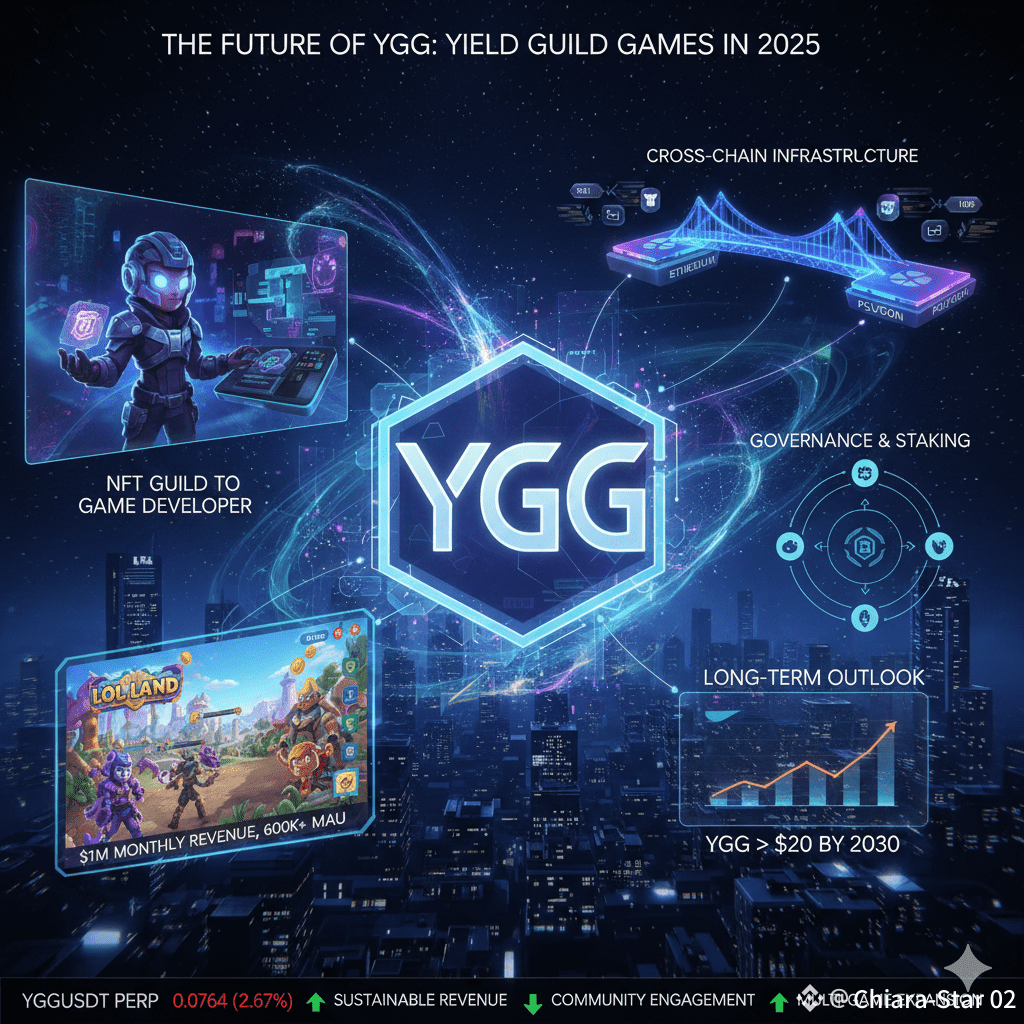
9. The Foundation for Long-Term Growth
YGG’s future growth is supported by:
Global guild expansion
Strong governance mechanics
NFT interoperability
New games in development
Treasury management and buybacks
An engaged player community
A developer-friendly ecosystem
Seamless low-cost transactions on Polygon
Revenue from LOL Land proves that YGG can generate real economic value — a major validation of its model.
Conclusion: YGG’s Future Looks Promising
Yield Guild Games is no longer just an NFT guild — it is a Web3 gaming ecosystem powered by community governance, technical innovation, and sustainable revenue.
In 2025, the fundamentals remain strong:
Cross-chain infrastructure
Growing global community
Successful game development
Treasury growth and token buybacks
Ongoing ecosystem expansion
Short-term market volatility is real, but long-term prospects remain highly positive. YGG is building a foundation that could make it one of the most influential players in blockcha
in gaming over the next decade.
For players, developers, and investors looking to tap into Web3 gaming, YGG remains one of the most compelling opportunities in the space.
YGGUSDT Perp
0.0764 (-2.67%)
