
fairytrail
5.9k منشورات

fairytrail
it takes courage to bloom .
فتح تداول

حائز على DUSK
مُتداول مُتكرر
1.1 سنوات
580 تتابع
21.5K+ المتابعون
19.9K+ إعجاب
منشورات
الحافظة الاستثمارية
الكل
اقتباسات
مقاطع فيديو
Live
What catches me about Dusk's transfer contract isn't the transfer — it's that the same infrastructure prices the work a transaction causes. Fees aren't a flat toll bolted onto execution; they're gas_used times gas_price, paid in DUSK, priced in LUX. Even a reverted transaction still pays for gas it burned — cost tracks work attempted, not completed.
I think that's the right call: treat computation as free and you invite congestion. Dusk even filters underfunded transactions via a minimum gas limit before they touch node resources, rather than letting them fail mid-execution.
Here's the tension, as I see it: the more expressive a transaction gets, the harder its cost is to predict — and predictability is what makes a fee model legible to a non-technical user.
What I keep noticing is that Dusk already lets contracts absorb gas on a user's behalf. That doesn't resolve the tension, it just relocates it, from wallet to app.
$DUSK @Dusk #dusk
$BMT
$STAR
I think that's the right call: treat computation as free and you invite congestion. Dusk even filters underfunded transactions via a minimum gas limit before they touch node resources, rather than letting them fail mid-execution.
Here's the tension, as I see it: the more expressive a transaction gets, the harder its cost is to predict — and predictability is what makes a fee model legible to a non-technical user.
What I keep noticing is that Dusk already lets contracts absorb gas on a user's behalf. That doesn't resolve the tension, it just relocates it, from wallet to app.
$DUSK @Dusk #dusk
$BMT
$STAR
I assumed Phoenix worked like most shielded systems: verify the math, then encrypt away who did it separately. Looking closer, I don't think that separation exists.
As I read it: ownership, sender authorship, and balance correctness aren't checked and then hidden — they're proven inside the same circuit that proves the transaction valid. The network isn't masking a visible transaction; it's checking a proof that never carried visible data, and that alone confirms nothing was double-spent or forged.
That's what changes my read on compliance. If visibility was never required for correctness, a viewing key isn't unlocking hidden truth — it's granting permission to look at something already verified. Disclosure stops being a cryptography question and becomes a governance one, decided by the keyholder.
When a regulator checks a transaction with a viewing key, I keep wondering: are they verifying anything the chain hadn't already, or just being let into a locked room?
$DUSK @Dusk #dusk
$PROM $UAI
As I read it: ownership, sender authorship, and balance correctness aren't checked and then hidden — they're proven inside the same circuit that proves the transaction valid. The network isn't masking a visible transaction; it's checking a proof that never carried visible data, and that alone confirms nothing was double-spent or forged.
That's what changes my read on compliance. If visibility was never required for correctness, a viewing key isn't unlocking hidden truth — it's granting permission to look at something already verified. Disclosure stops being a cryptography question and becomes a governance one, decided by the keyholder.
When a regulator checks a transaction with a viewing key, I keep wondering: are they verifying anything the chain hadn't already, or just being let into a locked room?
$DUSK @Dusk #dusk
$PROM $UAI
People lump Monero, Zcash, and Dusk into one bucket — "privacy coins" — and I think that's the wrong frame. They're not points on one dial; to me, they're answering different questions.
Here's how I'd describe Monero: it hides everything from everyone, always. After this year's FCMP++ upgrade, tracing a transaction means combing the entire unspent output set — over 1.8 million outputs — which I'd call computationally infeasible. No opt-out, no selective disclosure.
Zcash, in my read, treats privacy as a choice. Transparent and shielded pools coexist, with roughly 30% of ZEC supply now shielded, and viewing keys let a holder prove one transaction to an auditor without exposing the rest.
What I find most telling is Dusk: it doesn't ask how private a transaction is. It asks who's allowed to hold the asset — checked before issuance, at the wallet level. That's a different axis of privacy, and the one I think regulators actually care about.
$DUSK @Dusk #dusk
$ZRO $UAI
Here's how I'd describe Monero: it hides everything from everyone, always. After this year's FCMP++ upgrade, tracing a transaction means combing the entire unspent output set — over 1.8 million outputs — which I'd call computationally infeasible. No opt-out, no selective disclosure.
Zcash, in my read, treats privacy as a choice. Transparent and shielded pools coexist, with roughly 30% of ZEC supply now shielded, and viewing keys let a holder prove one transaction to an auditor without exposing the rest.
What I find most telling is Dusk: it doesn't ask how private a transaction is. It asks who's allowed to hold the asset — checked before issuance, at the wallet level. That's a different axis of privacy, and the one I think regulators actually care about.
$DUSK @Dusk #dusk
$ZRO $UAI

I used to assume tokenizing a regulated asset meant writing rules into the token and letting the chain sort out who's allowed to hold it. Dusk's onboarding sequence changed my mind: wallets get bound to verified participants before issuance, so eligibility lives at the identity layer, not inside the token logic.
That reframes "restricted": the contract enforces transfer rules only on wallets already recognized by the system. An unverified buyer isn't rejected at purchase — they simply never enter the addressable pool.
Here's what I keep sitting with: order book depth usually proxies for demand because anyone can buy in. On Dusk, visible liquidity only reflects whoever already cleared onboarding. Thin liquidity might not mean weak interest — the eligible pool may just not have caught up yet.
The question I can't shake: is slow liquidity growth a demand problem or a verification bottleneck? And if it's the latter, what happens to price discovery the day that pool doubles?
$DUSK @Dusk #dusk
$STX $DASH
That reframes "restricted": the contract enforces transfer rules only on wallets already recognized by the system. An unverified buyer isn't rejected at purchase — they simply never enter the addressable pool.
Here's what I keep sitting with: order book depth usually proxies for demand because anyone can buy in. On Dusk, visible liquidity only reflects whoever already cleared onboarding. Thin liquidity might not mean weak interest — the eligible pool may just not have caught up yet.
The question I can't shake: is slow liquidity growth a demand problem or a verification bottleneck? And if it's the latter, what happens to price discovery the day that pool doubles?
$DUSK @Dusk #dusk
$STX $DASH
I keep seeing this partnership described as "NPEX tokenizes stocks," and that undersells it. NPEX isn't a startup bolting crypto onto a whitepaper — it's a Dutch exchange regulated by the AFM, with over €200M raised for 100+ SMEs and 17,500+ active investors. What's actually moving onto Dusk is roughly €300M of that existing book.
Here's the detail I find most telling: the deal runs through the EU's DLT Pilot Regime, which lets a licensed trading venue like NPEX also perform the settlement role normally reserved for a separate central securities depository. NPEX currently uses Euroclear for that. Collapsing exchange and depository into one on-chain workflow is the actual unlock — not the word "blockchain."
Chainlink CCIP handles interoperability, so these assets can move across chains without breaking custody or compliance. To me, that's the real signal: Dusk isn't chasing retail speculation here, it's building plumbing regulators are willing to license.
$DUSK @Dusk #dusk
$BLESS
$ROBO
Here's the detail I find most telling: the deal runs through the EU's DLT Pilot Regime, which lets a licensed trading venue like NPEX also perform the settlement role normally reserved for a separate central securities depository. NPEX currently uses Euroclear for that. Collapsing exchange and depository into one on-chain workflow is the actual unlock — not the word "blockchain."
Chainlink CCIP handles interoperability, so these assets can move across chains without breaking custody or compliance. To me, that's the real signal: Dusk isn't chasing retail speculation here, it's building plumbing regulators are willing to license.
$DUSK @Dusk #dusk
$BLESS
$ROBO
I'll be blunt: "Dusk Mainnet Is Live" undersells what happened. DuskDS, the base network, launched early last year. What went live this year is DuskEVM — that's the headline I'd have written.
Here's what I mean: DuskEVM runs on OP Stack, so Solidity contracts deploy with minimal rewriting, but settlement still routes back to DuskDS. I don't read that as a sidechain trading security for convenience — it borrows DuskDS's guarantees in a language Ethereum developers already know.
What holds my attention more is Hedger: it layers homomorphic encryption and zero-knowledge proofs onto DuskEVM, keeping transactions confidential yet auditable to regulators — privacy Ethereum can't offer natively.
The way I see it, here's what changes: a DeFi protocol or stablecoin issuer on Ethereum no longer has to choose between its codebase and privacy. It can migrate as-is and inherit both. To me, that's the real story, not the announcement.
$DUSK @Dusk #dusk
$ONG $AVAAI
Here's what I mean: DuskEVM runs on OP Stack, so Solidity contracts deploy with minimal rewriting, but settlement still routes back to DuskDS. I don't read that as a sidechain trading security for convenience — it borrows DuskDS's guarantees in a language Ethereum developers already know.
What holds my attention more is Hedger: it layers homomorphic encryption and zero-knowledge proofs onto DuskEVM, keeping transactions confidential yet auditable to regulators — privacy Ethereum can't offer natively.
The way I see it, here's what changes: a DeFi protocol or stablecoin issuer on Ethereum no longer has to choose between its codebase and privacy. It can migrate as-is and inherit both. To me, that's the real story, not the announcement.
$DUSK @Dusk #dusk
$ONG $AVAAI
I keep coming back to one detail from Dusk's January 16 incident: what broke was smaller than the word "hack" implies. Monitoring flagged unusual activity on a team-managed wallet tied to bridge operations. The team didn't hesitate — they disabled and recycled the exposed addresses, paused bridge services, and coordinated with Binance after the flow touched their platform. That's the failure: an operational key, sitting on infrastructure outside the core chain.
What didn't break matters more to me. Dusk says this was never a protocol-level issue — DuskDS, the settlement layer, wasn't in play, and by their account no user funds were impacted. For a network built to carry regulated securities, that line isn't a technicality — it's the whole thesis. Bridges are plumbing. Break the plumbing and people get inconvenienced. Break the foundation and the institutional case evaporates. Here, the foundation held — that's the detail I'm still weighing, long after the headlines moved on.
$DUSK @Dusk #dusk
$HEMI
$RE
What didn't break matters more to me. Dusk says this was never a protocol-level issue — DuskDS, the settlement layer, wasn't in play, and by their account no user funds were impacted. For a network built to carry regulated securities, that line isn't a technicality — it's the whole thesis. Bridges are plumbing. Break the plumbing and people get inconvenienced. Break the foundation and the institutional case evaporates. Here, the foundation held — that's the detail I'm still weighing, long after the headlines moved on.
$DUSK @Dusk #dusk
$HEMI
$RE
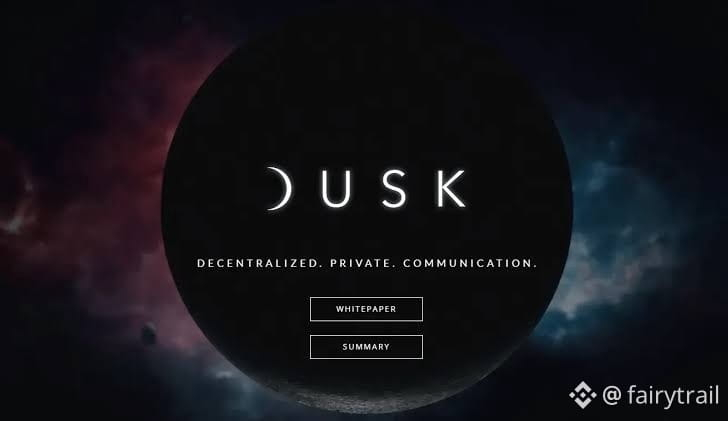
I used to think tokenization was the finish line for real-world assets. The more I looked at regulated markets, the more I realized it's only the first step. The real challenge is everything that happens after issuance: eligibility checks, ownership rules, privacy, trading, settlement, and ongoing servicing. That’s why Dusk caught my attention.
What stands out is how Dusk connects those pieces instead of treating them as separate systems. DuskVM gives Rust developers direct access to privacy and zero-knowledge capabilities, while DuskEVM lets Solidity builders use familiar Ethereum tooling on the same settlement layer. Add Citadel’s selective-disclosure identity and privacy-preserving smart contracts, and the result feels much closer to infrastructure designed for institutions than another tokenization narrative. If regulated assets are moving onchain, this integrated approach makes a strong case for how that market can actually function
$DUSK @Dusk #dusk
$STAR $GPS
What stands out is how Dusk connects those pieces instead of treating them as separate systems. DuskVM gives Rust developers direct access to privacy and zero-knowledge capabilities, while DuskEVM lets Solidity builders use familiar Ethereum tooling on the same settlement layer. Add Citadel’s selective-disclosure identity and privacy-preserving smart contracts, and the result feels much closer to infrastructure designed for institutions than another tokenization narrative. If regulated assets are moving onchain, this integrated approach makes a strong case for how that market can actually function
$DUSK @Dusk #dusk
$STAR $GPS
تمّ التحقق
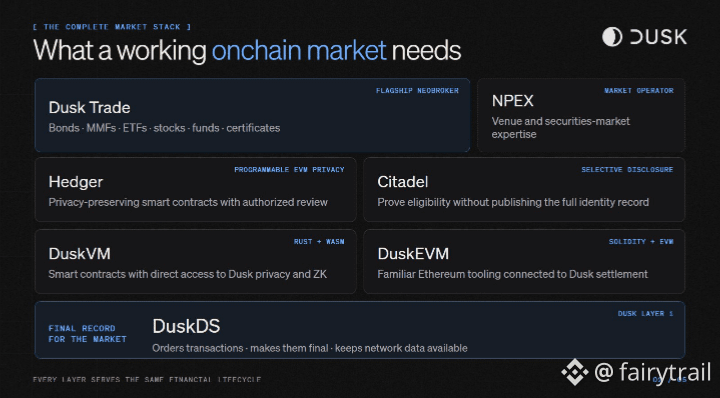
DuskEVM extends Ethereum compatibility into a privacy-first environment, letting developers deploy familiar smart contracts while shielding sensitive logic and data. Think of it as wrapping the EVM in frosted glass: execution remains verifiable but details stay obscured through zero-knowledge proofs. Recent progress on Dusk’s EVM support and steady DUSK token economics signal a focus on compliance-friendly DeFi, not hype. Still, privacy adds cost—builders should benchmark gas overhead and audit assumptions carefully. If privacy becomes programmable by default, does Ethereum’s design space widen, or just grow more complex? What trade-offs matter most to you?
$DUSK @Dusk #dusk
$PORTAL
$BTW
$DUSK @Dusk #dusk
$PORTAL
$BTW
تمّ التحقق
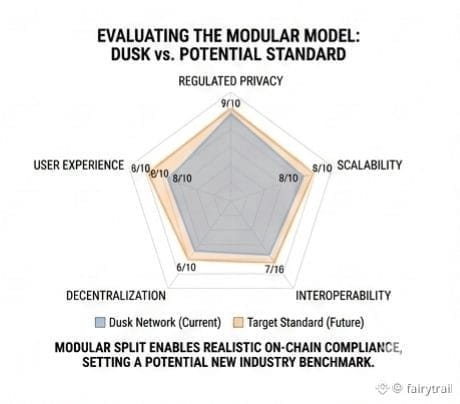
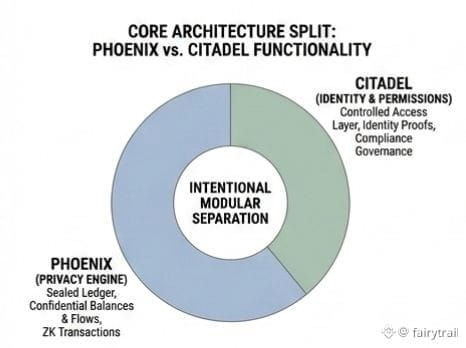
Phoenix & Citadel sit at the core of Dusk’s architecture, but they solve very different problems and that separation is intentional. Phoenix is the privacy engine: a zero knowledge transaction layer designed to keep balances, identities and flows confidential while still provably correct. Think of it as a sealed ledger where math replaces trust, enabling compliance-ready privacy that institutions actually need. Citadel, on the other hand, handles identity and permissions. It acts like a controlled access layer, letting participants prove who they are allowed to be without revealing who they actually are. Recent Dusk updates have focused on tightening this interaction streamlining proof generation, improving verifier efficiency and aligning token mechanics with long-term network usage, especially as visibility grows through Binance listed markets. Together, Phoenix hides the data, Citadel governs the doors. Does this modular split make regulated privacy more realistic on-chain? And how far can Dusk push this model before it becomes a new standard?
$DUSK @Dusk #dusk
$HEMI $COW
$DUSK @Dusk #dusk
$HEMI $COW
تمّ التحقق
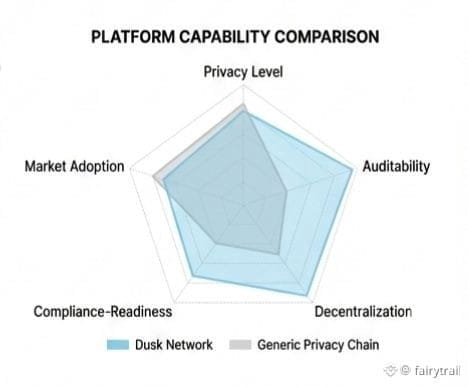
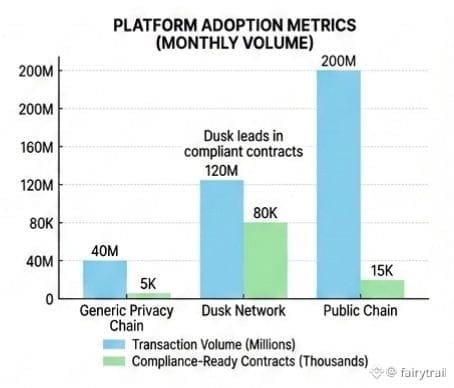
Dusk’s core idea is simple but often misunderstood: privacy only works if it can still prove things. In traditional finance, confidentiality doesn’t remove audits—it structures them. Dusk applies the same logic on-chain using zero-knowledge proofs, where transactions stay hidden, but compliance rules are mathematically enforced. Think of it like sealed bank vaults with transparent balance sheets.
Recent Dusk upgrades push confidential smart contracts further, enabling selective disclosure for regulators without exposing users. With the DUSK token actively traded on Binance, the market is clearly pricing this “privacy with rules” approach differently from pure anonymity plays.
Actionable takeaway: when evaluating privacy chains, ask who can verify what and when. Is privacy absolute, or provable?
Do you think real adoption needs this balance? Or does accountability dilute decentralization?
$DUSK @Dusk #dusk
$ACE
$AKE
Recent Dusk upgrades push confidential smart contracts further, enabling selective disclosure for regulators without exposing users. With the DUSK token actively traded on Binance, the market is clearly pricing this “privacy with rules” approach differently from pure anonymity plays.
Actionable takeaway: when evaluating privacy chains, ask who can verify what and when. Is privacy absolute, or provable?
Do you think real adoption needs this balance? Or does accountability dilute decentralization?
$DUSK @Dusk #dusk
$ACE
$AKE
تمّ التحقق
When we talk about designing for discretion we are not talking about hiding information. We are talking about being careful about who gets to see what. Dusk is a system that treats financial information in a very careful way. It is like a safe where valuable things are kept. The people who use Dusk can keep their assets private. They can still show that everything is okay.
Dusk uses something called zero knowledge proofs. This means that when people make transactions the system can check that everything is correct without needing to know who they are or how money they have. This way people can keep their information private. The system can still make sure that everything is working properly.
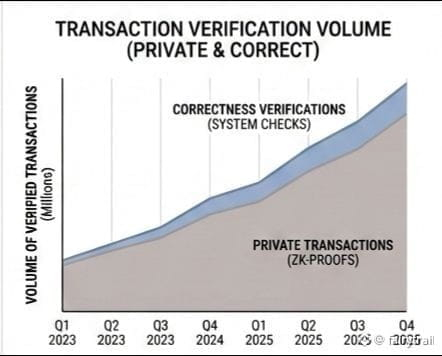
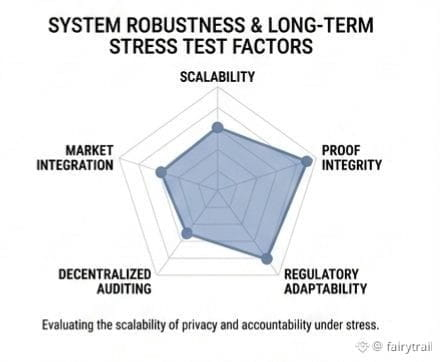
Recently the people who make Dusk have been working on making it comply with rules and regulations. They want to make sure that Dusk works with the way that real financial systems work. This is important because more and more people are getting interested in Dusk, including companies like Binance. They want to be able to see what is going on in the market so Dusk is working on making that possible. Dusk is about finding a balance between privacy and transparency and that is what makes it so useful, for people who want to keep their financial information private. The core question remains: who audits the auditors, and how robust are these proofs under long-term stress? Can privacy and accountability truly scale together, or is this balance still being tested?
$DUSK @Dusk #dusk
$EDEN
$AKE
Dusk uses something called zero knowledge proofs. This means that when people make transactions the system can check that everything is correct without needing to know who they are or how money they have. This way people can keep their information private. The system can still make sure that everything is working properly.
Recently the people who make Dusk have been working on making it comply with rules and regulations. They want to make sure that Dusk works with the way that real financial systems work. This is important because more and more people are getting interested in Dusk, including companies like Binance. They want to be able to see what is going on in the market so Dusk is working on making that possible. Dusk is about finding a balance between privacy and transparency and that is what makes it so useful, for people who want to keep their financial information private. The core question remains: who audits the auditors, and how robust are these proofs under long-term stress? Can privacy and accountability truly scale together, or is this balance still being tested?
$DUSK @Dusk #dusk
$EDEN
$AKE
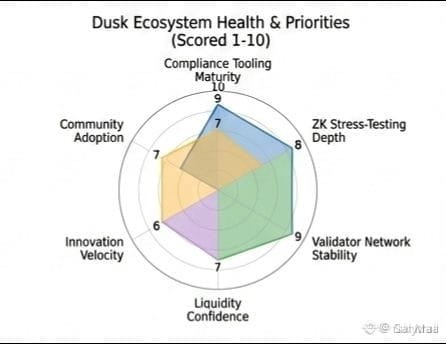
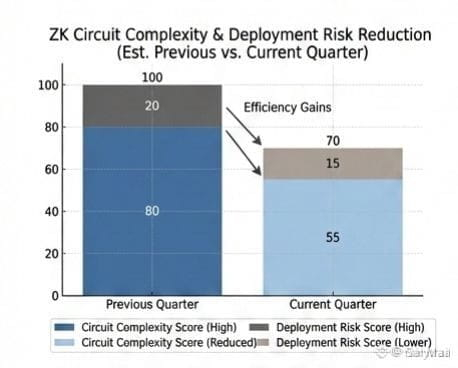
Dusk’s development environment feels like a compliance-first workshop where security isn’t bolted on later—it’s built into the frame. Recent tooling upgrades around zero-knowledge contract deployment and validator-focused testing show Dusk prioritizing controlled privacy and predictable execution. The DUSK token still anchors staking and network security, but efficiency gains must prove they reduce circuit complexity and deployment risk. Watching liquidity and staking sentiment on Binance can hint at real confidence. Are developers stress-testing ZK logic deeply enough? Could compliance tooling slow innovation, or actually stabilize adoption?
@Dusk #dusk $DUSK
$AKE
$ACU
@Dusk #dusk $DUSK
$AKE
$ACU
I dug into Babylon's $96M raise expecting the usual crypto playbook — private token sales wearing institutional clothing. That's not what I found. The rounds were structured as SAFEs plus token warrants, priced against equity, not against a token that didn't exist yet at the time.
A token warrant works differently than it sounds: investors buy equity now, and the right to tokens later rides on top of that stake. The valuation math never touches token price at all. Babylon effectively separated "fund the company" from "sell the token" — built for backers betting on Babylon Labs as a business, with BABY allocation as a downstream right, not the product itself.
What's missing is the fine print: how equity converts into BABY, and on what unlock schedule. Without that, sell pressure risk looks deferred, not resolved.
So the real test: does equity-first funding produce genuinely aligned holders, or the same overhang on a longer timer? Curious if anyone's tracking SAFE/warrant-funded projects against pure token sales post-listing.
$BABY @BabylonLabs_io #baby
$GIGGLE
$AXTIB
A token warrant works differently than it sounds: investors buy equity now, and the right to tokens later rides on top of that stake. The valuation math never touches token price at all. Babylon effectively separated "fund the company" from "sell the token" — built for backers betting on Babylon Labs as a business, with BABY allocation as a downstream right, not the product itself.
What's missing is the fine print: how equity converts into BABY, and on what unlock schedule. Without that, sell pressure risk looks deferred, not resolved.
So the real test: does equity-first funding produce genuinely aligned holders, or the same overhang on a longer timer? Curious if anyone's tracking SAFE/warrant-funded projects against pure token sales post-listing.
$BABY @BabylonLabs_io #baby
$GIGGLE
$AXTIB



I used to assume linking a BTC wallet and an ETH wallet made an app treat them as one depositor. TBV corrected that.
A peg-in request bundles my Ethereum address, Bitcoin public key, a BIP-322 proof of key possession, my Vault Provider, and a WOTS commitment. Off-chain, I authenticate via a challenge-response anchor. Nothing is accepted just because an interface shows an address — I must prove control before that key attaches to my Ethereum-side vault record.
I still keep my private key. The Provider only assists with setup; it can't move or hold my BTC.
This proof doesn't merge my wallets into one account. I still broadcast the Pre-PegIn transaction and sign release paths on Bitcoin, while requests, secret reveals, and borrowing or withdrawal happen on Ethereum. TBV links Bitcoin-side authority to an Ethereum-side request — it doesn't collapse two networks into one journey.
So: does key proof make self-custody trustworthy, or does coordinating two wallets remain the real risk?
$BABY @BabylonLabs_io #baby
$SNXXB
$MMT
A peg-in request bundles my Ethereum address, Bitcoin public key, a BIP-322 proof of key possession, my Vault Provider, and a WOTS commitment. Off-chain, I authenticate via a challenge-response anchor. Nothing is accepted just because an interface shows an address — I must prove control before that key attaches to my Ethereum-side vault record.
I still keep my private key. The Provider only assists with setup; it can't move or hold my BTC.
This proof doesn't merge my wallets into one account. I still broadcast the Pre-PegIn transaction and sign release paths on Bitcoin, while requests, secret reveals, and borrowing or withdrawal happen on Ethereum. TBV links Bitcoin-side authority to an Ethereum-side request — it doesn't collapse two networks into one journey.
So: does key proof make self-custody trustworthy, or does coordinating two wallets remain the real risk?
$BABY @BabylonLabs_io #baby
$SNXXB
$MMT




Babylon sells itself as the key to unlocking Bitcoin's trillion-dollar idle capital. I want to look past the pitch and into the mechanics underneath it.
The engineering is genuinely clever. BTC never leaves the Bitcoin chain. Timelock scripts and cryptographic proofs let holders back Proof-of-Stake finality without bridges or wrapped tokens. Roughly $5.6B in BTC now sits in these vaults, real capital, not speculation.
But self-custodial isn't risk-free. Slashing still exists. If a finality provider double-signs, the EOTS mechanism extracts staked BTC from the script. You keep your keys, yet you're trusting an operator you didn't choose.
Then there's yield. Real returns run near 1-3% APY, paid mostly in BABY, not Bitcoin. Add a 7-10 day unbonding window earning nothing, and returns look thinner than headline TVL suggests.
Babylon solved a real engineering problem. It hasn't erased the trade-off between yield and risk, it just relocated where that risk sits.
$BABY @BabylonLabs_io #baby $KAITO $COTI
The engineering is genuinely clever. BTC never leaves the Bitcoin chain. Timelock scripts and cryptographic proofs let holders back Proof-of-Stake finality without bridges or wrapped tokens. Roughly $5.6B in BTC now sits in these vaults, real capital, not speculation.
But self-custodial isn't risk-free. Slashing still exists. If a finality provider double-signs, the EOTS mechanism extracts staked BTC from the script. You keep your keys, yet you're trusting an operator you didn't choose.
Then there's yield. Real returns run near 1-3% APY, paid mostly in BABY, not Bitcoin. Add a 7-10 day unbonding window earning nothing, and returns look thinner than headline TVL suggests.
Babylon solved a real engineering problem. It hasn't erased the trade-off between yield and risk, it just relocated where that risk sits.
$BABY @BabylonLabs_io #baby $KAITO $COTI



I went to Babylon's docs for the staking architecture. What stopped me was one line on arbitration and court enforcement, beside repeated disclaimers on the Babylon Parties' liability.
These describe one system from different angles. Trustless vaults, validator coordination, and redemption flows cover the technical layer; disclaimers and arbitration clauses cover what sits outside it.
A validator set reaches consensus. A vault checks conditions before releasing assets. Contracts enforce fixed rules. None of that settles a dispute once people, jurisdictions, or off-chain obligations enter the picture — that's where arbitration and courts take over.
Decentralization isn't replacing legal infrastructure; it narrows where that infrastructure must act. Code absorbs routine friction. Law stays in reserve for the fraction of cases code can't resolve alone.
Babylon isn't software erasing institutions. It's software marking the exact point where institutional enforcement begins.
$BABY @BabylonLabs_io #baby $COTI $VANRY
These describe one system from different angles. Trustless vaults, validator coordination, and redemption flows cover the technical layer; disclaimers and arbitration clauses cover what sits outside it.
A validator set reaches consensus. A vault checks conditions before releasing assets. Contracts enforce fixed rules. None of that settles a dispute once people, jurisdictions, or off-chain obligations enter the picture — that's where arbitration and courts take over.
Decentralization isn't replacing legal infrastructure; it narrows where that infrastructure must act. Code absorbs routine friction. Law stays in reserve for the fraction of cases code can't resolve alone.
Babylon isn't software erasing institutions. It's software marking the exact point where institutional enforcement begins.
$BABY @BabylonLabs_io #baby $COTI $VANRY



I keep coming back to Babylon’s biggest paradox.
Nearly 56,800 BTC, worth over $5.6B, secures the network, yet those BTC stakers have zero governance power.
Every major protocol decision—from chain evolution to fee parameters and burn mechanics—remains in the hands of BABY holders, even though BABY’s market cap is only around 1% of the value the protocol protects.
With another 136.11M BABY unlocking on August 10 (~1.2% of total supply), continued dilution adds another layer to the incentive debate.
Babylon calls this a dual-staking model, but today BTC provides the economic security while BABY controls governance.
To me, the real question isn’t whether this is a flaw—it’s whether future protocol economics can genuinely align both sides of the network.
$BABY @BabylonLabs_io #baby
$DIA
$EUL
Nearly 56,800 BTC, worth over $5.6B, secures the network, yet those BTC stakers have zero governance power.
Every major protocol decision—from chain evolution to fee parameters and burn mechanics—remains in the hands of BABY holders, even though BABY’s market cap is only around 1% of the value the protocol protects.
With another 136.11M BABY unlocking on August 10 (~1.2% of total supply), continued dilution adds another layer to the incentive debate.
Babylon calls this a dual-staking model, but today BTC provides the economic security while BABY controls governance.
To me, the real question isn’t whether this is a flaw—it’s whether future protocol economics can genuinely align both sides of the network.
$BABY @BabylonLabs_io #baby
$DIA
$EUL



#baby $BABY When I look at BABY Token, I don’t see a token designed to sit idle in a wallet. I see an economic layer where utility, staking, and incentives reinforce one another.
Staking reduces the liquid supply while rewarding participants who commit capital over time, creating a stronger link between network participation and long-term alignment.
Every locked token acts like a brick removed from the circulating pool, tightening the system while encouraging sustained engagement instead of short-term speculation.
Utility gives the token purpose. Staking gives it commitment. The economic model connects both into a self-reinforcing cycle.
For me, the real strength of BABY Token isn’t price action—it’s whether its incentives can continue balancing participation, scarcity, and ecosystem growth while maintaining long-term sustainability.
$ESPORTS
$EUL
@BabylonLabs_io
Staking reduces the liquid supply while rewarding participants who commit capital over time, creating a stronger link between network participation and long-term alignment.
Every locked token acts like a brick removed from the circulating pool, tightening the system while encouraging sustained engagement instead of short-term speculation.
Utility gives the token purpose. Staking gives it commitment. The economic model connects both into a self-reinforcing cycle.
For me, the real strength of BABY Token isn’t price action—it’s whether its incentives can continue balancing participation, scarcity, and ecosystem growth while maintaining long-term sustainability.
$ESPORTS
$EUL
@BabylonLabs_io


UP
100%
DOWN
0%
2 الأصوات • تمّ إغلاق التصويت
#baby $BABY The more I studied Babylon, the more I felt it was solving a problem that many people overlooked.
It doesn't try to transform Bitcoin into a smart contract chain. Instead, it extends Bitcoin's security to Proof-of-Stake networks while letting me keep full custody of my BTC.
That distinction matters.
Rather than bridging assets or locking coins with a third party, the security comes from Bitcoin itself. Ownership stays unchanged, yet its economic weight can strengthen external consensus.
I think of it as building several cities on the same bedrock instead of moving the mountain beneath each one.
If this model scales, the biggest outcome won't be the amount of BTC staked.
It will be the realization that Bitcoin's greatest contribution isn't limited to being a store of value. Its decade-long record of trust and economic security can become foundational infrastructure for an entirely different generation of blockchain networks.
@BabylonLabs_io
It doesn't try to transform Bitcoin into a smart contract chain. Instead, it extends Bitcoin's security to Proof-of-Stake networks while letting me keep full custody of my BTC.
That distinction matters.
Rather than bridging assets or locking coins with a third party, the security comes from Bitcoin itself. Ownership stays unchanged, yet its economic weight can strengthen external consensus.
I think of it as building several cities on the same bedrock instead of moving the mountain beneath each one.
If this model scales, the biggest outcome won't be the amount of BTC staked.
It will be the realization that Bitcoin's greatest contribution isn't limited to being a store of value. Its decade-long record of trust and economic security can become foundational infrastructure for an entirely different generation of blockchain networks.
@BabylonLabs_io
BULLISH
50%
BEARISH
50%
2 الأصوات • تمّ إغلاق التصويت
سجّل الدخول لاستكشاف المزيد من المُحتوى