
JVX_24
2.3k منشورات

JVX_24
إبلاغ
حظر المُستخدم
فتح تداول
مُتداول مُتكرر
2.1 سنوات
40 تتابع
20.3K+ المتابعون
5.1K+ إعجاب
منشورات
الحافظة الاستثمارية
الكل
اقتباسات
Live
·
--
When I think about the future of AI in crypto, I realize that intelligence alone isn't enough. The bigger challenge is trust. If AI agents begin managing trades, executing strategies, and making financial decisions automatically, users need confidence that those actions remain transparent and follow clear rules.
That's why Newton Protocol (NEWT) stands out to me. Instead of focusing only on faster automation or more advanced AI, it aims to build a secure rollup where AI-driven strategies can operate within defined policies while keeping settlement connected to the blockchain. To me, that's a practical direction rather than a magical promise.
What interests me most is that Newton Protocol is trying to solve a real infrastructure problem. As AI becomes more involved in decentralized finance, accountability may become just as important as speed. Building systems that people can trust could matter far more than building systems that simply act faster.
Of course, the project is still in its early stages, and there are no guarantees. Like every emerging crypto protocol, its future will depend on execution, developer adoption, ecosystem growth, market sentiment, and real-world demand. The NEWT token is also speculative, and its value will ultimately reflect how successfully the network delivers on its long-term vision.
For now, I see Newton Protocol as an interesting project worth watching, not because it promises certainty, but because it's asking the right questions.
#newt $NEWT @NewtonProtocol #Newt
{spot}(NEWTUSDT)
When I think about the future of AI in crypto, I realize that intelligence alone isn't enough. The bigger challenge is trust. If AI agents begin managing trades, executing strategies, and making financial decisions automatically, users need confidence that those actions remain transparent and follow clear rules.
That's why Newton Protocol (NEWT) stands out to me. Instead of focusing only on faster automation or more advanced AI, it aims to build a secure rollup where AI-driven strategies can operate within defined policies while keeping settlement connected to the blockchain. To me, that's a practical direction rather than a magical promise.
What interests me most is that Newton Protocol is trying to solve a real infrastructure problem. As AI becomes more involved in decentralized finance, accountability may become just as important as speed. Building systems that people can trust could matter far more than building systems that simply act faster.
Of course, the project is still in its early stages, and there are no guarantees. Like every emerging crypto protocol, its future will depend on execution, developer adoption, ecosystem growth, market sentiment, and real-world demand. The NEWT token is also speculative, and its value will ultimately reflect how successfully the network delivers on its long-term vision.
For now, I see Newton Protocol as an interesting project worth watching, not because it promises certainty, but because it's asking the right questions.
#newt $NEWT @NewtonProtocol #Newt
That's why Newton Protocol (NEWT) stands out to me. Instead of focusing only on faster automation or more advanced AI, it aims to build a secure rollup where AI-driven strategies can operate within defined policies while keeping settlement connected to the blockchain. To me, that's a practical direction rather than a magical promise.
What interests me most is that Newton Protocol is trying to solve a real infrastructure problem. As AI becomes more involved in decentralized finance, accountability may become just as important as speed. Building systems that people can trust could matter far more than building systems that simply act faster.
Of course, the project is still in its early stages, and there are no guarantees. Like every emerging crypto protocol, its future will depend on execution, developer adoption, ecosystem growth, market sentiment, and real-world demand. The NEWT token is also speculative, and its value will ultimately reflect how successfully the network delivers on its long-term vision.
For now, I see Newton Protocol as an interesting project worth watching, not because it promises certainty, but because it's asking the right questions.
#newt $NEWT @NewtonProtocol #Newt
2
1
146
·
--
The Future of AI Isn't Just About Intelligence—It's About TrustI keep coming back to one question that feels more important every time I watch artificial intelligence become more involved in financial decisions: if software is making choices on our behalf, who do we actually trust? I do not mean trust in the sense of believing that an algorithm is intelligent. I mean trust in the process itself. Can we understand why decisions were made? Can we verify what happened after the fact? And if something goes wrong, is there any accountability beyond a line of code?
To me, that question sits quietly beneath almost every conversation about AI and crypto, yet it rarely receives the attention it deserves. Most discussions revolve around speed, automation, lower costs, or the promise of smarter trading. Those things matter, of course, but they often feel like surface-level improvements. They tell us what technology can do, not whether people should feel comfortable relying on it.
I think this is where the current narrative becomes incomplete. There is a growing assumption that more automation automatically leads to better outcomes. Markets, however, have never been that simple. Human behavior is unpredictable, incentives change quickly, and confidence can disappear overnight. Adding AI into that environment creates new possibilities, but it also introduces new questions about transparency, responsibility, and control.
That is why Newton Protocol caught my attention. Not because it promises that AI will outperform humans or because it presents automation as a perfect solution. Instead, I see it as an attempt to address something more fundamental. Rather than asking how AI can execute more strategies, it seems to ask how those strategies can exist inside a framework where security, verification, and coordination matter from the beginning.
I find that difference meaningful.
When I look at many AI projects, I sometimes feel as though they assume trust will naturally appear once the technology becomes powerful enough. History suggests otherwise. Better technology does not automatically create greater confidence. In many industries, trust is built through systems that reduce uncertainty instead of simply increasing capability. Banks rely on audits. Courts rely on evidence. Businesses rely on contracts. Financial markets rely on rules that participants believe will be enforced consistently.
Crypto has always tried to replace institutional trust with cryptographic trust. AI introduces another layer of complexity because decisions become dynamic rather than static. It is no longer just about whether transactions are valid. It becomes about whether automated actions follow expectations in environments that constantly change.
Newton Protocol appears to be exploring that intersection. From what I understand, its vision is not simply another blockchain or another AI assistant. It is trying to establish a secure rollup environment where AI-driven strategies, automated trading systems, and developers can operate within shared infrastructure instead of isolated applications. To me, the interesting part is not the technology itself but the philosophy behind it. It recognizes that automation without structure can become difficult to trust, especially when real assets are involved.
I think that feels practical rather than magical.
There is a temptation across the AI industry to describe intelligent systems as though they will eventually solve every problem on their own. I have never been fully convinced by that idea. Intelligence is valuable, but incentives matter just as much. Even the smartest system operates inside rules, economic pressures, and imperfect information. Building better infrastructure may ultimately matter more than building more impressive demonstrations.
That perspective also changes how I think about adoption.
People often assume users will embrace AI simply because it is more efficient. I am not sure that is enough. Financial decisions involve emotions as much as logic. People worry about losing money. They question unfamiliar systems. They hesitate before handing control to software they cannot fully understand. Those reactions are not irrational. They are natural.
If projects like Newton Protocol succeed in attracting developers and users, I suspect it will not happen because they promise perfection. It will happen because they gradually reduce uncertainty. Confidence usually grows through repeated experience, not through ambitious roadmaps or persuasive presentations.
I also think developer ecosystems deserve more attention than they often receive. Infrastructure projects rarely become valuable because of technology alone. They become useful when developers decide that building on top of them saves time, reduces risk, or creates opportunities that did not previously exist. A marketplace for AI developers sounds interesting in theory, but theory and reality are rarely identical. Communities need incentives, reliable tools, documentation, active participation, and enough economic activity to justify long-term commitment.
That process takes time.
I feel this is where patience becomes important. Crypto has developed a habit of judging projects almost entirely through token prices. Every announcement is measured against immediate market reactions. Every delay becomes evidence that something has failed. Every rally becomes proof that everything is working. Reality is usually much more complicated.
The NEWT token naturally becomes part of that conversation because tokens often represent both utility and speculation at the same time. I think it is important not to confuse those two ideas. Even if the protocol develops meaningful infrastructure, the market price of NEWT will still depend on many variables that extend beyond technical progress. Adoption, liquidity, overall market sentiment, execution quality, developer interest, competition, regulation, and macroeconomic conditions all influence valuation. None of those factors move in perfectly predictable ways.
That uncertainty does not necessarily weaken the project. It simply reminds me that investing and technological progress are different conversations. A useful protocol does not automatically create immediate market success, just as a rising token price does not automatically prove long-term value.
I keep coming back to the human side of all this because technology alone has never changed the world without people deciding to trust it. Every successful financial system, whether traditional or decentralized, ultimately depends on shared confidence. Rules matter because people believe those rules will continue to exist tomorrow.
Perhaps that is why Newton Protocol feels more interesting to me than projects focused purely on performance metrics. Faster execution, larger models, and more sophisticated automation are impressive achievements, but they do not answer the deeper question that keeps returning to my mind. How do we create environments where intelligent systems can operate responsibly enough that ordinary users are willing to rely on them?
I do not know whether Newton Protocol will become an important part of that future. No one does. The project is still developing, the competitive landscape is crowded, and execution always determines whether ambitious ideas survive beyond early enthusiasm. There are many reasons to remain cautious alongside any curiosity.
Still, I appreciate projects that attempt to solve structural problems rather than simply adding another layer of complexity. Building secure foundations rarely attracts as much attention as launching exciting applications, yet foundations often determine whether those applications can last.
When I think about AI and crypto together, I no longer ask which model will become the smartest or which strategy will generate the highest returns. Those questions change every few months. The question that stays with me is much simpler and, I believe, much more important.
If intelligent systems become trusted participants in financial markets, what will make that trust feel earned instead of assumed?
To me, Newton Protocol is interesting because it seems to treat that question as the starting point rather than the conclusion. Whether it ultimately succeeds remains uncertain, but I think asking the right question is often where meaningful progress begins.
@NewtonProtocol #Newt $NEWT
{spot}(NEWTUSDT)
The Future of AI Isn't Just About Intelligence—It's About Trust
I keep coming back to one question that feels more important every time I watch artificial intelligence become more involved in financial decisions: if software is making choices on our behalf, who do we actually trust? I do not mean trust in the sense of believing that an algorithm is intelligent. I mean trust in the process itself. Can we understand why decisions were made? Can we verify what happened after the fact? And if something goes wrong, is there any accountability beyond a line of code?
To me, that question sits quietly beneath almost every conversation about AI and crypto, yet it rarely receives the attention it deserves. Most discussions revolve around speed, automation, lower costs, or the promise of smarter trading. Those things matter, of course, but they often feel like surface-level improvements. They tell us what technology can do, not whether people should feel comfortable relying on it.
I think this is where the current narrative becomes incomplete. There is a growing assumption that more automation automatically leads to better outcomes. Markets, however, have never been that simple. Human behavior is unpredictable, incentives change quickly, and confidence can disappear overnight. Adding AI into that environment creates new possibilities, but it also introduces new questions about transparency, responsibility, and control.
That is why Newton Protocol caught my attention. Not because it promises that AI will outperform humans or because it presents automation as a perfect solution. Instead, I see it as an attempt to address something more fundamental. Rather than asking how AI can execute more strategies, it seems to ask how those strategies can exist inside a framework where security, verification, and coordination matter from the beginning.
I find that difference meaningful.
When I look at many AI projects, I sometimes feel as though they assume trust will naturally appear once the technology becomes powerful enough. History suggests otherwise. Better technology does not automatically create greater confidence. In many industries, trust is built through systems that reduce uncertainty instead of simply increasing capability. Banks rely on audits. Courts rely on evidence. Businesses rely on contracts. Financial markets rely on rules that participants believe will be enforced consistently.
Crypto has always tried to replace institutional trust with cryptographic trust. AI introduces another layer of complexity because decisions become dynamic rather than static. It is no longer just about whether transactions are valid. It becomes about whether automated actions follow expectations in environments that constantly change.
Newton Protocol appears to be exploring that intersection. From what I understand, its vision is not simply another blockchain or another AI assistant. It is trying to establish a secure rollup environment where AI-driven strategies, automated trading systems, and developers can operate within shared infrastructure instead of isolated applications. To me, the interesting part is not the technology itself but the philosophy behind it. It recognizes that automation without structure can become difficult to trust, especially when real assets are involved.
I think that feels practical rather than magical.
There is a temptation across the AI industry to describe intelligent systems as though they will eventually solve every problem on their own. I have never been fully convinced by that idea. Intelligence is valuable, but incentives matter just as much. Even the smartest system operates inside rules, economic pressures, and imperfect information. Building better infrastructure may ultimately matter more than building more impressive demonstrations.
That perspective also changes how I think about adoption.
People often assume users will embrace AI simply because it is more efficient. I am not sure that is enough. Financial decisions involve emotions as much as logic. People worry about losing money. They question unfamiliar systems. They hesitate before handing control to software they cannot fully understand. Those reactions are not irrational. They are natural.
If projects like Newton Protocol succeed in attracting developers and users, I suspect it will not happen because they promise perfection. It will happen because they gradually reduce uncertainty. Confidence usually grows through repeated experience, not through ambitious roadmaps or persuasive presentations.
I also think developer ecosystems deserve more attention than they often receive. Infrastructure projects rarely become valuable because of technology alone. They become useful when developers decide that building on top of them saves time, reduces risk, or creates opportunities that did not previously exist. A marketplace for AI developers sounds interesting in theory, but theory and reality are rarely identical. Communities need incentives, reliable tools, documentation, active participation, and enough economic activity to justify long-term commitment.
That process takes time.
I feel this is where patience becomes important. Crypto has developed a habit of judging projects almost entirely through token prices. Every announcement is measured against immediate market reactions. Every delay becomes evidence that something has failed. Every rally becomes proof that everything is working. Reality is usually much more complicated.
The NEWT token naturally becomes part of that conversation because tokens often represent both utility and speculation at the same time. I think it is important not to confuse those two ideas. Even if the protocol develops meaningful infrastructure, the market price of NEWT will still depend on many variables that extend beyond technical progress. Adoption, liquidity, overall market sentiment, execution quality, developer interest, competition, regulation, and macroeconomic conditions all influence valuation. None of those factors move in perfectly predictable ways.
That uncertainty does not necessarily weaken the project. It simply reminds me that investing and technological progress are different conversations. A useful protocol does not automatically create immediate market success, just as a rising token price does not automatically prove long-term value.
I keep coming back to the human side of all this because technology alone has never changed the world without people deciding to trust it. Every successful financial system, whether traditional or decentralized, ultimately depends on shared confidence. Rules matter because people believe those rules will continue to exist tomorrow.
Perhaps that is why Newton Protocol feels more interesting to me than projects focused purely on performance metrics. Faster execution, larger models, and more sophisticated automation are impressive achievements, but they do not answer the deeper question that keeps returning to my mind. How do we create environments where intelligent systems can operate responsibly enough that ordinary users are willing to rely on them?
I do not know whether Newton Protocol will become an important part of that future. No one does. The project is still developing, the competitive landscape is crowded, and execution always determines whether ambitious ideas survive beyond early enthusiasm. There are many reasons to remain cautious alongside any curiosity.
Still, I appreciate projects that attempt to solve structural problems rather than simply adding another layer of complexity. Building secure foundations rarely attracts as much attention as launching exciting applications, yet foundations often determine whether those applications can last.
When I think about AI and crypto together, I no longer ask which model will become the smartest or which strategy will generate the highest returns. Those questions change every few months. The question that stays with me is much simpler and, I believe, much more important.
If intelligent systems become trusted participants in financial markets, what will make that trust feel earned instead of assumed?
To me, Newton Protocol is interesting because it seems to treat that question as the starting point rather than the conclusion. Whether it ultimately succeeds remains uncertain, but I think asking the right question is often where meaningful progress begins.
@NewtonProtocol #Newt $NEWT
To me, that question sits quietly beneath almost every conversation about AI and crypto, yet it rarely receives the attention it deserves. Most discussions revolve around speed, automation, lower costs, or the promise of smarter trading. Those things matter, of course, but they often feel like surface-level improvements. They tell us what technology can do, not whether people should feel comfortable relying on it.
I think this is where the current narrative becomes incomplete. There is a growing assumption that more automation automatically leads to better outcomes. Markets, however, have never been that simple. Human behavior is unpredictable, incentives change quickly, and confidence can disappear overnight. Adding AI into that environment creates new possibilities, but it also introduces new questions about transparency, responsibility, and control.
That is why Newton Protocol caught my attention. Not because it promises that AI will outperform humans or because it presents automation as a perfect solution. Instead, I see it as an attempt to address something more fundamental. Rather than asking how AI can execute more strategies, it seems to ask how those strategies can exist inside a framework where security, verification, and coordination matter from the beginning.
I find that difference meaningful.
When I look at many AI projects, I sometimes feel as though they assume trust will naturally appear once the technology becomes powerful enough. History suggests otherwise. Better technology does not automatically create greater confidence. In many industries, trust is built through systems that reduce uncertainty instead of simply increasing capability. Banks rely on audits. Courts rely on evidence. Businesses rely on contracts. Financial markets rely on rules that participants believe will be enforced consistently.
Crypto has always tried to replace institutional trust with cryptographic trust. AI introduces another layer of complexity because decisions become dynamic rather than static. It is no longer just about whether transactions are valid. It becomes about whether automated actions follow expectations in environments that constantly change.
Newton Protocol appears to be exploring that intersection. From what I understand, its vision is not simply another blockchain or another AI assistant. It is trying to establish a secure rollup environment where AI-driven strategies, automated trading systems, and developers can operate within shared infrastructure instead of isolated applications. To me, the interesting part is not the technology itself but the philosophy behind it. It recognizes that automation without structure can become difficult to trust, especially when real assets are involved.
I think that feels practical rather than magical.
There is a temptation across the AI industry to describe intelligent systems as though they will eventually solve every problem on their own. I have never been fully convinced by that idea. Intelligence is valuable, but incentives matter just as much. Even the smartest system operates inside rules, economic pressures, and imperfect information. Building better infrastructure may ultimately matter more than building more impressive demonstrations.
That perspective also changes how I think about adoption.
People often assume users will embrace AI simply because it is more efficient. I am not sure that is enough. Financial decisions involve emotions as much as logic. People worry about losing money. They question unfamiliar systems. They hesitate before handing control to software they cannot fully understand. Those reactions are not irrational. They are natural.
If projects like Newton Protocol succeed in attracting developers and users, I suspect it will not happen because they promise perfection. It will happen because they gradually reduce uncertainty. Confidence usually grows through repeated experience, not through ambitious roadmaps or persuasive presentations.
I also think developer ecosystems deserve more attention than they often receive. Infrastructure projects rarely become valuable because of technology alone. They become useful when developers decide that building on top of them saves time, reduces risk, or creates opportunities that did not previously exist. A marketplace for AI developers sounds interesting in theory, but theory and reality are rarely identical. Communities need incentives, reliable tools, documentation, active participation, and enough economic activity to justify long-term commitment.
That process takes time.
I feel this is where patience becomes important. Crypto has developed a habit of judging projects almost entirely through token prices. Every announcement is measured against immediate market reactions. Every delay becomes evidence that something has failed. Every rally becomes proof that everything is working. Reality is usually much more complicated.
The NEWT token naturally becomes part of that conversation because tokens often represent both utility and speculation at the same time. I think it is important not to confuse those two ideas. Even if the protocol develops meaningful infrastructure, the market price of NEWT will still depend on many variables that extend beyond technical progress. Adoption, liquidity, overall market sentiment, execution quality, developer interest, competition, regulation, and macroeconomic conditions all influence valuation. None of those factors move in perfectly predictable ways.
That uncertainty does not necessarily weaken the project. It simply reminds me that investing and technological progress are different conversations. A useful protocol does not automatically create immediate market success, just as a rising token price does not automatically prove long-term value.
I keep coming back to the human side of all this because technology alone has never changed the world without people deciding to trust it. Every successful financial system, whether traditional or decentralized, ultimately depends on shared confidence. Rules matter because people believe those rules will continue to exist tomorrow.
Perhaps that is why Newton Protocol feels more interesting to me than projects focused purely on performance metrics. Faster execution, larger models, and more sophisticated automation are impressive achievements, but they do not answer the deeper question that keeps returning to my mind. How do we create environments where intelligent systems can operate responsibly enough that ordinary users are willing to rely on them?
I do not know whether Newton Protocol will become an important part of that future. No one does. The project is still developing, the competitive landscape is crowded, and execution always determines whether ambitious ideas survive beyond early enthusiasm. There are many reasons to remain cautious alongside any curiosity.
Still, I appreciate projects that attempt to solve structural problems rather than simply adding another layer of complexity. Building secure foundations rarely attracts as much attention as launching exciting applications, yet foundations often determine whether those applications can last.
When I think about AI and crypto together, I no longer ask which model will become the smartest or which strategy will generate the highest returns. Those questions change every few months. The question that stays with me is much simpler and, I believe, much more important.
If intelligent systems become trusted participants in financial markets, what will make that trust feel earned instead of assumed?
To me, Newton Protocol is interesting because it seems to treat that question as the starting point rather than the conclusion. Whether it ultimately succeeds remains uncertain, but I think asking the right question is often where meaningful progress begins.
@NewtonProtocol #Newt $NEWT
1
126
·
--
I think one of the biggest questions facing crypto today isn't whether AI can make better decisions—it's whether we can trust those decisions when real assets are involved.
That's what makes Newton Protocol stand out to me. Instead of treating AI as a magic solution, it focuses on creating a secure environment where AI-driven strategies can operate with greater transparency and accountability. To me, that's a much more practical direction than simply chasing bigger promises.
The idea of combining automated trading, secure rollups, and a marketplace for AI developers feels relevant because AI is becoming a larger part of financial systems. Still, technology alone doesn't guarantee success. Adoption, developer participation, user trust, and consistent execution will ultimately determine whether the ecosystem grows over time.
The NEWT token is also part of that journey, but like every crypto asset, its value remains speculative. Market sentiment, liquidity, real-world usage, and the team's ability to deliver all play important roles. None of these outcomes are guaranteed.
I feel Newton Protocol is worth watching not because it claims to have every answer, but because it's trying to solve a real problem: how to make AI-powered finance more transparent, secure, and trustworthy without pretending that risk can ever be completely eliminated.
@NewtonProtocol $NEWT #Newt
{spot}(NEWTUSDT)
I think one of the biggest questions facing crypto today isn't whether AI can make better decisions—it's whether we can trust those decisions when real assets are involved.
That's what makes Newton Protocol stand out to me. Instead of treating AI as a magic solution, it focuses on creating a secure environment where AI-driven strategies can operate with greater transparency and accountability. To me, that's a much more practical direction than simply chasing bigger promises.
The idea of combining automated trading, secure rollups, and a marketplace for AI developers feels relevant because AI is becoming a larger part of financial systems. Still, technology alone doesn't guarantee success. Adoption, developer participation, user trust, and consistent execution will ultimately determine whether the ecosystem grows over time.
The NEWT token is also part of that journey, but like every crypto asset, its value remains speculative. Market sentiment, liquidity, real-world usage, and the team's ability to deliver all play important roles. None of these outcomes are guaranteed.
I feel Newton Protocol is worth watching not because it claims to have every answer, but because it's trying to solve a real problem: how to make AI-powered finance more transparent, secure, and trustworthy without pretending that risk can ever be completely eliminated.
@NewtonProtocol $NEWT #Newt
That's what makes Newton Protocol stand out to me. Instead of treating AI as a magic solution, it focuses on creating a secure environment where AI-driven strategies can operate with greater transparency and accountability. To me, that's a much more practical direction than simply chasing bigger promises.
The idea of combining automated trading, secure rollups, and a marketplace for AI developers feels relevant because AI is becoming a larger part of financial systems. Still, technology alone doesn't guarantee success. Adoption, developer participation, user trust, and consistent execution will ultimately determine whether the ecosystem grows over time.
The NEWT token is also part of that journey, but like every crypto asset, its value remains speculative. Market sentiment, liquidity, real-world usage, and the team's ability to deliver all play important roles. None of these outcomes are guaranteed.
I feel Newton Protocol is worth watching not because it claims to have every answer, but because it's trying to solve a real problem: how to make AI-powered finance more transparent, secure, and trustworthy without pretending that risk can ever be completely eliminated.
@NewtonProtocol $NEWT #Newt
2
2
134
·
--
Beyond Smarter Machines: Why Trust May Matter More Than Intelligence in Newton ProtocolI keep coming back to the same question whenever I look at new crypto projects: what happens when software begins making financial decisions on our behalf instead of simply helping us make them? That feels like a much bigger shift than most conversations acknowledge. We spend a lot of time talking about faster blockchains, lower fees, and better user interfaces, but much less time asking what trust should look like when autonomous systems start interacting with money. To me, that question feels more important than almost anything else happening in this space.
I think many discussions around AI and crypto are strangely incomplete. The conversation often swings between two extremes. One side imagines a future where intelligent agents effortlessly manage everything from investments to business operations. The other dismisses the entire idea as another passing trend fueled by hype. Neither perspective seems satisfying to me because both avoid the difficult middle ground where real technology usually develops.
The challenge is not whether AI can become more capable. It probably will. The harder question is whether people will trust automated systems enough to let them participate in financial decisions that carry real consequences. Capability and trust are different things. History has shown us that even impressive technology struggles when people cannot understand how decisions are made or who is responsible when something goes wrong.
That is why Newton Protocol caught my attention.
Not because I believe it has already solved the problem, and certainly not because I think success is guaranteed. Rather, I find its direction interesting because it seems to begin with a practical assumption instead of a magical one. Instead of asking how AI can replace human decision-making overnight, it appears to ask how AI-driven strategies can operate inside an environment where actions are structured, verifiable, and easier to evaluate.
To me, that difference matters.
There is a tendency in technology to believe that intelligence alone creates value. I am not convinced that is true. Intelligence without accountability can create as many problems as it solves. If an automated trading strategy performs well, people celebrate it. If it fails unexpectedly, everyone immediately asks who designed it, who approved it, and whether the process could have been more transparent. Those questions never disappear simply because software made the decision instead of a person.
I feel that this is where the broader AI conversation often misses something important. We spend enormous amounts of time discussing what AI can do while spending far less time discussing the systems surrounding it. Trust rarely comes from intelligence alone. It usually comes from predictable rules, consistent behavior, and environments where participants understand the boundaries.
Newton Protocol appears to explore that surrounding environment rather than focusing only on AI itself. The idea of building secure infrastructure for AI-driven strategies, automated trading, and developers feels less like chasing a futuristic dream and more like acknowledging that powerful tools still require dependable foundations. Whether those foundations prove strong enough is another question entirely, but I appreciate the direction.
I also think this reflects a broader shift happening across crypto. Earlier cycles often rewarded projects simply for introducing new ideas. Today the expectations feel different. Users increasingly ask whether systems are sustainable, whether incentives align, and whether products remain useful after the initial excitement fades. That is a healthier conversation because long-term adoption rarely depends on novelty alone.
Still, I do not believe infrastructure automatically creates trust. Human behavior is far more complicated than software architecture.
People do not always choose the safest option. Sometimes they choose convenience. Sometimes they follow trends. Sometimes they chase returns without understanding the underlying risks. Even the strongest protocol cannot completely remove those realities. Technology can reduce uncertainty, but it cannot eliminate human emotion.
That is one reason I remain cautious whenever any project is presented as a complete solution. Markets evolve. User expectations change. Regulations develop. Competition never stops. A protocol that feels innovative today may need to adapt repeatedly over the coming years simply to remain relevant.
Newton Protocol is not immune to those challenges.
Like every developing project, its future depends on execution more than ideas alone. Building secure systems is difficult. Encouraging developers to build meaningful applications is difficult. Attracting users who remain active long after the initial launch is difficult. Each of those milestones requires patience, coordination, and continuous improvement. None of them can be assumed.
The same perspective applies to the NEWT token.
I think it is important to separate appreciation for a project's direction from assumptions about its market value. Tokens exist within financial markets that respond to many different forces. Adoption matters. Liquidity matters. Community participation matters. Broader crypto sentiment matters. Timing matters. Even excellent technology can struggle if market conditions are unfavorable, while weaker projects occasionally benefit from temporary excitement.
Because of that, I do not view NEWT as something whose value can be understood through technology alone. Its long-term role will depend on whether the ecosystem around Newton Protocol grows in meaningful ways and whether participants genuinely find value in using it rather than simply speculating on it. That distinction feels increasingly important as the crypto industry matures.
I also keep thinking about developers.
So much attention is given to end users that we sometimes overlook the people building the tools everyone else depends on. If developers are expected to create increasingly sophisticated AI applications, they also need environments where those applications can operate responsibly. A marketplace and infrastructure designed with those realities in mind feels like an attempt to support an ecosystem instead of only launching another isolated product.
Whether that vision succeeds remains uncertain.
I actually find that uncertainty refreshing because it keeps expectations realistic. Innovation has never followed a straight line. Some ideas evolve into lasting infrastructure. Others become lessons that influence future generations of projects. At this stage, it is impossible to know where Newton Protocol will ultimately fit within that spectrum.
Perhaps that is exactly how it should be.
I feel more comfortable with projects that acknowledge complexity than those promising effortless transformation. The future of AI and crypto will almost certainly involve experimentation, unexpected setbacks, gradual improvements, and changing assumptions. Real progress rarely arrives in dramatic moments. More often, it emerges through countless small decisions that slowly build confidence over time.
When I return to the question that first drew my attention, I realize it has not really changed. What happens when software begins making financial decisions on our behalf?
I still do not have a complete answer.
What I do know is that intelligence alone will never be enough. Systems will also need transparency, accountability, dependable infrastructure, and users willing to trust them gradually rather than blindly. Newton Protocol seems to be exploring that difficult intersection instead of pretending the problem is already solved.
Whether it ultimately succeeds is something only time, adoption, execution, and real-world experience can answer. As for the NEWT token, its future will naturally reflect those same realities rather than existing independently of them.
For me, that is the most interesting part of the entire project. It is not a promise about where the industry is going. It is a reminder that before autonomous systems can earn our confidence, they must first earn our trust. And perhaps that has been the real challenge all along.
@NewtonProtocol #Newt $NEWT
{spot}(NEWTUSDT)
Beyond Smarter Machines: Why Trust May Matter More Than Intelligence in Newton Protocol
I keep coming back to the same question whenever I look at new crypto projects: what happens when software begins making financial decisions on our behalf instead of simply helping us make them? That feels like a much bigger shift than most conversations acknowledge. We spend a lot of time talking about faster blockchains, lower fees, and better user interfaces, but much less time asking what trust should look like when autonomous systems start interacting with money. To me, that question feels more important than almost anything else happening in this space.
I think many discussions around AI and crypto are strangely incomplete. The conversation often swings between two extremes. One side imagines a future where intelligent agents effortlessly manage everything from investments to business operations. The other dismisses the entire idea as another passing trend fueled by hype. Neither perspective seems satisfying to me because both avoid the difficult middle ground where real technology usually develops.
The challenge is not whether AI can become more capable. It probably will. The harder question is whether people will trust automated systems enough to let them participate in financial decisions that carry real consequences. Capability and trust are different things. History has shown us that even impressive technology struggles when people cannot understand how decisions are made or who is responsible when something goes wrong.
That is why Newton Protocol caught my attention.
Not because I believe it has already solved the problem, and certainly not because I think success is guaranteed. Rather, I find its direction interesting because it seems to begin with a practical assumption instead of a magical one. Instead of asking how AI can replace human decision-making overnight, it appears to ask how AI-driven strategies can operate inside an environment where actions are structured, verifiable, and easier to evaluate.
To me, that difference matters.
There is a tendency in technology to believe that intelligence alone creates value. I am not convinced that is true. Intelligence without accountability can create as many problems as it solves. If an automated trading strategy performs well, people celebrate it. If it fails unexpectedly, everyone immediately asks who designed it, who approved it, and whether the process could have been more transparent. Those questions never disappear simply because software made the decision instead of a person.
I feel that this is where the broader AI conversation often misses something important. We spend enormous amounts of time discussing what AI can do while spending far less time discussing the systems surrounding it. Trust rarely comes from intelligence alone. It usually comes from predictable rules, consistent behavior, and environments where participants understand the boundaries.
Newton Protocol appears to explore that surrounding environment rather than focusing only on AI itself. The idea of building secure infrastructure for AI-driven strategies, automated trading, and developers feels less like chasing a futuristic dream and more like acknowledging that powerful tools still require dependable foundations. Whether those foundations prove strong enough is another question entirely, but I appreciate the direction.
I also think this reflects a broader shift happening across crypto. Earlier cycles often rewarded projects simply for introducing new ideas. Today the expectations feel different. Users increasingly ask whether systems are sustainable, whether incentives align, and whether products remain useful after the initial excitement fades. That is a healthier conversation because long-term adoption rarely depends on novelty alone.
Still, I do not believe infrastructure automatically creates trust. Human behavior is far more complicated than software architecture.
People do not always choose the safest option. Sometimes they choose convenience. Sometimes they follow trends. Sometimes they chase returns without understanding the underlying risks. Even the strongest protocol cannot completely remove those realities. Technology can reduce uncertainty, but it cannot eliminate human emotion.
That is one reason I remain cautious whenever any project is presented as a complete solution. Markets evolve. User expectations change. Regulations develop. Competition never stops. A protocol that feels innovative today may need to adapt repeatedly over the coming years simply to remain relevant.
Newton Protocol is not immune to those challenges.
Like every developing project, its future depends on execution more than ideas alone. Building secure systems is difficult. Encouraging developers to build meaningful applications is difficult. Attracting users who remain active long after the initial launch is difficult. Each of those milestones requires patience, coordination, and continuous improvement. None of them can be assumed.
The same perspective applies to the NEWT token.
I think it is important to separate appreciation for a project's direction from assumptions about its market value. Tokens exist within financial markets that respond to many different forces. Adoption matters. Liquidity matters. Community participation matters. Broader crypto sentiment matters. Timing matters. Even excellent technology can struggle if market conditions are unfavorable, while weaker projects occasionally benefit from temporary excitement.
Because of that, I do not view NEWT as something whose value can be understood through technology alone. Its long-term role will depend on whether the ecosystem around Newton Protocol grows in meaningful ways and whether participants genuinely find value in using it rather than simply speculating on it. That distinction feels increasingly important as the crypto industry matures.
I also keep thinking about developers.
So much attention is given to end users that we sometimes overlook the people building the tools everyone else depends on. If developers are expected to create increasingly sophisticated AI applications, they also need environments where those applications can operate responsibly. A marketplace and infrastructure designed with those realities in mind feels like an attempt to support an ecosystem instead of only launching another isolated product.
Whether that vision succeeds remains uncertain.
I actually find that uncertainty refreshing because it keeps expectations realistic. Innovation has never followed a straight line. Some ideas evolve into lasting infrastructure. Others become lessons that influence future generations of projects. At this stage, it is impossible to know where Newton Protocol will ultimately fit within that spectrum.
Perhaps that is exactly how it should be.
I feel more comfortable with projects that acknowledge complexity than those promising effortless transformation. The future of AI and crypto will almost certainly involve experimentation, unexpected setbacks, gradual improvements, and changing assumptions. Real progress rarely arrives in dramatic moments. More often, it emerges through countless small decisions that slowly build confidence over time.
When I return to the question that first drew my attention, I realize it has not really changed. What happens when software begins making financial decisions on our behalf?
I still do not have a complete answer.
What I do know is that intelligence alone will never be enough. Systems will also need transparency, accountability, dependable infrastructure, and users willing to trust them gradually rather than blindly. Newton Protocol seems to be exploring that difficult intersection instead of pretending the problem is already solved.
Whether it ultimately succeeds is something only time, adoption, execution, and real-world experience can answer. As for the NEWT token, its future will naturally reflect those same realities rather than existing independently of them.
For me, that is the most interesting part of the entire project. It is not a promise about where the industry is going. It is a reminder that before autonomous systems can earn our confidence, they must first earn our trust. And perhaps that has been the real challenge all along.
@NewtonProtocol #Newt $NEWT
I think many discussions around AI and crypto are strangely incomplete. The conversation often swings between two extremes. One side imagines a future where intelligent agents effortlessly manage everything from investments to business operations. The other dismisses the entire idea as another passing trend fueled by hype. Neither perspective seems satisfying to me because both avoid the difficult middle ground where real technology usually develops.
The challenge is not whether AI can become more capable. It probably will. The harder question is whether people will trust automated systems enough to let them participate in financial decisions that carry real consequences. Capability and trust are different things. History has shown us that even impressive technology struggles when people cannot understand how decisions are made or who is responsible when something goes wrong.
That is why Newton Protocol caught my attention.
Not because I believe it has already solved the problem, and certainly not because I think success is guaranteed. Rather, I find its direction interesting because it seems to begin with a practical assumption instead of a magical one. Instead of asking how AI can replace human decision-making overnight, it appears to ask how AI-driven strategies can operate inside an environment where actions are structured, verifiable, and easier to evaluate.
To me, that difference matters.
There is a tendency in technology to believe that intelligence alone creates value. I am not convinced that is true. Intelligence without accountability can create as many problems as it solves. If an automated trading strategy performs well, people celebrate it. If it fails unexpectedly, everyone immediately asks who designed it, who approved it, and whether the process could have been more transparent. Those questions never disappear simply because software made the decision instead of a person.
I feel that this is where the broader AI conversation often misses something important. We spend enormous amounts of time discussing what AI can do while spending far less time discussing the systems surrounding it. Trust rarely comes from intelligence alone. It usually comes from predictable rules, consistent behavior, and environments where participants understand the boundaries.
Newton Protocol appears to explore that surrounding environment rather than focusing only on AI itself. The idea of building secure infrastructure for AI-driven strategies, automated trading, and developers feels less like chasing a futuristic dream and more like acknowledging that powerful tools still require dependable foundations. Whether those foundations prove strong enough is another question entirely, but I appreciate the direction.
I also think this reflects a broader shift happening across crypto. Earlier cycles often rewarded projects simply for introducing new ideas. Today the expectations feel different. Users increasingly ask whether systems are sustainable, whether incentives align, and whether products remain useful after the initial excitement fades. That is a healthier conversation because long-term adoption rarely depends on novelty alone.
Still, I do not believe infrastructure automatically creates trust. Human behavior is far more complicated than software architecture.
People do not always choose the safest option. Sometimes they choose convenience. Sometimes they follow trends. Sometimes they chase returns without understanding the underlying risks. Even the strongest protocol cannot completely remove those realities. Technology can reduce uncertainty, but it cannot eliminate human emotion.
That is one reason I remain cautious whenever any project is presented as a complete solution. Markets evolve. User expectations change. Regulations develop. Competition never stops. A protocol that feels innovative today may need to adapt repeatedly over the coming years simply to remain relevant.
Newton Protocol is not immune to those challenges.
Like every developing project, its future depends on execution more than ideas alone. Building secure systems is difficult. Encouraging developers to build meaningful applications is difficult. Attracting users who remain active long after the initial launch is difficult. Each of those milestones requires patience, coordination, and continuous improvement. None of them can be assumed.
The same perspective applies to the NEWT token.
I think it is important to separate appreciation for a project's direction from assumptions about its market value. Tokens exist within financial markets that respond to many different forces. Adoption matters. Liquidity matters. Community participation matters. Broader crypto sentiment matters. Timing matters. Even excellent technology can struggle if market conditions are unfavorable, while weaker projects occasionally benefit from temporary excitement.
Because of that, I do not view NEWT as something whose value can be understood through technology alone. Its long-term role will depend on whether the ecosystem around Newton Protocol grows in meaningful ways and whether participants genuinely find value in using it rather than simply speculating on it. That distinction feels increasingly important as the crypto industry matures.
I also keep thinking about developers.
So much attention is given to end users that we sometimes overlook the people building the tools everyone else depends on. If developers are expected to create increasingly sophisticated AI applications, they also need environments where those applications can operate responsibly. A marketplace and infrastructure designed with those realities in mind feels like an attempt to support an ecosystem instead of only launching another isolated product.
Whether that vision succeeds remains uncertain.
I actually find that uncertainty refreshing because it keeps expectations realistic. Innovation has never followed a straight line. Some ideas evolve into lasting infrastructure. Others become lessons that influence future generations of projects. At this stage, it is impossible to know where Newton Protocol will ultimately fit within that spectrum.
Perhaps that is exactly how it should be.
I feel more comfortable with projects that acknowledge complexity than those promising effortless transformation. The future of AI and crypto will almost certainly involve experimentation, unexpected setbacks, gradual improvements, and changing assumptions. Real progress rarely arrives in dramatic moments. More often, it emerges through countless small decisions that slowly build confidence over time.
When I return to the question that first drew my attention, I realize it has not really changed. What happens when software begins making financial decisions on our behalf?
I still do not have a complete answer.
What I do know is that intelligence alone will never be enough. Systems will also need transparency, accountability, dependable infrastructure, and users willing to trust them gradually rather than blindly. Newton Protocol seems to be exploring that difficult intersection instead of pretending the problem is already solved.
Whether it ultimately succeeds is something only time, adoption, execution, and real-world experience can answer. As for the NEWT token, its future will naturally reflect those same realities rather than existing independently of them.
For me, that is the most interesting part of the entire project. It is not a promise about where the industry is going. It is a reminder that before autonomous systems can earn our confidence, they must first earn our trust. And perhaps that has been the real challenge all along.
@NewtonProtocol #Newt $NEWT
2
2
149
·
--
I think one of the biggest questions facing crypto today isn't how fast a blockchain can process transactions or how advanced AI can become. To me, the real challenge is trust. As AI starts making more financial decisions, people need systems that are transparent, verifiable, and accountable—not just intelligent.
That's one reason Newton Protocol caught my attention. Rather than treating AI as a magic solution, it appears focused on creating a secure environment where AI-driven strategies can operate within clear, on-chain rules. I feel that approach is more practical because trust is built through transparency, not promises.
Of course, the project is still in its early stages, and there are no guarantees. Success will depend on execution, developer adoption, user confidence, and whether the ecosystem can deliver meaningful real-world value over time.
The NEWT token is also speculative. Its future isn't determined by hype alone but by factors such as adoption, liquidity, market sentiment, and the long-term usefulness of the network. That's why I think it's important to separate curiosity about the technology from expectations about the token's price.
I keep coming back to the same question: if AI is going to play a bigger role in finance, how do we make sure people can actually trust it? For me, Newton Protocol is an interesting attempt to explore that question.
@NewtonProtocol $NEWT #Newt
{spot}(NEWTUSDT)
I think one of the biggest questions facing crypto today isn't how fast a blockchain can process transactions or how advanced AI can become. To me, the real challenge is trust. As AI starts making more financial decisions, people need systems that are transparent, verifiable, and accountable—not just intelligent.
That's one reason Newton Protocol caught my attention. Rather than treating AI as a magic solution, it appears focused on creating a secure environment where AI-driven strategies can operate within clear, on-chain rules. I feel that approach is more practical because trust is built through transparency, not promises.
Of course, the project is still in its early stages, and there are no guarantees. Success will depend on execution, developer adoption, user confidence, and whether the ecosystem can deliver meaningful real-world value over time.
The NEWT token is also speculative. Its future isn't determined by hype alone but by factors such as adoption, liquidity, market sentiment, and the long-term usefulness of the network. That's why I think it's important to separate curiosity about the technology from expectations about the token's price.
I keep coming back to the same question: if AI is going to play a bigger role in finance, how do we make sure people can actually trust it? For me, Newton Protocol is an interesting attempt to explore that question.
@NewtonProtocol $NEWT #Newt
That's one reason Newton Protocol caught my attention. Rather than treating AI as a magic solution, it appears focused on creating a secure environment where AI-driven strategies can operate within clear, on-chain rules. I feel that approach is more practical because trust is built through transparency, not promises.
Of course, the project is still in its early stages, and there are no guarantees. Success will depend on execution, developer adoption, user confidence, and whether the ecosystem can deliver meaningful real-world value over time.
The NEWT token is also speculative. Its future isn't determined by hype alone but by factors such as adoption, liquidity, market sentiment, and the long-term usefulness of the network. That's why I think it's important to separate curiosity about the technology from expectations about the token's price.
I keep coming back to the same question: if AI is going to play a bigger role in finance, how do we make sure people can actually trust it? For me, Newton Protocol is an interesting attempt to explore that question.
@NewtonProtocol $NEWT #Newt
1
1
121
·
--
مقالة
Trust Before Intelligence: Why Newton Protocol Made Me Rethink the Future of AI in CryptoSometimes I think the biggest challenge in crypto is not building more powerful technology. It is deciding what, or who, deserves our trust when software begins making decisions on our behalf. That question stays with me because every new cycle seems to promise greater automation, smarter systems, and less human effort. Yet I rarely hear enough discussion about what happens when convenience grows faster than accountability. If an autonomous system executes trades, manages capital, or follows a strategy without constant human input, where does responsibility actually live?
I keep coming back to that thought because it feels more important than the next trend or the next token. The future of decentralized finance may depend less on creating increasingly intelligent tools and more on creating systems that people can understand well enough to trust. Intelligence without transparency has always made me uncomfortable, whether it comes from people or machines.
To me, the conversation around AI in crypto often feels incomplete. Many discussions focus on how quickly AI can analyze markets or optimize strategies, but they spend much less time asking whether those strategies can be verified, audited, or challenged. Speed is exciting, but speed alone does not create confidence. Automation is useful, but usefulness can disappear quickly if users feel they are surrendering too much control to processes they cannot fully inspect.
That is one reason Newton Protocol caught my attention. I did not see it simply as another project trying to combine artificial intelligence with blockchain because that story has become surprisingly common. Instead, I think Newton Protocol begins with a quieter question. How do we create an environment where AI-driven financial activity can operate within rules that are transparent enough for people to trust?
That difference matters to me.
Rather than presenting AI as something almost magical, Newton Protocol appears to approach it as something that should operate inside clear boundaries. The project is developing a secure rollup intended to support AI-driven strategies, automated trading, and a marketplace where developers can build and share AI-based financial tools. What interests me is not the list of components themselves. It is the underlying assumption that intelligent automation cannot become widely accepted unless there is reliable infrastructure supporting it.
I feel that this reflects a more practical understanding of human behavior.
People rarely reject new technology simply because it is unfamiliar. More often, they hesitate because they are unsure who benefits when something goes wrong. If an automated strategy loses money, if an AI behaves unexpectedly, or if incentives become misaligned, users naturally want to know what protections exist. Technology alone cannot answer those questions. Governance, transparency, and predictable rules matter just as much.
Crypto has spent years reducing the need to trust centralized institutions. Now it faces a different challenge. It must decide how much trust people should place in autonomous systems that may become increasingly capable. Those are not exactly the same problem.
I think that distinction deserves more attention.
An AI agent may process information faster than any individual trader, but that does not automatically make its decisions wise or appropriate. Markets are shaped by uncertainty, emotion, unexpected events, and changing incentives. Even sophisticated algorithms cannot remove those realities. They simply interact with them differently.
That is why I appreciate projects that appear focused on creating reliable frameworks instead of promising perfect outcomes.
Newton Protocol seems to recognize that automation should exist within structures that encourage verification rather than blind confidence. To me, that feels healthier than narratives suggesting artificial intelligence will solve every inefficiency in finance. Every powerful technology creates new opportunities while introducing new forms of risk. Ignoring either side makes the conversation less honest.
I also find myself thinking about developers.
Many discussions around AI focus almost entirely on end users, yet developers shape the experiences everyone else eventually relies upon. A marketplace where AI developers can build, distribute, and potentially collaborate around automated financial strategies could encourage experimentation in ways that isolated development cannot. Of course, building such an ecosystem is much easier to imagine than to accomplish.
Communities do not appear overnight.
Healthy marketplaces require incentives that remain balanced over time. They require participants who contribute value rather than simply extracting it. They require standards, reputation, ongoing maintenance, and continuous improvement. Those things rarely receive the same attention as new product announcements, yet they often determine whether an ecosystem becomes sustainable.
That uncertainty is important to acknowledge.
Newton Protocol is still developing. Like many ambitious blockchain projects, its long-term success depends on execution far more than ideas alone. Strong concepts do not guarantee meaningful adoption. Technical architecture does not automatically attract developers. Even active communities can lose momentum if progress slows or expectations become unrealistic.
I think investors sometimes underestimate how many variables influence the future of a project. Market sentiment changes quickly. Liquidity conditions evolve. Competition becomes stronger. Regulatory environments shift. User preferences rarely remain fixed for long. Success usually depends on many smaller decisions being made consistently over several years rather than one impressive launch.
The NEWT token should probably be viewed through that same lens.
Its future value is ultimately speculative. Adoption of the protocol, developer participation, overall market conditions, liquidity, execution quality, and community confidence could all influence how the token performs over time. None of those factors are guaranteed, and none exist independently of one another. A thoughtful project can still struggle, while a popular project can still face unexpected setbacks.
For me, that uncertainty does not reduce the project's significance. Instead, it encourages a more balanced perspective. I prefer viewing tokens as pieces of evolving ecosystems rather than simple price charts. If the ecosystem creates lasting utility, the token may eventually reflect that value. If it does not, speculation alone is unlikely to sustain meaningful long-term demand.
I also think there is something refreshing about projects that acknowledge complexity rather than pretending every challenge already has an answer.
The relationship between AI and decentralized finance is still being written. Nobody knows exactly how users will behave once autonomous agents become more common. Nobody knows which governance models will prove resilient. Nobody knows how regulators, developers, institutions, and everyday participants will collectively shape this emerging landscape.
That uncertainty is not necessarily a weakness.
It is simply the reality of innovation.
As I reflect on Newton Protocol, I find myself returning to the same question that first captured my attention. How do we build trust in systems that increasingly think, act, and execute without constant human involvement? I do not believe the answer comes from making AI appear more intelligent. I think it comes from making its environment more transparent, more accountable, and easier for ordinary people to understand.
Whether Newton Protocol ultimately succeeds remains impossible to know today. The project still has significant work ahead, and like every ambitious blockchain initiative, it must prove itself through execution rather than intention. Yet I believe the question it is trying to address is one that will remain relevant long after today's market narratives fade.
In the end, that may be what keeps me interested. Not because I expect certainty, but because I think the future of decentralized finance will depend less on how intelligent our machines become and more on whether we can build systems that deserve our confidence without ever asking for blind faith.
@NewtonProtocol #Newt $NEWT
{spot}(NEWTUSDT)
Trust Before Intelligence: Why Newton Protocol Made Me Rethink the Future of AI in Crypto
Sometimes I think the biggest challenge in crypto is not building more powerful technology. It is deciding what, or who, deserves our trust when software begins making decisions on our behalf. That question stays with me because every new cycle seems to promise greater automation, smarter systems, and less human effort. Yet I rarely hear enough discussion about what happens when convenience grows faster than accountability. If an autonomous system executes trades, manages capital, or follows a strategy without constant human input, where does responsibility actually live?
I keep coming back to that thought because it feels more important than the next trend or the next token. The future of decentralized finance may depend less on creating increasingly intelligent tools and more on creating systems that people can understand well enough to trust. Intelligence without transparency has always made me uncomfortable, whether it comes from people or machines.
To me, the conversation around AI in crypto often feels incomplete. Many discussions focus on how quickly AI can analyze markets or optimize strategies, but they spend much less time asking whether those strategies can be verified, audited, or challenged. Speed is exciting, but speed alone does not create confidence. Automation is useful, but usefulness can disappear quickly if users feel they are surrendering too much control to processes they cannot fully inspect.
That is one reason Newton Protocol caught my attention. I did not see it simply as another project trying to combine artificial intelligence with blockchain because that story has become surprisingly common. Instead, I think Newton Protocol begins with a quieter question. How do we create an environment where AI-driven financial activity can operate within rules that are transparent enough for people to trust?
That difference matters to me.
Rather than presenting AI as something almost magical, Newton Protocol appears to approach it as something that should operate inside clear boundaries. The project is developing a secure rollup intended to support AI-driven strategies, automated trading, and a marketplace where developers can build and share AI-based financial tools. What interests me is not the list of components themselves. It is the underlying assumption that intelligent automation cannot become widely accepted unless there is reliable infrastructure supporting it.
I feel that this reflects a more practical understanding of human behavior.
People rarely reject new technology simply because it is unfamiliar. More often, they hesitate because they are unsure who benefits when something goes wrong. If an automated strategy loses money, if an AI behaves unexpectedly, or if incentives become misaligned, users naturally want to know what protections exist. Technology alone cannot answer those questions. Governance, transparency, and predictable rules matter just as much.
Crypto has spent years reducing the need to trust centralized institutions. Now it faces a different challenge. It must decide how much trust people should place in autonomous systems that may become increasingly capable. Those are not exactly the same problem.
I think that distinction deserves more attention.
An AI agent may process information faster than any individual trader, but that does not automatically make its decisions wise or appropriate. Markets are shaped by uncertainty, emotion, unexpected events, and changing incentives. Even sophisticated algorithms cannot remove those realities. They simply interact with them differently.
That is why I appreciate projects that appear focused on creating reliable frameworks instead of promising perfect outcomes.
Newton Protocol seems to recognize that automation should exist within structures that encourage verification rather than blind confidence. To me, that feels healthier than narratives suggesting artificial intelligence will solve every inefficiency in finance. Every powerful technology creates new opportunities while introducing new forms of risk. Ignoring either side makes the conversation less honest.
I also find myself thinking about developers.
Many discussions around AI focus almost entirely on end users, yet developers shape the experiences everyone else eventually relies upon. A marketplace where AI developers can build, distribute, and potentially collaborate around automated financial strategies could encourage experimentation in ways that isolated development cannot. Of course, building such an ecosystem is much easier to imagine than to accomplish.
Communities do not appear overnight.
Healthy marketplaces require incentives that remain balanced over time. They require participants who contribute value rather than simply extracting it. They require standards, reputation, ongoing maintenance, and continuous improvement. Those things rarely receive the same attention as new product announcements, yet they often determine whether an ecosystem becomes sustainable.
That uncertainty is important to acknowledge.
Newton Protocol is still developing. Like many ambitious blockchain projects, its long-term success depends on execution far more than ideas alone. Strong concepts do not guarantee meaningful adoption. Technical architecture does not automatically attract developers. Even active communities can lose momentum if progress slows or expectations become unrealistic.
I think investors sometimes underestimate how many variables influence the future of a project. Market sentiment changes quickly. Liquidity conditions evolve. Competition becomes stronger. Regulatory environments shift. User preferences rarely remain fixed for long. Success usually depends on many smaller decisions being made consistently over several years rather than one impressive launch.
The NEWT token should probably be viewed through that same lens.
Its future value is ultimately speculative. Adoption of the protocol, developer participation, overall market conditions, liquidity, execution quality, and community confidence could all influence how the token performs over time. None of those factors are guaranteed, and none exist independently of one another. A thoughtful project can still struggle, while a popular project can still face unexpected setbacks.
For me, that uncertainty does not reduce the project's significance. Instead, it encourages a more balanced perspective. I prefer viewing tokens as pieces of evolving ecosystems rather than simple price charts. If the ecosystem creates lasting utility, the token may eventually reflect that value. If it does not, speculation alone is unlikely to sustain meaningful long-term demand.
I also think there is something refreshing about projects that acknowledge complexity rather than pretending every challenge already has an answer.
The relationship between AI and decentralized finance is still being written. Nobody knows exactly how users will behave once autonomous agents become more common. Nobody knows which governance models will prove resilient. Nobody knows how regulators, developers, institutions, and everyday participants will collectively shape this emerging landscape.
That uncertainty is not necessarily a weakness.
It is simply the reality of innovation.
As I reflect on Newton Protocol, I find myself returning to the same question that first captured my attention. How do we build trust in systems that increasingly think, act, and execute without constant human involvement? I do not believe the answer comes from making AI appear more intelligent. I think it comes from making its environment more transparent, more accountable, and easier for ordinary people to understand.
Whether Newton Protocol ultimately succeeds remains impossible to know today. The project still has significant work ahead, and like every ambitious blockchain initiative, it must prove itself through execution rather than intention. Yet I believe the question it is trying to address is one that will remain relevant long after today's market narratives fade.
In the end, that may be what keeps me interested. Not because I expect certainty, but because I think the future of decentralized finance will depend less on how intelligent our machines become and more on whether we can build systems that deserve our confidence without ever asking for blind faith.
@NewtonProtocol #Newt $NEWT
I keep coming back to that thought because it feels more important than the next trend or the next token. The future of decentralized finance may depend less on creating increasingly intelligent tools and more on creating systems that people can understand well enough to trust. Intelligence without transparency has always made me uncomfortable, whether it comes from people or machines.
To me, the conversation around AI in crypto often feels incomplete. Many discussions focus on how quickly AI can analyze markets or optimize strategies, but they spend much less time asking whether those strategies can be verified, audited, or challenged. Speed is exciting, but speed alone does not create confidence. Automation is useful, but usefulness can disappear quickly if users feel they are surrendering too much control to processes they cannot fully inspect.
That is one reason Newton Protocol caught my attention. I did not see it simply as another project trying to combine artificial intelligence with blockchain because that story has become surprisingly common. Instead, I think Newton Protocol begins with a quieter question. How do we create an environment where AI-driven financial activity can operate within rules that are transparent enough for people to trust?
That difference matters to me.
Rather than presenting AI as something almost magical, Newton Protocol appears to approach it as something that should operate inside clear boundaries. The project is developing a secure rollup intended to support AI-driven strategies, automated trading, and a marketplace where developers can build and share AI-based financial tools. What interests me is not the list of components themselves. It is the underlying assumption that intelligent automation cannot become widely accepted unless there is reliable infrastructure supporting it.
I feel that this reflects a more practical understanding of human behavior.
People rarely reject new technology simply because it is unfamiliar. More often, they hesitate because they are unsure who benefits when something goes wrong. If an automated strategy loses money, if an AI behaves unexpectedly, or if incentives become misaligned, users naturally want to know what protections exist. Technology alone cannot answer those questions. Governance, transparency, and predictable rules matter just as much.
Crypto has spent years reducing the need to trust centralized institutions. Now it faces a different challenge. It must decide how much trust people should place in autonomous systems that may become increasingly capable. Those are not exactly the same problem.
I think that distinction deserves more attention.
An AI agent may process information faster than any individual trader, but that does not automatically make its decisions wise or appropriate. Markets are shaped by uncertainty, emotion, unexpected events, and changing incentives. Even sophisticated algorithms cannot remove those realities. They simply interact with them differently.
That is why I appreciate projects that appear focused on creating reliable frameworks instead of promising perfect outcomes.
Newton Protocol seems to recognize that automation should exist within structures that encourage verification rather than blind confidence. To me, that feels healthier than narratives suggesting artificial intelligence will solve every inefficiency in finance. Every powerful technology creates new opportunities while introducing new forms of risk. Ignoring either side makes the conversation less honest.
I also find myself thinking about developers.
Many discussions around AI focus almost entirely on end users, yet developers shape the experiences everyone else eventually relies upon. A marketplace where AI developers can build, distribute, and potentially collaborate around automated financial strategies could encourage experimentation in ways that isolated development cannot. Of course, building such an ecosystem is much easier to imagine than to accomplish.
Communities do not appear overnight.
Healthy marketplaces require incentives that remain balanced over time. They require participants who contribute value rather than simply extracting it. They require standards, reputation, ongoing maintenance, and continuous improvement. Those things rarely receive the same attention as new product announcements, yet they often determine whether an ecosystem becomes sustainable.
That uncertainty is important to acknowledge.
Newton Protocol is still developing. Like many ambitious blockchain projects, its long-term success depends on execution far more than ideas alone. Strong concepts do not guarantee meaningful adoption. Technical architecture does not automatically attract developers. Even active communities can lose momentum if progress slows or expectations become unrealistic.
I think investors sometimes underestimate how many variables influence the future of a project. Market sentiment changes quickly. Liquidity conditions evolve. Competition becomes stronger. Regulatory environments shift. User preferences rarely remain fixed for long. Success usually depends on many smaller decisions being made consistently over several years rather than one impressive launch.
The NEWT token should probably be viewed through that same lens.
Its future value is ultimately speculative. Adoption of the protocol, developer participation, overall market conditions, liquidity, execution quality, and community confidence could all influence how the token performs over time. None of those factors are guaranteed, and none exist independently of one another. A thoughtful project can still struggle, while a popular project can still face unexpected setbacks.
For me, that uncertainty does not reduce the project's significance. Instead, it encourages a more balanced perspective. I prefer viewing tokens as pieces of evolving ecosystems rather than simple price charts. If the ecosystem creates lasting utility, the token may eventually reflect that value. If it does not, speculation alone is unlikely to sustain meaningful long-term demand.
I also think there is something refreshing about projects that acknowledge complexity rather than pretending every challenge already has an answer.
The relationship between AI and decentralized finance is still being written. Nobody knows exactly how users will behave once autonomous agents become more common. Nobody knows which governance models will prove resilient. Nobody knows how regulators, developers, institutions, and everyday participants will collectively shape this emerging landscape.
That uncertainty is not necessarily a weakness.
It is simply the reality of innovation.
As I reflect on Newton Protocol, I find myself returning to the same question that first captured my attention. How do we build trust in systems that increasingly think, act, and execute without constant human involvement? I do not believe the answer comes from making AI appear more intelligent. I think it comes from making its environment more transparent, more accountable, and easier for ordinary people to understand.
Whether Newton Protocol ultimately succeeds remains impossible to know today. The project still has significant work ahead, and like every ambitious blockchain initiative, it must prove itself through execution rather than intention. Yet I believe the question it is trying to address is one that will remain relevant long after today's market narratives fade.
In the end, that may be what keeps me interested. Not because I expect certainty, but because I think the future of decentralized finance will depend less on how intelligent our machines become and more on whether we can build systems that deserve our confidence without ever asking for blind faith.
@NewtonProtocol #Newt $NEWT
6
6
121
·
--
The more I think about the future of crypto, the more I realize that automation alone isn't enough. AI can analyze data, execute strategies, and react faster than humans, but none of that matters if people don't trust the systems making those decisions.
That's one reason Newton Protocol caught my attention. Instead of treating AI as a buzzword, the project appears focused on building secure infrastructure for AI-driven strategies, automated trading, and a marketplace where developers can create useful AI applications. To me, that feels like a practical direction rather than an attempt to promise unrealistic outcomes.
What interests me most is the idea that reliable infrastructure should come before widespread adoption. If AI is going to play a larger role in decentralized finance, users will need systems that emphasize transparency, security, and accountability alongside innovation.
Of course, Newton Protocol is still an evolving project, and there are no guarantees. Like many emerging crypto ecosystems, its future will depend on execution, developer activity, real user adoption, market liquidity, and overall sentiment. The NEWT token is also speculative, and its value will ultimately reflect how the ecosystem grows over time.
I think that's the right way to view projects like this—with curiosity, balanced expectations, and a long-term perspective rather than hype.
#newt $NEWT @NewtonProtocol #Newt
{spot}(NEWTUSDT)
The more I think about the future of crypto, the more I realize that automation alone isn't enough. AI can analyze data, execute strategies, and react faster than humans, but none of that matters if people don't trust the systems making those decisions.
That's one reason Newton Protocol caught my attention. Instead of treating AI as a buzzword, the project appears focused on building secure infrastructure for AI-driven strategies, automated trading, and a marketplace where developers can create useful AI applications. To me, that feels like a practical direction rather than an attempt to promise unrealistic outcomes.
What interests me most is the idea that reliable infrastructure should come before widespread adoption. If AI is going to play a larger role in decentralized finance, users will need systems that emphasize transparency, security, and accountability alongside innovation.
Of course, Newton Protocol is still an evolving project, and there are no guarantees. Like many emerging crypto ecosystems, its future will depend on execution, developer activity, real user adoption, market liquidity, and overall sentiment. The NEWT token is also speculative, and its value will ultimately reflect how the ecosystem grows over time.
I think that's the right way to view projects like this—with curiosity, balanced expectations, and a long-term perspective rather than hype.
#newt $NEWT @NewtonProtocol #Newt
That's one reason Newton Protocol caught my attention. Instead of treating AI as a buzzword, the project appears focused on building secure infrastructure for AI-driven strategies, automated trading, and a marketplace where developers can create useful AI applications. To me, that feels like a practical direction rather than an attempt to promise unrealistic outcomes.
What interests me most is the idea that reliable infrastructure should come before widespread adoption. If AI is going to play a larger role in decentralized finance, users will need systems that emphasize transparency, security, and accountability alongside innovation.
Of course, Newton Protocol is still an evolving project, and there are no guarantees. Like many emerging crypto ecosystems, its future will depend on execution, developer activity, real user adoption, market liquidity, and overall sentiment. The NEWT token is also speculative, and its value will ultimately reflect how the ecosystem grows over time.
I think that's the right way to view projects like this—with curiosity, balanced expectations, and a long-term perspective rather than hype.
#newt $NEWT @NewtonProtocol #Newt
3
1
128
·
--
مقالة
The Quiet Question Behind Newton Protocol: Who Should We Trust in an AI-Driven World?I keep coming back to one question whenever I look at new blockchain projects: how do we learn to trust systems that are increasingly making decisions on our behalf? It feels like a simple question at first, but the more I think about it, the more complicated it becomes. Crypto has always been about reducing the need to trust people by replacing them with transparent rules. Now, as artificial intelligence becomes more involved in financial decisions, automated strategies, and digital coordination, the conversation seems to be shifting again. The challenge is no longer just about trusting code. It is about trusting the logic that guides code when that logic becomes increasingly autonomous.
To me, this is where many discussions about AI and crypto start to feel incomplete. The narrative often swings between two extremes. On one side, AI is presented as the answer to almost every problem, capable of making markets smarter and users wealthier. On the other side, people dismiss the entire idea as another passing trend attached to blockchain for attention. I think both views miss something important. The real question is not whether AI is good or bad. The question is whether we can build environments where intelligent automation operates within clear, transparent, and verifiable boundaries.
That is why Newton Protocol caught my attention. I do not see it as simply another blockchain project trying to combine AI with decentralized finance. Instead, I see it as an attempt to address a deeper concern that may become increasingly relevant over time. If AI agents are expected to execute strategies, move assets, or interact with decentralized applications, then users need more than promises about intelligence. They need confidence that those actions happen within a framework that is visible, accountable, and resistant to manipulation.
I think this difference matters more than it first appears. Technology often advances faster than trust. We become excited by what machines can do long before we decide what they should be allowed to do. In financial systems, that gap can become dangerous. Automation can improve efficiency, but efficiency alone is not enough. Without transparency, it becomes difficult to understand why decisions were made. Without predictable rules, users may hesitate to hand meaningful control to software, no matter how advanced it claims to be.
From that perspective, Newton Protocol feels less focused on creating smarter AI and more interested in creating an environment where intelligent systems can operate responsibly. To me, that seems like a practical direction rather than a magical one. The project appears to recognize that AI does not exist in isolation. It interacts with markets, incentives, developers, and ordinary users. Each of those relationships introduces new forms of risk that cannot be solved simply by making algorithms more powerful.
I also find it interesting that the project includes the idea of a marketplace for AI developers. Innovation rarely comes from a single team. It usually grows through experimentation, competition, and continuous refinement by many participants. If developers can build and improve AI-driven strategies within a structured ecosystem, the result could be more diverse solutions instead of relying on a handful of centralized providers. Whether that vision succeeds is another question entirely, but I think it reflects an understanding that healthy ecosystems depend on communities, not just technology.
Still, I do not think it is helpful to view projects like this through an idealistic lens. Every ambitious blockchain project begins with ideas that sound compelling. Turning those ideas into reliable infrastructure is far more difficult. Adoption is uncertain. Developers need incentives to build. Users need reasons to trust unfamiliar systems. Liquidity must grow naturally rather than through temporary excitement. Security has to withstand real-world pressure rather than theoretical assumptions. None of those challenges disappear simply because a project has an interesting concept.
This is also why I separate the protocol from its token whenever I think about long-term value. The NEWT token exists within an ecosystem that is still developing. Like many crypto assets, its market value is influenced by far more than technical design. Adoption, execution, community participation, liquidity, overall market sentiment, and broader economic conditions all play significant roles. Even projects with thoughtful ideas can struggle if they fail to attract sustained usage. Likewise, strong price movements do not automatically prove that a project has solved meaningful problems. Markets often reward narratives long before they reward lasting utility.
I feel this distinction is sometimes overlooked in crypto discussions. There is a tendency to reduce complex projects to a single chart or a short-term price movement. That approach may be understandable, but it rarely captures the bigger picture. Infrastructure develops slowly. Trust develops even more slowly. A protocol designed to support AI-driven activity must convince users that reliability matters as much as innovation. That is not something that can be measured over a few weeks or months.
Another aspect I find worth considering is user behavior. Even when better tools exist, people do not always adopt them immediately. Habits are powerful. Many users prefer familiar platforms despite their limitations because familiarity creates its own form of comfort. If Newton Protocol wants to become part of the broader crypto ecosystem, it will need to fit naturally into how developers and users already work while offering meaningful improvements. Practical usefulness often wins over theoretical elegance.
Perhaps that is what keeps bringing me back to this project. It does not seem to promise a future where AI replaces human judgment completely. Instead, it raises questions about how humans and intelligent systems might interact under rules that everyone can inspect. I think that is a healthier conversation than asking whether AI will transform finance overnight. Real progress usually happens through careful improvements rather than dramatic revolutions.
Of course, there is no guarantee that Newton Protocol will achieve its ambitions. Many capable teams have pursued difficult problems and fallen short for reasons that had little to do with technical ability. Regulation evolves. Competition increases. User expectations change. Technology itself moves quickly enough to reshape priorities before products reach maturity. Every developing protocol operates within that uncertainty, and Newton Protocol is no exception.
Even so, I believe the questions it encourages us to ask are valuable regardless of the eventual outcome. How should automated systems earn our trust? What responsibilities should AI have when interacting with financial assets? How do we preserve transparency as software becomes increasingly capable of acting independently? These questions extend beyond any single blockchain or token. They touch on the future relationship between people and intelligent digital systems.
As I think about Newton Protocol and the NEWT token, I find myself returning to the same question that started this reflection. Trust has always been one of crypto's most important challenges, and AI only makes that challenge more complex. Whether this project ultimately succeeds or not remains uncertain, and I would not treat the token as anything other than a speculative digital asset whose value depends on execution, adoption, liquidity, and market sentiment. But I do think the underlying conversation is worth having. If the next generation of blockchain applications depends on autonomous intelligence, then perhaps the most important innovation will not be making AI more powerful. It will be making its actions understandable, accountable, and worthy of the trust people choose to place in it.
@NewtonProtocol #Newt $NEWT
{future}(NEWTUSDT)
The Quiet Question Behind Newton Protocol: Who Should We Trust in an AI-Driven World?
I keep coming back to one question whenever I look at new blockchain projects: how do we learn to trust systems that are increasingly making decisions on our behalf? It feels like a simple question at first, but the more I think about it, the more complicated it becomes. Crypto has always been about reducing the need to trust people by replacing them with transparent rules. Now, as artificial intelligence becomes more involved in financial decisions, automated strategies, and digital coordination, the conversation seems to be shifting again. The challenge is no longer just about trusting code. It is about trusting the logic that guides code when that logic becomes increasingly autonomous.
To me, this is where many discussions about AI and crypto start to feel incomplete. The narrative often swings between two extremes. On one side, AI is presented as the answer to almost every problem, capable of making markets smarter and users wealthier. On the other side, people dismiss the entire idea as another passing trend attached to blockchain for attention. I think both views miss something important. The real question is not whether AI is good or bad. The question is whether we can build environments where intelligent automation operates within clear, transparent, and verifiable boundaries.
That is why Newton Protocol caught my attention. I do not see it as simply another blockchain project trying to combine AI with decentralized finance. Instead, I see it as an attempt to address a deeper concern that may become increasingly relevant over time. If AI agents are expected to execute strategies, move assets, or interact with decentralized applications, then users need more than promises about intelligence. They need confidence that those actions happen within a framework that is visible, accountable, and resistant to manipulation.
I think this difference matters more than it first appears. Technology often advances faster than trust. We become excited by what machines can do long before we decide what they should be allowed to do. In financial systems, that gap can become dangerous. Automation can improve efficiency, but efficiency alone is not enough. Without transparency, it becomes difficult to understand why decisions were made. Without predictable rules, users may hesitate to hand meaningful control to software, no matter how advanced it claims to be.
From that perspective, Newton Protocol feels less focused on creating smarter AI and more interested in creating an environment where intelligent systems can operate responsibly. To me, that seems like a practical direction rather than a magical one. The project appears to recognize that AI does not exist in isolation. It interacts with markets, incentives, developers, and ordinary users. Each of those relationships introduces new forms of risk that cannot be solved simply by making algorithms more powerful.
I also find it interesting that the project includes the idea of a marketplace for AI developers. Innovation rarely comes from a single team. It usually grows through experimentation, competition, and continuous refinement by many participants. If developers can build and improve AI-driven strategies within a structured ecosystem, the result could be more diverse solutions instead of relying on a handful of centralized providers. Whether that vision succeeds is another question entirely, but I think it reflects an understanding that healthy ecosystems depend on communities, not just technology.
Still, I do not think it is helpful to view projects like this through an idealistic lens. Every ambitious blockchain project begins with ideas that sound compelling. Turning those ideas into reliable infrastructure is far more difficult. Adoption is uncertain. Developers need incentives to build. Users need reasons to trust unfamiliar systems. Liquidity must grow naturally rather than through temporary excitement. Security has to withstand real-world pressure rather than theoretical assumptions. None of those challenges disappear simply because a project has an interesting concept.
This is also why I separate the protocol from its token whenever I think about long-term value. The NEWT token exists within an ecosystem that is still developing. Like many crypto assets, its market value is influenced by far more than technical design. Adoption, execution, community participation, liquidity, overall market sentiment, and broader economic conditions all play significant roles. Even projects with thoughtful ideas can struggle if they fail to attract sustained usage. Likewise, strong price movements do not automatically prove that a project has solved meaningful problems. Markets often reward narratives long before they reward lasting utility.
I feel this distinction is sometimes overlooked in crypto discussions. There is a tendency to reduce complex projects to a single chart or a short-term price movement. That approach may be understandable, but it rarely captures the bigger picture. Infrastructure develops slowly. Trust develops even more slowly. A protocol designed to support AI-driven activity must convince users that reliability matters as much as innovation. That is not something that can be measured over a few weeks or months.
Another aspect I find worth considering is user behavior. Even when better tools exist, people do not always adopt them immediately. Habits are powerful. Many users prefer familiar platforms despite their limitations because familiarity creates its own form of comfort. If Newton Protocol wants to become part of the broader crypto ecosystem, it will need to fit naturally into how developers and users already work while offering meaningful improvements. Practical usefulness often wins over theoretical elegance.
Perhaps that is what keeps bringing me back to this project. It does not seem to promise a future where AI replaces human judgment completely. Instead, it raises questions about how humans and intelligent systems might interact under rules that everyone can inspect. I think that is a healthier conversation than asking whether AI will transform finance overnight. Real progress usually happens through careful improvements rather than dramatic revolutions.
Of course, there is no guarantee that Newton Protocol will achieve its ambitions. Many capable teams have pursued difficult problems and fallen short for reasons that had little to do with technical ability. Regulation evolves. Competition increases. User expectations change. Technology itself moves quickly enough to reshape priorities before products reach maturity. Every developing protocol operates within that uncertainty, and Newton Protocol is no exception.
Even so, I believe the questions it encourages us to ask are valuable regardless of the eventual outcome. How should automated systems earn our trust? What responsibilities should AI have when interacting with financial assets? How do we preserve transparency as software becomes increasingly capable of acting independently? These questions extend beyond any single blockchain or token. They touch on the future relationship between people and intelligent digital systems.
As I think about Newton Protocol and the NEWT token, I find myself returning to the same question that started this reflection. Trust has always been one of crypto's most important challenges, and AI only makes that challenge more complex. Whether this project ultimately succeeds or not remains uncertain, and I would not treat the token as anything other than a speculative digital asset whose value depends on execution, adoption, liquidity, and market sentiment. But I do think the underlying conversation is worth having. If the next generation of blockchain applications depends on autonomous intelligence, then perhaps the most important innovation will not be making AI more powerful. It will be making its actions understandable, accountable, and worthy of the trust people choose to place in it.
@NewtonProtocol #Newt $NEWT
To me, this is where many discussions about AI and crypto start to feel incomplete. The narrative often swings between two extremes. On one side, AI is presented as the answer to almost every problem, capable of making markets smarter and users wealthier. On the other side, people dismiss the entire idea as another passing trend attached to blockchain for attention. I think both views miss something important. The real question is not whether AI is good or bad. The question is whether we can build environments where intelligent automation operates within clear, transparent, and verifiable boundaries.
That is why Newton Protocol caught my attention. I do not see it as simply another blockchain project trying to combine AI with decentralized finance. Instead, I see it as an attempt to address a deeper concern that may become increasingly relevant over time. If AI agents are expected to execute strategies, move assets, or interact with decentralized applications, then users need more than promises about intelligence. They need confidence that those actions happen within a framework that is visible, accountable, and resistant to manipulation.
I think this difference matters more than it first appears. Technology often advances faster than trust. We become excited by what machines can do long before we decide what they should be allowed to do. In financial systems, that gap can become dangerous. Automation can improve efficiency, but efficiency alone is not enough. Without transparency, it becomes difficult to understand why decisions were made. Without predictable rules, users may hesitate to hand meaningful control to software, no matter how advanced it claims to be.
From that perspective, Newton Protocol feels less focused on creating smarter AI and more interested in creating an environment where intelligent systems can operate responsibly. To me, that seems like a practical direction rather than a magical one. The project appears to recognize that AI does not exist in isolation. It interacts with markets, incentives, developers, and ordinary users. Each of those relationships introduces new forms of risk that cannot be solved simply by making algorithms more powerful.
I also find it interesting that the project includes the idea of a marketplace for AI developers. Innovation rarely comes from a single team. It usually grows through experimentation, competition, and continuous refinement by many participants. If developers can build and improve AI-driven strategies within a structured ecosystem, the result could be more diverse solutions instead of relying on a handful of centralized providers. Whether that vision succeeds is another question entirely, but I think it reflects an understanding that healthy ecosystems depend on communities, not just technology.
Still, I do not think it is helpful to view projects like this through an idealistic lens. Every ambitious blockchain project begins with ideas that sound compelling. Turning those ideas into reliable infrastructure is far more difficult. Adoption is uncertain. Developers need incentives to build. Users need reasons to trust unfamiliar systems. Liquidity must grow naturally rather than through temporary excitement. Security has to withstand real-world pressure rather than theoretical assumptions. None of those challenges disappear simply because a project has an interesting concept.
This is also why I separate the protocol from its token whenever I think about long-term value. The NEWT token exists within an ecosystem that is still developing. Like many crypto assets, its market value is influenced by far more than technical design. Adoption, execution, community participation, liquidity, overall market sentiment, and broader economic conditions all play significant roles. Even projects with thoughtful ideas can struggle if they fail to attract sustained usage. Likewise, strong price movements do not automatically prove that a project has solved meaningful problems. Markets often reward narratives long before they reward lasting utility.
I feel this distinction is sometimes overlooked in crypto discussions. There is a tendency to reduce complex projects to a single chart or a short-term price movement. That approach may be understandable, but it rarely captures the bigger picture. Infrastructure develops slowly. Trust develops even more slowly. A protocol designed to support AI-driven activity must convince users that reliability matters as much as innovation. That is not something that can be measured over a few weeks or months.
Another aspect I find worth considering is user behavior. Even when better tools exist, people do not always adopt them immediately. Habits are powerful. Many users prefer familiar platforms despite their limitations because familiarity creates its own form of comfort. If Newton Protocol wants to become part of the broader crypto ecosystem, it will need to fit naturally into how developers and users already work while offering meaningful improvements. Practical usefulness often wins over theoretical elegance.
Perhaps that is what keeps bringing me back to this project. It does not seem to promise a future where AI replaces human judgment completely. Instead, it raises questions about how humans and intelligent systems might interact under rules that everyone can inspect. I think that is a healthier conversation than asking whether AI will transform finance overnight. Real progress usually happens through careful improvements rather than dramatic revolutions.
Of course, there is no guarantee that Newton Protocol will achieve its ambitions. Many capable teams have pursued difficult problems and fallen short for reasons that had little to do with technical ability. Regulation evolves. Competition increases. User expectations change. Technology itself moves quickly enough to reshape priorities before products reach maturity. Every developing protocol operates within that uncertainty, and Newton Protocol is no exception.
Even so, I believe the questions it encourages us to ask are valuable regardless of the eventual outcome. How should automated systems earn our trust? What responsibilities should AI have when interacting with financial assets? How do we preserve transparency as software becomes increasingly capable of acting independently? These questions extend beyond any single blockchain or token. They touch on the future relationship between people and intelligent digital systems.
As I think about Newton Protocol and the NEWT token, I find myself returning to the same question that started this reflection. Trust has always been one of crypto's most important challenges, and AI only makes that challenge more complex. Whether this project ultimately succeeds or not remains uncertain, and I would not treat the token as anything other than a speculative digital asset whose value depends on execution, adoption, liquidity, and market sentiment. But I do think the underlying conversation is worth having. If the next generation of blockchain applications depends on autonomous intelligence, then perhaps the most important innovation will not be making AI more powerful. It will be making its actions understandable, accountable, and worthy of the trust people choose to place in it.
@NewtonProtocol #Newt $NEWT
6
2
152
·
--
I think one of the biggest questions facing crypto today isn't how fast a blockchain can process transactions. It's whether we can truly trust AI systems that are beginning to make financial decisions on our behalf.
That idea is what drew my attention to Newton Protocol. Instead of treating AI as something that should simply be trusted because it's intelligent, the project seems focused on building an environment where AI-driven actions can be more secure, transparent, and verifiable.
To me, that's a more realistic approach than promising that AI will solve every problem. As automation becomes more common in crypto, trust and accountability may become just as important as performance.
Of course, Newton Protocol is still an evolving project, and there are many uncertainties ahead. Adoption, developer activity, real-world demand, and execution will ultimately determine whether its vision gains traction.
The same applies to the NEWT token. Its value is speculative and can be influenced by adoption, liquidity, market sentiment, and the team's ability to deliver over time. None of those outcomes are guaranteed.
I feel the most interesting part of Newton Protocol isn't the hype around AI. It's the reminder that the future of decentralized technology may depend not only on intelligence, but on building systems people are genuinely willing to trust.
#newt $NEWT @NewtonProtocol #Newt
{spot}(NEWTUSDT)
I think one of the biggest questions facing crypto today isn't how fast a blockchain can process transactions. It's whether we can truly trust AI systems that are beginning to make financial decisions on our behalf.
That idea is what drew my attention to Newton Protocol. Instead of treating AI as something that should simply be trusted because it's intelligent, the project seems focused on building an environment where AI-driven actions can be more secure, transparent, and verifiable.
To me, that's a more realistic approach than promising that AI will solve every problem. As automation becomes more common in crypto, trust and accountability may become just as important as performance.
Of course, Newton Protocol is still an evolving project, and there are many uncertainties ahead. Adoption, developer activity, real-world demand, and execution will ultimately determine whether its vision gains traction.
The same applies to the NEWT token. Its value is speculative and can be influenced by adoption, liquidity, market sentiment, and the team's ability to deliver over time. None of those outcomes are guaranteed.
I feel the most interesting part of Newton Protocol isn't the hype around AI. It's the reminder that the future of decentralized technology may depend not only on intelligence, but on building systems people are genuinely willing to trust.
#newt $NEWT @NewtonProtocol #Newt
That idea is what drew my attention to Newton Protocol. Instead of treating AI as something that should simply be trusted because it's intelligent, the project seems focused on building an environment where AI-driven actions can be more secure, transparent, and verifiable.
To me, that's a more realistic approach than promising that AI will solve every problem. As automation becomes more common in crypto, trust and accountability may become just as important as performance.
Of course, Newton Protocol is still an evolving project, and there are many uncertainties ahead. Adoption, developer activity, real-world demand, and execution will ultimately determine whether its vision gains traction.
The same applies to the NEWT token. Its value is speculative and can be influenced by adoption, liquidity, market sentiment, and the team's ability to deliver over time. None of those outcomes are guaranteed.
I feel the most interesting part of Newton Protocol isn't the hype around AI. It's the reminder that the future of decentralized technology may depend not only on intelligence, but on building systems people are genuinely willing to trust.
#newt $NEWT @NewtonProtocol #Newt
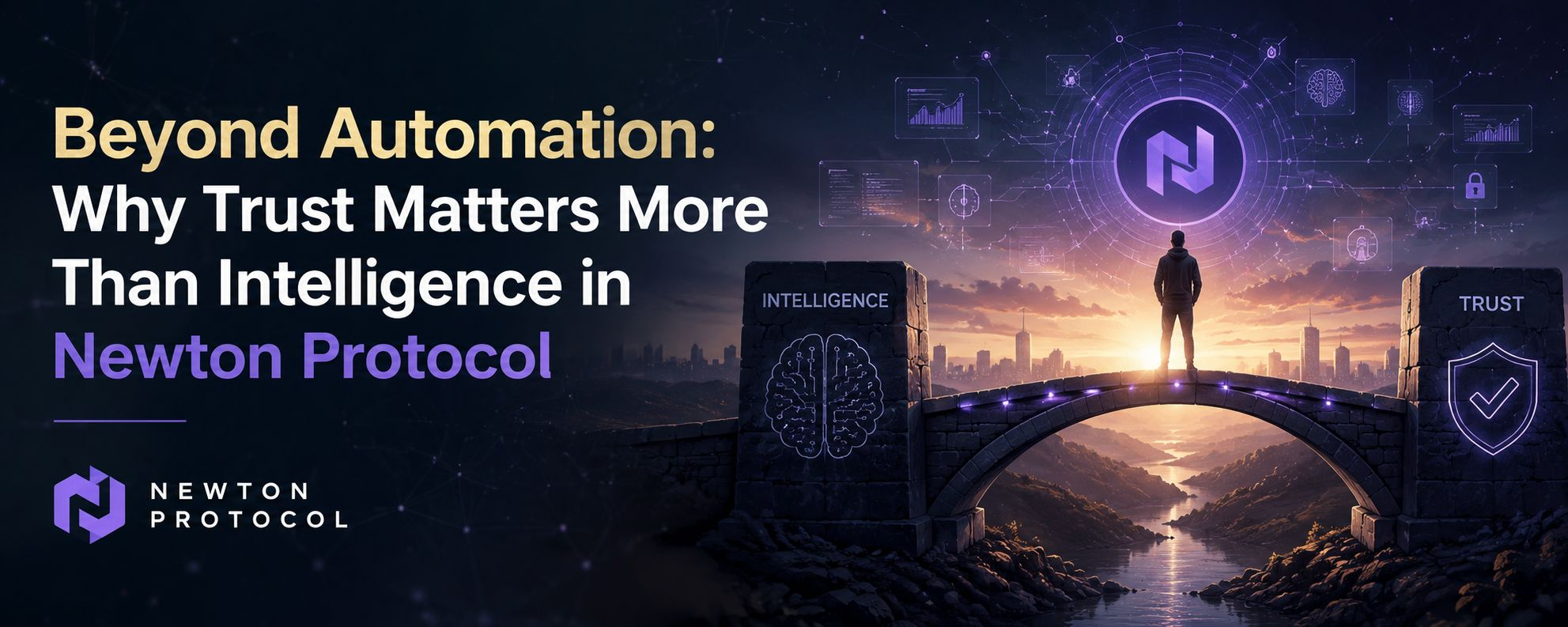
1
96
·
--
مقالة
Beyond Automation: Why Trust Matters More Than Intelligence in Newton ProtocolI keep coming back to one question whenever I read about new blockchain projects: can we ever build systems that people are willing to trust without asking them to blindly trust the people behind them? To me, that question feels much bigger than cryptocurrency itself. It touches the way we interact with technology, the choices we delegate to software, and the balance between convenience and control. As artificial intelligence becomes more capable, that question feels even more important. AI can make decisions faster than people, but speed alone does not create confidence. If anything, it makes trust more difficult because the process often becomes less visible.
I think that is where many conversations around AI and crypto become too simple. One side imagines a future where intelligent agents manage everything from investments to business operations. The other side dismisses the idea as another passing trend driven by speculation. Both perspectives miss something important. Technology rarely succeeds because it sounds impressive. It succeeds when ordinary people believe they understand enough of it to use it without feeling powerless.
That is one reason Newton Protocol caught my attention. I did not find it interesting because it promises AI-driven strategies, automated trading, or a marketplace for AI developers. Many projects mention similar ideas in one form or another. What made me pause was the underlying direction. Instead of treating AI as something that should simply be unleashed into decentralized finance, Newton Protocol appears to ask a more practical question: how can intelligent systems operate in a way that remains accountable inside blockchain infrastructure?
To me, that feels like a healthier place to begin.
The deeper challenge has never been creating smarter software. We already see AI writing, analyzing data, generating code, and assisting with decisions every day. The harder challenge is knowing when those decisions deserve our confidence. In financial systems, confidence is fragile because mistakes have real consequences. An algorithm that executes thousands of trades automatically might be incredibly efficient, but efficiency means very little if users cannot understand the rules under which it operates or verify that those rules are being followed.
I feel that blockchain and AI often solve opposite problems. Blockchain is built around transparency, verification, and predictable execution. AI is built around learning patterns that can sometimes appear unpredictable from the outside. Combining those worlds is exciting, but it is also uncomfortable because each one exposes the limitations of the other. Blockchain reminds us that trust should be earned through verification. AI reminds us that many valuable decisions cannot always be reduced to simple formulas.
Newton Protocol seems to recognize this tension instead of pretending it does not exist. Rather than presenting AI as something magical, the project appears to focus on creating an environment where AI-driven strategies can exist within clearer boundaries. That distinction matters to me because responsible technology usually grows through constraints, not unlimited freedom. A system that acknowledges its own limits often feels more believable than one claiming to solve every problem at once.
Of course, believing in an idea is very different from seeing it succeed in practice. Crypto has introduced countless ambitious concepts over the years, yet many struggled not because the ideas were impossible but because adoption proved much harder than expected. People do not change habits simply because better technology exists. They change when the benefits clearly outweigh the uncertainty, and when using the system feels easier than avoiding it.
That is why I think user behavior matters more than technical ambition. A protocol can be secure, efficient, and carefully designed, but if developers do not build meaningful applications or users hesitate to trust automated systems with valuable assets, growth becomes difficult. Trust is not downloaded with software updates. It develops slowly through experience, reliability, and consistent execution over time.
I also keep thinking about the developers themselves. Building AI tools for decentralized environments is not only about writing code. It requires thinking about incentives, accountability, and the unintended consequences of automation. A marketplace for AI developers sounds useful in principle because innovation often happens when creators can build on shared infrastructure instead of starting from scratch. Yet the real value of such an ecosystem depends on the quality of what people actually create. Good infrastructure opens possibilities, but it cannot guarantee meaningful outcomes.
The same uncertainty applies to the NEWT token. I think it is important to separate the usefulness of a protocol from the market behavior of its native asset. Tokens exist inside markets shaped by many forces beyond technology itself. Adoption, liquidity, investor sentiment, broader economic conditions, regulatory developments, and consistent project execution all influence price. Even strong ideas sometimes struggle in weak markets, while less impressive projects occasionally experience temporary excitement driven by speculation alone.
Because of that, I do not see NEWT as something whose future can be understood through simple optimism or pessimism. It is ultimately a speculative asset connected to a developing ecosystem. Whether its long-term value grows will depend on whether the protocol becomes genuinely useful, whether developers choose to build within it, whether users trust the applications created there, and whether the team continues delivering on its vision. None of those outcomes are guaranteed, and I think acknowledging that uncertainty makes the conversation more honest.
What I appreciate most is that the broader discussion does not have to revolve around price charts. Markets will always fluctuate, and narratives will change with them. But the larger question remains remarkably stable. Can AI become something people rely on without forcing them to surrender transparency or accountability? I believe that is the real issue projects like Newton Protocol are attempting to explore.
Whether Newton Protocol ultimately succeeds or not, I think the question it raises is worth asking. The future of crypto may not belong to the loudest promises or the fastest automation. It may belong to systems that quietly earn confidence through careful design and practical usefulness. If AI is going to become part of decentralized finance, it cannot simply be intelligent. It also has to be understandable enough that people feel comfortable placing real responsibility in its hands.
I keep coming back to that original question because I suspect it will outlast individual market cycles and individual projects. Technology evolves quickly, but trust moves at a human pace. Newton Protocol represents one attempt to bridge those two realities. Whether that bridge becomes widely used remains uncertain, and there are many obstacles ahead. Still, I think the conversation it encourages is more valuable than any short-term excitement surrounding it. In the end, the future may depend less on how powerful our intelligent systems become and more on whether they give people convincing reasons to trust them without ever asking for blind faith.
@NewtonProtocol #Newt $NEWT
{future}(NEWTUSDT)
Beyond Automation: Why Trust Matters More Than Intelligence in Newton Protocol
I keep coming back to one question whenever I read about new blockchain projects: can we ever build systems that people are willing to trust without asking them to blindly trust the people behind them? To me, that question feels much bigger than cryptocurrency itself. It touches the way we interact with technology, the choices we delegate to software, and the balance between convenience and control. As artificial intelligence becomes more capable, that question feels even more important. AI can make decisions faster than people, but speed alone does not create confidence. If anything, it makes trust more difficult because the process often becomes less visible.
I think that is where many conversations around AI and crypto become too simple. One side imagines a future where intelligent agents manage everything from investments to business operations. The other side dismisses the idea as another passing trend driven by speculation. Both perspectives miss something important. Technology rarely succeeds because it sounds impressive. It succeeds when ordinary people believe they understand enough of it to use it without feeling powerless.
That is one reason Newton Protocol caught my attention. I did not find it interesting because it promises AI-driven strategies, automated trading, or a marketplace for AI developers. Many projects mention similar ideas in one form or another. What made me pause was the underlying direction. Instead of treating AI as something that should simply be unleashed into decentralized finance, Newton Protocol appears to ask a more practical question: how can intelligent systems operate in a way that remains accountable inside blockchain infrastructure?
To me, that feels like a healthier place to begin.
The deeper challenge has never been creating smarter software. We already see AI writing, analyzing data, generating code, and assisting with decisions every day. The harder challenge is knowing when those decisions deserve our confidence. In financial systems, confidence is fragile because mistakes have real consequences. An algorithm that executes thousands of trades automatically might be incredibly efficient, but efficiency means very little if users cannot understand the rules under which it operates or verify that those rules are being followed.
I feel that blockchain and AI often solve opposite problems. Blockchain is built around transparency, verification, and predictable execution. AI is built around learning patterns that can sometimes appear unpredictable from the outside. Combining those worlds is exciting, but it is also uncomfortable because each one exposes the limitations of the other. Blockchain reminds us that trust should be earned through verification. AI reminds us that many valuable decisions cannot always be reduced to simple formulas.
Newton Protocol seems to recognize this tension instead of pretending it does not exist. Rather than presenting AI as something magical, the project appears to focus on creating an environment where AI-driven strategies can exist within clearer boundaries. That distinction matters to me because responsible technology usually grows through constraints, not unlimited freedom. A system that acknowledges its own limits often feels more believable than one claiming to solve every problem at once.
Of course, believing in an idea is very different from seeing it succeed in practice. Crypto has introduced countless ambitious concepts over the years, yet many struggled not because the ideas were impossible but because adoption proved much harder than expected. People do not change habits simply because better technology exists. They change when the benefits clearly outweigh the uncertainty, and when using the system feels easier than avoiding it.
That is why I think user behavior matters more than technical ambition. A protocol can be secure, efficient, and carefully designed, but if developers do not build meaningful applications or users hesitate to trust automated systems with valuable assets, growth becomes difficult. Trust is not downloaded with software updates. It develops slowly through experience, reliability, and consistent execution over time.
I also keep thinking about the developers themselves. Building AI tools for decentralized environments is not only about writing code. It requires thinking about incentives, accountability, and the unintended consequences of automation. A marketplace for AI developers sounds useful in principle because innovation often happens when creators can build on shared infrastructure instead of starting from scratch. Yet the real value of such an ecosystem depends on the quality of what people actually create. Good infrastructure opens possibilities, but it cannot guarantee meaningful outcomes.
The same uncertainty applies to the NEWT token. I think it is important to separate the usefulness of a protocol from the market behavior of its native asset. Tokens exist inside markets shaped by many forces beyond technology itself. Adoption, liquidity, investor sentiment, broader economic conditions, regulatory developments, and consistent project execution all influence price. Even strong ideas sometimes struggle in weak markets, while less impressive projects occasionally experience temporary excitement driven by speculation alone.
Because of that, I do not see NEWT as something whose future can be understood through simple optimism or pessimism. It is ultimately a speculative asset connected to a developing ecosystem. Whether its long-term value grows will depend on whether the protocol becomes genuinely useful, whether developers choose to build within it, whether users trust the applications created there, and whether the team continues delivering on its vision. None of those outcomes are guaranteed, and I think acknowledging that uncertainty makes the conversation more honest.
What I appreciate most is that the broader discussion does not have to revolve around price charts. Markets will always fluctuate, and narratives will change with them. But the larger question remains remarkably stable. Can AI become something people rely on without forcing them to surrender transparency or accountability? I believe that is the real issue projects like Newton Protocol are attempting to explore.
Whether Newton Protocol ultimately succeeds or not, I think the question it raises is worth asking. The future of crypto may not belong to the loudest promises or the fastest automation. It may belong to systems that quietly earn confidence through careful design and practical usefulness. If AI is going to become part of decentralized finance, it cannot simply be intelligent. It also has to be understandable enough that people feel comfortable placing real responsibility in its hands.
I keep coming back to that original question because I suspect it will outlast individual market cycles and individual projects. Technology evolves quickly, but trust moves at a human pace. Newton Protocol represents one attempt to bridge those two realities. Whether that bridge becomes widely used remains uncertain, and there are many obstacles ahead. Still, I think the conversation it encourages is more valuable than any short-term excitement surrounding it. In the end, the future may depend less on how powerful our intelligent systems become and more on whether they give people convincing reasons to trust them without ever asking for blind faith.
@NewtonProtocol #Newt $NEWT
I think that is where many conversations around AI and crypto become too simple. One side imagines a future where intelligent agents manage everything from investments to business operations. The other side dismisses the idea as another passing trend driven by speculation. Both perspectives miss something important. Technology rarely succeeds because it sounds impressive. It succeeds when ordinary people believe they understand enough of it to use it without feeling powerless.
That is one reason Newton Protocol caught my attention. I did not find it interesting because it promises AI-driven strategies, automated trading, or a marketplace for AI developers. Many projects mention similar ideas in one form or another. What made me pause was the underlying direction. Instead of treating AI as something that should simply be unleashed into decentralized finance, Newton Protocol appears to ask a more practical question: how can intelligent systems operate in a way that remains accountable inside blockchain infrastructure?
To me, that feels like a healthier place to begin.
The deeper challenge has never been creating smarter software. We already see AI writing, analyzing data, generating code, and assisting with decisions every day. The harder challenge is knowing when those decisions deserve our confidence. In financial systems, confidence is fragile because mistakes have real consequences. An algorithm that executes thousands of trades automatically might be incredibly efficient, but efficiency means very little if users cannot understand the rules under which it operates or verify that those rules are being followed.
I feel that blockchain and AI often solve opposite problems. Blockchain is built around transparency, verification, and predictable execution. AI is built around learning patterns that can sometimes appear unpredictable from the outside. Combining those worlds is exciting, but it is also uncomfortable because each one exposes the limitations of the other. Blockchain reminds us that trust should be earned through verification. AI reminds us that many valuable decisions cannot always be reduced to simple formulas.
Newton Protocol seems to recognize this tension instead of pretending it does not exist. Rather than presenting AI as something magical, the project appears to focus on creating an environment where AI-driven strategies can exist within clearer boundaries. That distinction matters to me because responsible technology usually grows through constraints, not unlimited freedom. A system that acknowledges its own limits often feels more believable than one claiming to solve every problem at once.
Of course, believing in an idea is very different from seeing it succeed in practice. Crypto has introduced countless ambitious concepts over the years, yet many struggled not because the ideas were impossible but because adoption proved much harder than expected. People do not change habits simply because better technology exists. They change when the benefits clearly outweigh the uncertainty, and when using the system feels easier than avoiding it.
That is why I think user behavior matters more than technical ambition. A protocol can be secure, efficient, and carefully designed, but if developers do not build meaningful applications or users hesitate to trust automated systems with valuable assets, growth becomes difficult. Trust is not downloaded with software updates. It develops slowly through experience, reliability, and consistent execution over time.
I also keep thinking about the developers themselves. Building AI tools for decentralized environments is not only about writing code. It requires thinking about incentives, accountability, and the unintended consequences of automation. A marketplace for AI developers sounds useful in principle because innovation often happens when creators can build on shared infrastructure instead of starting from scratch. Yet the real value of such an ecosystem depends on the quality of what people actually create. Good infrastructure opens possibilities, but it cannot guarantee meaningful outcomes.
The same uncertainty applies to the NEWT token. I think it is important to separate the usefulness of a protocol from the market behavior of its native asset. Tokens exist inside markets shaped by many forces beyond technology itself. Adoption, liquidity, investor sentiment, broader economic conditions, regulatory developments, and consistent project execution all influence price. Even strong ideas sometimes struggle in weak markets, while less impressive projects occasionally experience temporary excitement driven by speculation alone.
Because of that, I do not see NEWT as something whose future can be understood through simple optimism or pessimism. It is ultimately a speculative asset connected to a developing ecosystem. Whether its long-term value grows will depend on whether the protocol becomes genuinely useful, whether developers choose to build within it, whether users trust the applications created there, and whether the team continues delivering on its vision. None of those outcomes are guaranteed, and I think acknowledging that uncertainty makes the conversation more honest.
What I appreciate most is that the broader discussion does not have to revolve around price charts. Markets will always fluctuate, and narratives will change with them. But the larger question remains remarkably stable. Can AI become something people rely on without forcing them to surrender transparency or accountability? I believe that is the real issue projects like Newton Protocol are attempting to explore.
Whether Newton Protocol ultimately succeeds or not, I think the question it raises is worth asking. The future of crypto may not belong to the loudest promises or the fastest automation. It may belong to systems that quietly earn confidence through careful design and practical usefulness. If AI is going to become part of decentralized finance, it cannot simply be intelligent. It also has to be understandable enough that people feel comfortable placing real responsibility in its hands.
I keep coming back to that original question because I suspect it will outlast individual market cycles and individual projects. Technology evolves quickly, but trust moves at a human pace. Newton Protocol represents one attempt to bridge those two realities. Whether that bridge becomes widely used remains uncertain, and there are many obstacles ahead. Still, I think the conversation it encourages is more valuable than any short-term excitement surrounding it. In the end, the future may depend less on how powerful our intelligent systems become and more on whether they give people convincing reasons to trust them without ever asking for blind faith.
@NewtonProtocol #Newt $NEWT
116
·
--
The more I think about AI in crypto, the less I believe the biggest challenge is building smarter systems. I think the real challenge is building systems people can actually trust.
That is why Newton Protocol (NEWT) caught my attention. Instead of treating AI like a magic solution, it focuses on creating an environment where AI-driven strategies can operate with greater transparency and secure execution. To me, that feels more practical than chasing hype.
AI will likely play a larger role in finance over time, but automation alone is not enough. Users need confidence that these systems behave as expected and that the underlying infrastructure is reliable. Trust is something that takes years to build.
Of course, Newton Protocol is still an evolving project. Its long-term success depends on adoption, developer participation, execution, and the ability to solve real problems. The NEWT token is also speculative, with its value influenced by market sentiment, liquidity, and ecosystem growth rather than technology alone.
I am not looking at Newton Protocol as a guaranteed winner. I simply see it as a thoughtful attempt to address an important question: if AI becomes part of decentralized finance, how do we build systems that people are willing to trust?
#newt $NEWT @NewtonProtocol #Newt
{spot}(NEWTUSDT)
The more I think about AI in crypto, the less I believe the biggest challenge is building smarter systems. I think the real challenge is building systems people can actually trust.
That is why Newton Protocol (NEWT) caught my attention. Instead of treating AI like a magic solution, it focuses on creating an environment where AI-driven strategies can operate with greater transparency and secure execution. To me, that feels more practical than chasing hype.
AI will likely play a larger role in finance over time, but automation alone is not enough. Users need confidence that these systems behave as expected and that the underlying infrastructure is reliable. Trust is something that takes years to build.
Of course, Newton Protocol is still an evolving project. Its long-term success depends on adoption, developer participation, execution, and the ability to solve real problems. The NEWT token is also speculative, with its value influenced by market sentiment, liquidity, and ecosystem growth rather than technology alone.
I am not looking at Newton Protocol as a guaranteed winner. I simply see it as a thoughtful attempt to address an important question: if AI becomes part of decentralized finance, how do we build systems that people are willing to trust?
#newt $NEWT @NewtonProtocol #Newt
That is why Newton Protocol (NEWT) caught my attention. Instead of treating AI like a magic solution, it focuses on creating an environment where AI-driven strategies can operate with greater transparency and secure execution. To me, that feels more practical than chasing hype.
AI will likely play a larger role in finance over time, but automation alone is not enough. Users need confidence that these systems behave as expected and that the underlying infrastructure is reliable. Trust is something that takes years to build.
Of course, Newton Protocol is still an evolving project. Its long-term success depends on adoption, developer participation, execution, and the ability to solve real problems. The NEWT token is also speculative, with its value influenced by market sentiment, liquidity, and ecosystem growth rather than technology alone.
I am not looking at Newton Protocol as a guaranteed winner. I simply see it as a thoughtful attempt to address an important question: if AI becomes part of decentralized finance, how do we build systems that people are willing to trust?
#newt $NEWT @NewtonProtocol #Newt
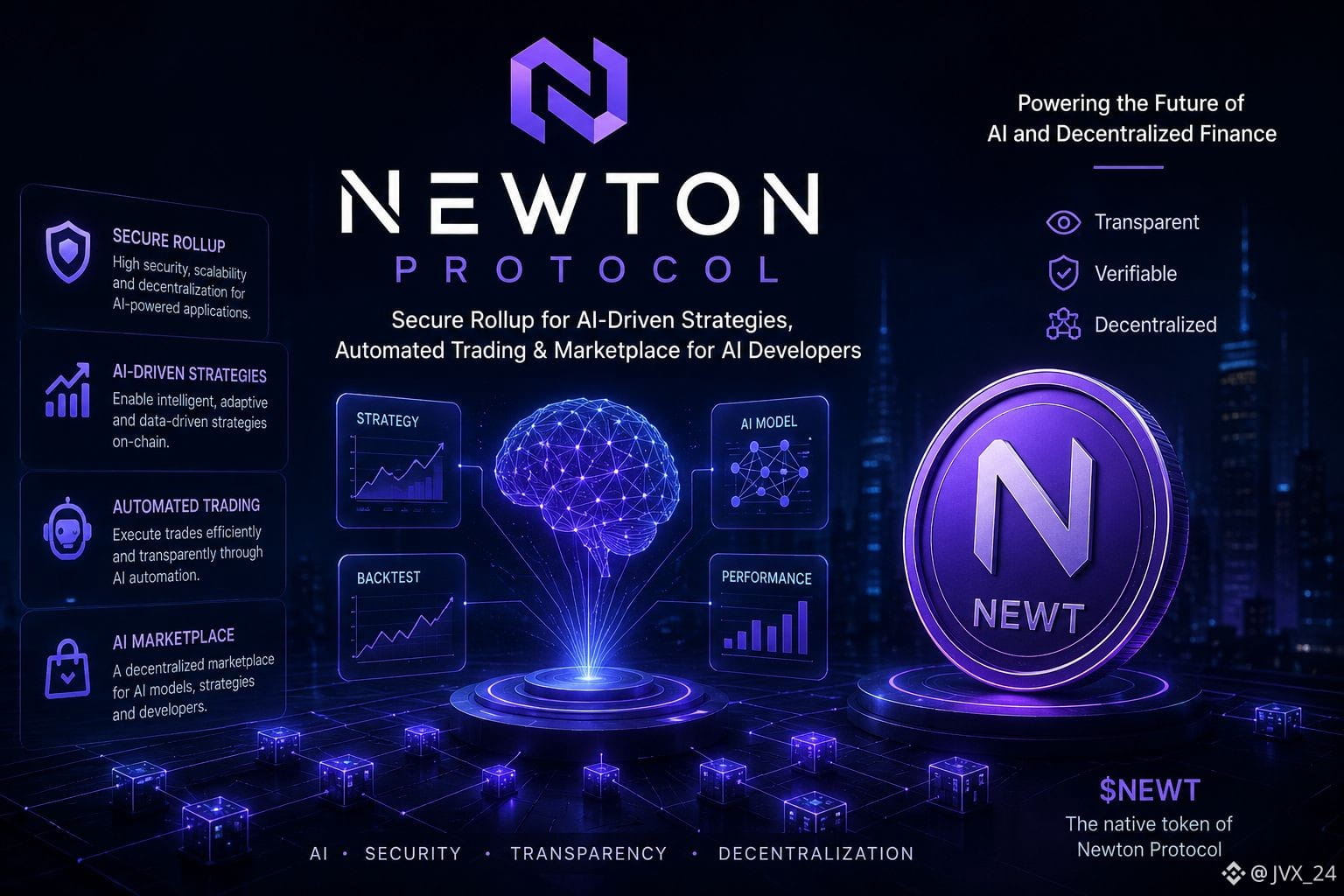
1
104
·
--
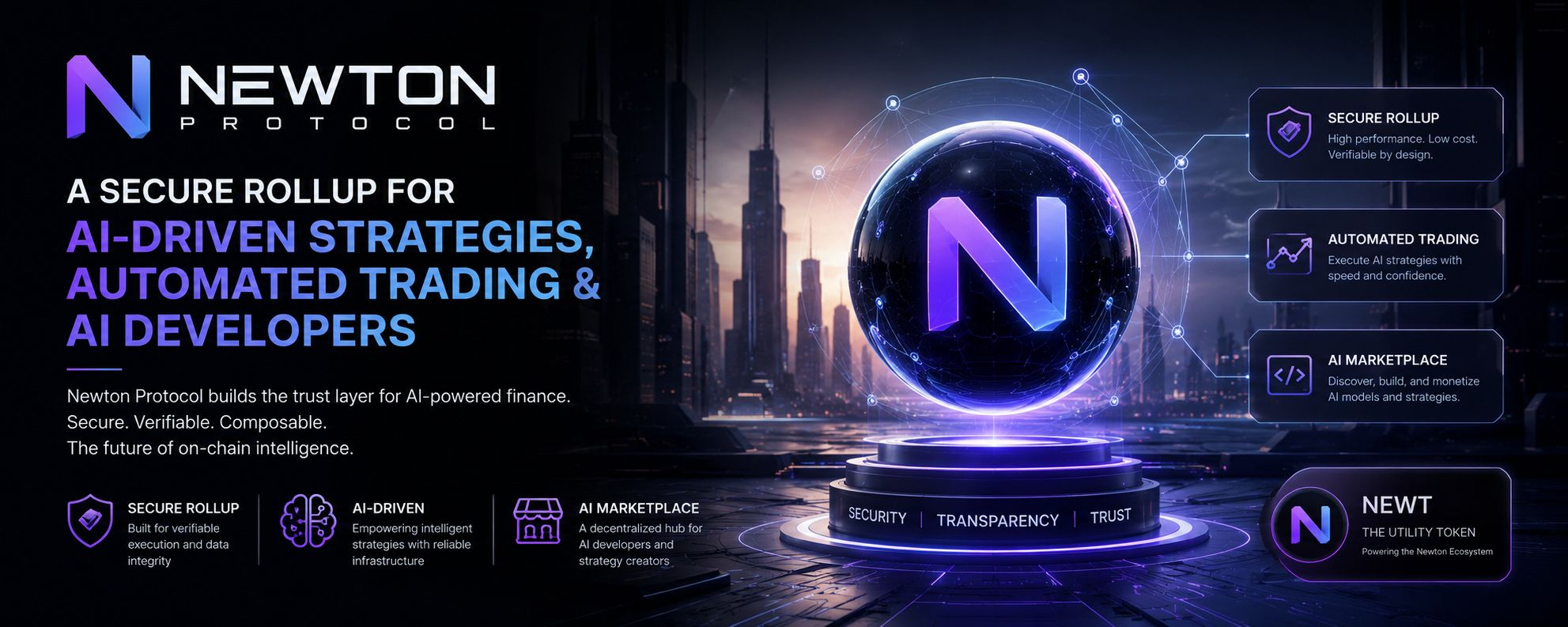
مقالة
Beyond Smarter Machines: Why Trust May Be the Real Currency Behind Newton ProtocolI keep coming back to one question whenever I think about the future of crypto: how do we know when we should trust a system that is making decisions faster than we can even understand them?
That question feels more important to me than discussions about speed, scalability, or the latest market trend. Technology has reached a point where automation is no longer a distant possibility. It is becoming part of how people trade, invest, manage risk, and even build software. Yet I often feel that the conversation around AI and blockchain skips over the uncomfortable part. We celebrate what machines can do without spending enough time asking how those actions can remain transparent, accountable, and worthy of trust.
I think that gap is where many projects struggle. They promise intelligence, automation, and efficiency, but they rarely explain why users should feel comfortable handing over meaningful decisions to systems they cannot fully inspect. Faster execution is valuable, but speed alone has never been the same as confidence. If anything, moving faster without stronger foundations can simply make mistakes happen more quickly.
That is why Newton Protocol caught my attention.
Not because it claims to combine AI with blockchain. Many projects have already tried to build that narrative. Instead, I found myself thinking about the problem it appears to be addressing. To me, the real challenge is not creating more intelligent trading systems. The challenge is creating an environment where automated strategies can exist without forcing users to blindly trust the people or algorithms behind them.
I feel that this distinction matters more than it first appears.
Automation changes the relationship between humans and financial decisions. In traditional investing, people often accept responsibility for every choice they make, even if those choices are emotional or imperfect. AI changes that dynamic. Decisions can happen in milliseconds. Complex strategies may react to hundreds of market signals before a person even realizes what is happening. While that sounds impressive, it also creates a different kind of uncertainty. If something goes wrong, where does accountability exist?
That question has stayed with me.
Newton Protocol seems to approach this issue from a more practical direction. Rather than treating AI as something magical that automatically improves every outcome, it appears to recognize that automated systems need secure infrastructure before they deserve widespread confidence. To me, that feels like a healthier starting point than simply promising smarter algorithms.
I also find the idea of creating a marketplace for AI developers interesting, though not because marketplaces are new. Markets already exist everywhere. What matters is whether people can evaluate quality, understand risk, and build reputations over time. Without those elements, a marketplace becomes little more than a collection of competing claims.
Trust cannot be programmed with a single line of code.
It develops slowly through consistency, transparency, and repeated experience. I think many crypto projects underestimate how patient that process can be. Communities may become excited during launches, but genuine trust often requires years rather than months.
That is another reason I do not see Newton Protocol as a project that should be judged solely by its technical architecture. Technology creates possibilities, but adoption decides whether those possibilities matter. A protocol can be elegant on paper and still struggle if users cannot understand its value or if developers choose other ecosystems instead.
Real adoption has always been difficult.
People rarely change established habits unless the alternative solves a problem they genuinely experience. I believe this is true inside crypto just as much as outside it. Building secure infrastructure is important, but convincing traders, developers, and institutions to rely on it is an entirely different challenge.
Sometimes the hardest part of innovation is not engineering. It is changing behavior.
That is why I remain careful whenever I think about projects connected to artificial intelligence. Public excitement often moves much faster than practical implementation. Expectations become enormous before products have enough time to mature. Eventually reality catches up, and only the projects with meaningful utility continue evolving.
I feel Newton Protocol exists within that same environment. It benefits from growing interest in AI, but it also inherits the pressure that comes with that attention. People naturally expect revolutionary outcomes whenever AI becomes part of a project's identity. Those expectations can become unrealistic, making it difficult for any team to satisfy the market regardless of the quality of their work.
This also shapes how I think about the NEWT token.
Like many digital assets, its future value depends on factors that extend far beyond technology itself. Adoption, liquidity, community participation, market sentiment, regulatory developments, competition, and the team's ability to execute all play meaningful roles. Even excellent ideas can struggle if they fail to attract sustainable ecosystems, while less ambitious projects sometimes succeed because timing happens to work in their favor.
That uncertainty is something I consider healthy to acknowledge.
Too often, conversations about tokens become simplified into stories about inevitable growth or guaranteed success. I do not find those narratives convincing anymore. Markets are influenced by countless variables that no individual can predict with confidence. The NEWT token is part of an evolving ecosystem, and like any emerging asset, it carries meaningful uncertainty alongside its potential usefulness.
Perhaps that honesty makes the project more interesting rather than less.
I think mature conversations about crypto should leave room for both optimism and skepticism. Innovation deserves attention, but questions deserve equal attention. If people stop asking difficult questions simply because a technology sounds exciting, they risk confusing possibility with certainty.
To me, Newton Protocol feels grounded because it seems to begin with a real problem instead of an impossible promise. It acknowledges, at least in principle, that AI-driven systems require reliable foundations before they can earn widespread confidence. Whether that vision ultimately succeeds is impossible to know today, but I appreciate that the conversation begins with infrastructure rather than hype.
The crypto industry has always been full of ambitious ideas. Some changed the landscape forever. Others disappeared almost as quickly as they arrived. The difference was rarely determined by excitement alone. Long-term usefulness usually came from solving problems that continued to exist after the headlines faded.
I keep coming back to that original question because I think it extends beyond Newton Protocol itself. As AI becomes more deeply integrated into financial systems, we will eventually need to decide not only what machines can do, but what responsibilities we are willing to give them. That conversation will shape the future of digital finance far more than any short-term market movement.
For me, Newton Protocol represents one attempt to engage with that larger question. Whether it ultimately becomes an important part of the answer remains uncertain. The technology will continue evolving, the ecosystem will face challenges, and the NEWT token will experience the same unpredictable forces that influence every emerging crypto asset.
In the end, I am less interested in whether any single project wins and more interested in whether the industry learns to build systems that people can trust without asking them to suspend their judgment. If that future is possible, it will not come from promises alone. It will come from patient execution, transparent design, and the willingness to earn confidence one step at a time.
@NewtonProtocol #Newt $NEWT
{future}(NEWTUSDT)
Beyond Smarter Machines: Why Trust May Be the Real Currency Behind Newton Protocol
I keep coming back to one question whenever I think about the future of crypto: how do we know when we should trust a system that is making decisions faster than we can even understand them?
That question feels more important to me than discussions about speed, scalability, or the latest market trend. Technology has reached a point where automation is no longer a distant possibility. It is becoming part of how people trade, invest, manage risk, and even build software. Yet I often feel that the conversation around AI and blockchain skips over the uncomfortable part. We celebrate what machines can do without spending enough time asking how those actions can remain transparent, accountable, and worthy of trust.
I think that gap is where many projects struggle. They promise intelligence, automation, and efficiency, but they rarely explain why users should feel comfortable handing over meaningful decisions to systems they cannot fully inspect. Faster execution is valuable, but speed alone has never been the same as confidence. If anything, moving faster without stronger foundations can simply make mistakes happen more quickly.
That is why Newton Protocol caught my attention.
Not because it claims to combine AI with blockchain. Many projects have already tried to build that narrative. Instead, I found myself thinking about the problem it appears to be addressing. To me, the real challenge is not creating more intelligent trading systems. The challenge is creating an environment where automated strategies can exist without forcing users to blindly trust the people or algorithms behind them.
I feel that this distinction matters more than it first appears.
Automation changes the relationship between humans and financial decisions. In traditional investing, people often accept responsibility for every choice they make, even if those choices are emotional or imperfect. AI changes that dynamic. Decisions can happen in milliseconds. Complex strategies may react to hundreds of market signals before a person even realizes what is happening. While that sounds impressive, it also creates a different kind of uncertainty. If something goes wrong, where does accountability exist?
That question has stayed with me.
Newton Protocol seems to approach this issue from a more practical direction. Rather than treating AI as something magical that automatically improves every outcome, it appears to recognize that automated systems need secure infrastructure before they deserve widespread confidence. To me, that feels like a healthier starting point than simply promising smarter algorithms.
I also find the idea of creating a marketplace for AI developers interesting, though not because marketplaces are new. Markets already exist everywhere. What matters is whether people can evaluate quality, understand risk, and build reputations over time. Without those elements, a marketplace becomes little more than a collection of competing claims.
Trust cannot be programmed with a single line of code.
It develops slowly through consistency, transparency, and repeated experience. I think many crypto projects underestimate how patient that process can be. Communities may become excited during launches, but genuine trust often requires years rather than months.
That is another reason I do not see Newton Protocol as a project that should be judged solely by its technical architecture. Technology creates possibilities, but adoption decides whether those possibilities matter. A protocol can be elegant on paper and still struggle if users cannot understand its value or if developers choose other ecosystems instead.
Real adoption has always been difficult.
People rarely change established habits unless the alternative solves a problem they genuinely experience. I believe this is true inside crypto just as much as outside it. Building secure infrastructure is important, but convincing traders, developers, and institutions to rely on it is an entirely different challenge.
Sometimes the hardest part of innovation is not engineering. It is changing behavior.
That is why I remain careful whenever I think about projects connected to artificial intelligence. Public excitement often moves much faster than practical implementation. Expectations become enormous before products have enough time to mature. Eventually reality catches up, and only the projects with meaningful utility continue evolving.
I feel Newton Protocol exists within that same environment. It benefits from growing interest in AI, but it also inherits the pressure that comes with that attention. People naturally expect revolutionary outcomes whenever AI becomes part of a project's identity. Those expectations can become unrealistic, making it difficult for any team to satisfy the market regardless of the quality of their work.
This also shapes how I think about the NEWT token.
Like many digital assets, its future value depends on factors that extend far beyond technology itself. Adoption, liquidity, community participation, market sentiment, regulatory developments, competition, and the team's ability to execute all play meaningful roles. Even excellent ideas can struggle if they fail to attract sustainable ecosystems, while less ambitious projects sometimes succeed because timing happens to work in their favor.
That uncertainty is something I consider healthy to acknowledge.
Too often, conversations about tokens become simplified into stories about inevitable growth or guaranteed success. I do not find those narratives convincing anymore. Markets are influenced by countless variables that no individual can predict with confidence. The NEWT token is part of an evolving ecosystem, and like any emerging asset, it carries meaningful uncertainty alongside its potential usefulness.
Perhaps that honesty makes the project more interesting rather than less.
I think mature conversations about crypto should leave room for both optimism and skepticism. Innovation deserves attention, but questions deserve equal attention. If people stop asking difficult questions simply because a technology sounds exciting, they risk confusing possibility with certainty.
To me, Newton Protocol feels grounded because it seems to begin with a real problem instead of an impossible promise. It acknowledges, at least in principle, that AI-driven systems require reliable foundations before they can earn widespread confidence. Whether that vision ultimately succeeds is impossible to know today, but I appreciate that the conversation begins with infrastructure rather than hype.
The crypto industry has always been full of ambitious ideas. Some changed the landscape forever. Others disappeared almost as quickly as they arrived. The difference was rarely determined by excitement alone. Long-term usefulness usually came from solving problems that continued to exist after the headlines faded.
I keep coming back to that original question because I think it extends beyond Newton Protocol itself. As AI becomes more deeply integrated into financial systems, we will eventually need to decide not only what machines can do, but what responsibilities we are willing to give them. That conversation will shape the future of digital finance far more than any short-term market movement.
For me, Newton Protocol represents one attempt to engage with that larger question. Whether it ultimately becomes an important part of the answer remains uncertain. The technology will continue evolving, the ecosystem will face challenges, and the NEWT token will experience the same unpredictable forces that influence every emerging crypto asset.
In the end, I am less interested in whether any single project wins and more interested in whether the industry learns to build systems that people can trust without asking them to suspend their judgment. If that future is possible, it will not come from promises alone. It will come from patient execution, transparent design, and the willingness to earn confidence one step at a time.
@NewtonProtocol #Newt $NEWT
That question feels more important to me than discussions about speed, scalability, or the latest market trend. Technology has reached a point where automation is no longer a distant possibility. It is becoming part of how people trade, invest, manage risk, and even build software. Yet I often feel that the conversation around AI and blockchain skips over the uncomfortable part. We celebrate what machines can do without spending enough time asking how those actions can remain transparent, accountable, and worthy of trust.
I think that gap is where many projects struggle. They promise intelligence, automation, and efficiency, but they rarely explain why users should feel comfortable handing over meaningful decisions to systems they cannot fully inspect. Faster execution is valuable, but speed alone has never been the same as confidence. If anything, moving faster without stronger foundations can simply make mistakes happen more quickly.
That is why Newton Protocol caught my attention.
Not because it claims to combine AI with blockchain. Many projects have already tried to build that narrative. Instead, I found myself thinking about the problem it appears to be addressing. To me, the real challenge is not creating more intelligent trading systems. The challenge is creating an environment where automated strategies can exist without forcing users to blindly trust the people or algorithms behind them.
I feel that this distinction matters more than it first appears.
Automation changes the relationship between humans and financial decisions. In traditional investing, people often accept responsibility for every choice they make, even if those choices are emotional or imperfect. AI changes that dynamic. Decisions can happen in milliseconds. Complex strategies may react to hundreds of market signals before a person even realizes what is happening. While that sounds impressive, it also creates a different kind of uncertainty. If something goes wrong, where does accountability exist?
That question has stayed with me.
Newton Protocol seems to approach this issue from a more practical direction. Rather than treating AI as something magical that automatically improves every outcome, it appears to recognize that automated systems need secure infrastructure before they deserve widespread confidence. To me, that feels like a healthier starting point than simply promising smarter algorithms.
I also find the idea of creating a marketplace for AI developers interesting, though not because marketplaces are new. Markets already exist everywhere. What matters is whether people can evaluate quality, understand risk, and build reputations over time. Without those elements, a marketplace becomes little more than a collection of competing claims.
Trust cannot be programmed with a single line of code.
It develops slowly through consistency, transparency, and repeated experience. I think many crypto projects underestimate how patient that process can be. Communities may become excited during launches, but genuine trust often requires years rather than months.
That is another reason I do not see Newton Protocol as a project that should be judged solely by its technical architecture. Technology creates possibilities, but adoption decides whether those possibilities matter. A protocol can be elegant on paper and still struggle if users cannot understand its value or if developers choose other ecosystems instead.
Real adoption has always been difficult.
People rarely change established habits unless the alternative solves a problem they genuinely experience. I believe this is true inside crypto just as much as outside it. Building secure infrastructure is important, but convincing traders, developers, and institutions to rely on it is an entirely different challenge.
Sometimes the hardest part of innovation is not engineering. It is changing behavior.
That is why I remain careful whenever I think about projects connected to artificial intelligence. Public excitement often moves much faster than practical implementation. Expectations become enormous before products have enough time to mature. Eventually reality catches up, and only the projects with meaningful utility continue evolving.
I feel Newton Protocol exists within that same environment. It benefits from growing interest in AI, but it also inherits the pressure that comes with that attention. People naturally expect revolutionary outcomes whenever AI becomes part of a project's identity. Those expectations can become unrealistic, making it difficult for any team to satisfy the market regardless of the quality of their work.
This also shapes how I think about the NEWT token.
Like many digital assets, its future value depends on factors that extend far beyond technology itself. Adoption, liquidity, community participation, market sentiment, regulatory developments, competition, and the team's ability to execute all play meaningful roles. Even excellent ideas can struggle if they fail to attract sustainable ecosystems, while less ambitious projects sometimes succeed because timing happens to work in their favor.
That uncertainty is something I consider healthy to acknowledge.
Too often, conversations about tokens become simplified into stories about inevitable growth or guaranteed success. I do not find those narratives convincing anymore. Markets are influenced by countless variables that no individual can predict with confidence. The NEWT token is part of an evolving ecosystem, and like any emerging asset, it carries meaningful uncertainty alongside its potential usefulness.
Perhaps that honesty makes the project more interesting rather than less.
I think mature conversations about crypto should leave room for both optimism and skepticism. Innovation deserves attention, but questions deserve equal attention. If people stop asking difficult questions simply because a technology sounds exciting, they risk confusing possibility with certainty.
To me, Newton Protocol feels grounded because it seems to begin with a real problem instead of an impossible promise. It acknowledges, at least in principle, that AI-driven systems require reliable foundations before they can earn widespread confidence. Whether that vision ultimately succeeds is impossible to know today, but I appreciate that the conversation begins with infrastructure rather than hype.
The crypto industry has always been full of ambitious ideas. Some changed the landscape forever. Others disappeared almost as quickly as they arrived. The difference was rarely determined by excitement alone. Long-term usefulness usually came from solving problems that continued to exist after the headlines faded.
I keep coming back to that original question because I think it extends beyond Newton Protocol itself. As AI becomes more deeply integrated into financial systems, we will eventually need to decide not only what machines can do, but what responsibilities we are willing to give them. That conversation will shape the future of digital finance far more than any short-term market movement.
For me, Newton Protocol represents one attempt to engage with that larger question. Whether it ultimately becomes an important part of the answer remains uncertain. The technology will continue evolving, the ecosystem will face challenges, and the NEWT token will experience the same unpredictable forces that influence every emerging crypto asset.
In the end, I am less interested in whether any single project wins and more interested in whether the industry learns to build systems that people can trust without asking them to suspend their judgment. If that future is possible, it will not come from promises alone. It will come from patient execution, transparent design, and the willingness to earn confidence one step at a time.
@NewtonProtocol #Newt $NEWT
7
3
143
·
--
When I first started reading about @NewtonProtocol , I realized the most interesting part wasn't AI itself. It was trust.
Everyone talks about smarter algorithms, faster automation, and AI-powered trading, but I think those conversations often skip the harder question. If AI is going to make decisions that affect real assets, how do we know those decisions can be trusted?
That is what makes Newton Protocol stand out to me. Instead of presenting AI as something magical, it focuses on building an environment where AI-driven strategies can operate with greater transparency and security. To me, that feels like a more practical direction.
Of course, the project is still developing, and there are no guarantees. Building technology is one challenge, but attracting developers, users, and long-term adoption is another. Success will depend on execution, community participation, and whether the ecosystem creates real value over time.
The NEWT token is also speculative. Its future depends on many factors, including adoption, liquidity, market sentiment, and continued development. I don't see it as something with guaranteed outcomes, but as part of a broader experiment exploring how AI and blockchain might work together more responsibly.
For me, Newton Protocol is less about hype and more about asking an important question: can intelligent systems also become trustworthy?
#newt $NEWT @NewtonProtocol #Newt
{spot}(NEWTUSDT)
When I first started reading about @NewtonProtocol , I realized the most interesting part wasn't AI itself. It was trust.
Everyone talks about smarter algorithms, faster automation, and AI-powered trading, but I think those conversations often skip the harder question. If AI is going to make decisions that affect real assets, how do we know those decisions can be trusted?
That is what makes Newton Protocol stand out to me. Instead of presenting AI as something magical, it focuses on building an environment where AI-driven strategies can operate with greater transparency and security. To me, that feels like a more practical direction.
Of course, the project is still developing, and there are no guarantees. Building technology is one challenge, but attracting developers, users, and long-term adoption is another. Success will depend on execution, community participation, and whether the ecosystem creates real value over time.
The NEWT token is also speculative. Its future depends on many factors, including adoption, liquidity, market sentiment, and continued development. I don't see it as something with guaranteed outcomes, but as part of a broader experiment exploring how AI and blockchain might work together more responsibly.
For me, Newton Protocol is less about hype and more about asking an important question: can intelligent systems also become trustworthy?
#newt $NEWT @NewtonProtocol #Newt
Everyone talks about smarter algorithms, faster automation, and AI-powered trading, but I think those conversations often skip the harder question. If AI is going to make decisions that affect real assets, how do we know those decisions can be trusted?
That is what makes Newton Protocol stand out to me. Instead of presenting AI as something magical, it focuses on building an environment where AI-driven strategies can operate with greater transparency and security. To me, that feels like a more practical direction.
Of course, the project is still developing, and there are no guarantees. Building technology is one challenge, but attracting developers, users, and long-term adoption is another. Success will depend on execution, community participation, and whether the ecosystem creates real value over time.
The NEWT token is also speculative. Its future depends on many factors, including adoption, liquidity, market sentiment, and continued development. I don't see it as something with guaranteed outcomes, but as part of a broader experiment exploring how AI and blockchain might work together more responsibly.
For me, Newton Protocol is less about hype and more about asking an important question: can intelligent systems also become trustworthy?
#newt $NEWT @NewtonProtocol #Newt
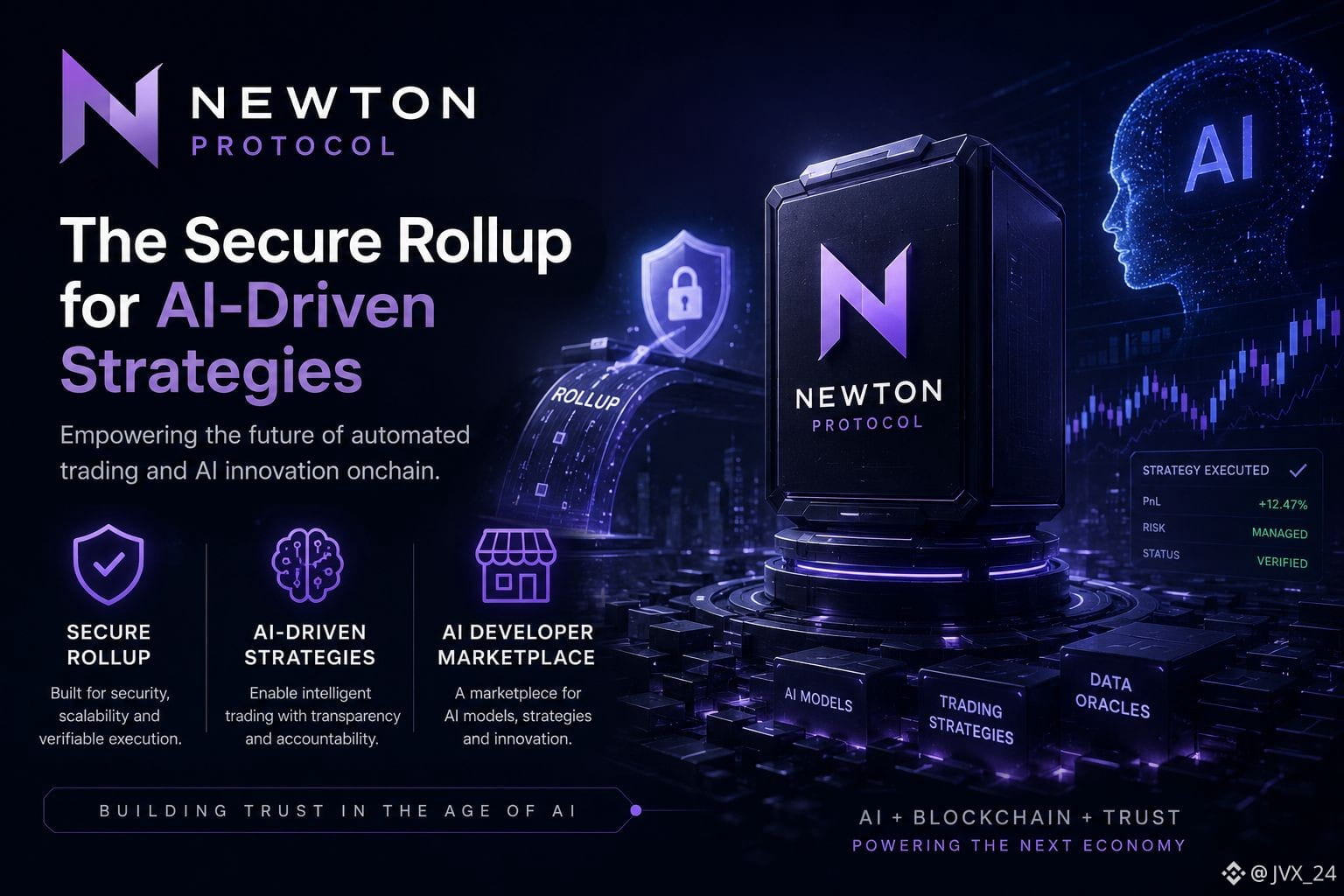
82
·
--
مقالة
The Missing Layer of AI: Why Newton Protocol Made Me Rethink Trust in CryptoI keep coming back to one question whenever I think about artificial intelligence and crypto: how do we know when a machine has earned our trust? Not whether it can generate better answers, execute trades faster, or process more data than a human. Those things matter, but they are not the whole story. To me, trust has always been the missing piece. We are building systems that can increasingly make decisions on our behalf, yet we still struggle with a simple question: who verifies that those decisions were made fairly, securely, and in the way we expected?
I think that question has become even more important as AI becomes more deeply connected with blockchain. The conversation often feels strangely incomplete. Most discussions revolve around speed, automation, or efficiency. There is always excitement about smarter trading bots, autonomous agents, and increasingly complex strategies. Those ideas are interesting, but they sometimes overlook the reality that automation also increases the consequences of mistakes. The more responsibility we hand to software, the more confidence we need that the software is behaving as intended.
That is why Newton Protocol caught my attention.
Not because it promises to replace human decision-making or because it claims to unlock some revolutionary future overnight. Instead, I feel it starts from a more practical place. Rather than assuming AI should simply be trusted, it asks how that trust can be supported by infrastructure designed for verification and accountability. That feels like a healthier direction than simply asking how AI can become more powerful.
When I first learned about the project, I found myself thinking less about its technical architecture and more about the environment it hopes to create. AI developers, automated trading strategies, and decentralized applications all have one thing in common. They rely on users believing that the system behind the scenes is operating honestly. That belief cannot rely entirely on reputation or marketing. Eventually, people want evidence. They want transparency where it matters and security where it counts.
To me, Newton Protocol seems to recognize that challenge.
The idea of creating a secure rollup designed around AI-driven strategies is interesting because it shifts attention away from AI as entertainment and toward AI as infrastructure. Infrastructure is rarely glamorous. People do not celebrate roads the same way they celebrate sports cars. Yet without reliable roads, the fastest car becomes much less useful. I think blockchain is reaching a similar point. Impressive AI applications may continue appearing, but the systems underneath them need to become trustworthy enough for people to depend on them over long periods.
That feels like a more difficult problem than simply building smarter algorithms.
Trust is not created because someone says a protocol is decentralized. It is built through consistency. It grows when users repeatedly experience systems behaving as expected. It survives when markets become volatile, when incentives change, and when unexpected situations appear. Those are the moments that reveal whether an ecosystem was designed carefully or simply designed to attract attention.
I also think there is an interesting human side to this conversation that often gets ignored.
People like convenience. We like systems that save time and reduce effort. Automated trading reflects that desire perfectly. Many participants would happily allow software to execute strategies if they believed the software was reliable. At the same time, people are naturally skeptical when money is involved. They want efficiency, but they also want reassurance. Those two desires can easily conflict with each other.
That tension may become one of the defining challenges of AI in crypto.
Newton Protocol appears to acknowledge that this balance matters. Instead of treating automation as the final destination, it seems to treat secure execution and verification as equally important parts of the equation. I find that perspective refreshing because it accepts that technology alone is not enough. Human confidence still determines whether any network becomes widely adopted.
Of course, ideas are always easier than execution.
Building technology is difficult. Building communities is even harder. Convincing developers to build within a new ecosystem takes time. Encouraging users to trust unfamiliar infrastructure requires patience. Even if the underlying design is strong, adoption depends on many moving parts that no team can completely control. Competition evolves quickly. Regulations change. User preferences shift. Markets often reward narratives long before they reward practical utility, and sometimes they never reward it at all.
That uncertainty is important to remember.
I think it is tempting to look at projects connected with AI and assume that every one of them will automatically benefit from growing interest in artificial intelligence. Reality is rarely that simple. A compelling idea still has to become a working ecosystem. Partnerships need to create genuine value rather than temporary headlines. Developers need reasons to remain active after initial excitement fades. Most importantly, users need to feel that using the protocol solves a real problem instead of introducing unnecessary complexity.
That applies to the NEWT token as well.
Whenever I evaluate a token, I try to separate the protocol from the market. The protocol represents an idea and a long-term vision. The token exists within financial markets that are driven by far more than technology alone. Adoption matters. Liquidity matters. Execution matters. Market sentiment matters. Broader economic conditions matter. Sometimes excellent projects struggle because timing works against them. Sometimes average projects experience remarkable price appreciation because narratives temporarily dominate fundamentals.
To me, that is exactly why tokens should be viewed carefully.
NEWT may eventually benefit if Newton Protocol succeeds in attracting developers, applications, and meaningful network activity. It may also face challenges if adoption develops more slowly than expected or if competing solutions solve similar problems more effectively. Neither outcome is guaranteed. That uncertainty is not a flaw unique to this project. It is simply the reality of emerging technologies where innovation moves faster than certainty.
I also appreciate that Newton Protocol feels grounded in a problem that is likely to remain relevant regardless of market cycles. AI will probably continue evolving. Blockchain infrastructure will continue evolving. As those worlds become more connected, questions about trust, verification, accountability, and secure execution are unlikely to disappear. In fact, they may become even more important as autonomous systems begin handling increasingly valuable decisions.
Whether Newton Protocol becomes a major part of that future is impossible for me to know.
But I do think it is asking one of the right questions.
Too many conversations begin with what AI can do. I find myself becoming more interested in how we decide when AI deserves our confidence. Those are different conversations, and I suspect the second one will matter much more over the coming years.
In the end, I keep returning to the same thought that started this reflection. Technology becomes meaningful only when people are willing to trust it enough to use it consistently. Faster systems, smarter models, and more sophisticated automation all have value, but they cannot replace confidence. Newton Protocol stands out to me because it seems less focused on making AI appear magical and more interested in making it accountable. Whether that approach ultimately succeeds remains uncertain, and the future of NEWT will depend on many factors that no one can predict with confidence. Still, I think projects that begin by asking difficult questions about trust are often more interesting than projects that promise easy answers.
@NewtonProtocol #Newt $NEWT #newt
{future}(NEWTUSDT)
The Missing Layer of AI: Why Newton Protocol Made Me Rethink Trust in Crypto
I keep coming back to one question whenever I think about artificial intelligence and crypto: how do we know when a machine has earned our trust? Not whether it can generate better answers, execute trades faster, or process more data than a human. Those things matter, but they are not the whole story. To me, trust has always been the missing piece. We are building systems that can increasingly make decisions on our behalf, yet we still struggle with a simple question: who verifies that those decisions were made fairly, securely, and in the way we expected?
I think that question has become even more important as AI becomes more deeply connected with blockchain. The conversation often feels strangely incomplete. Most discussions revolve around speed, automation, or efficiency. There is always excitement about smarter trading bots, autonomous agents, and increasingly complex strategies. Those ideas are interesting, but they sometimes overlook the reality that automation also increases the consequences of mistakes. The more responsibility we hand to software, the more confidence we need that the software is behaving as intended.
That is why Newton Protocol caught my attention.
Not because it promises to replace human decision-making or because it claims to unlock some revolutionary future overnight. Instead, I feel it starts from a more practical place. Rather than assuming AI should simply be trusted, it asks how that trust can be supported by infrastructure designed for verification and accountability. That feels like a healthier direction than simply asking how AI can become more powerful.
When I first learned about the project, I found myself thinking less about its technical architecture and more about the environment it hopes to create. AI developers, automated trading strategies, and decentralized applications all have one thing in common. They rely on users believing that the system behind the scenes is operating honestly. That belief cannot rely entirely on reputation or marketing. Eventually, people want evidence. They want transparency where it matters and security where it counts.
To me, Newton Protocol seems to recognize that challenge.
The idea of creating a secure rollup designed around AI-driven strategies is interesting because it shifts attention away from AI as entertainment and toward AI as infrastructure. Infrastructure is rarely glamorous. People do not celebrate roads the same way they celebrate sports cars. Yet without reliable roads, the fastest car becomes much less useful. I think blockchain is reaching a similar point. Impressive AI applications may continue appearing, but the systems underneath them need to become trustworthy enough for people to depend on them over long periods.
That feels like a more difficult problem than simply building smarter algorithms.
Trust is not created because someone says a protocol is decentralized. It is built through consistency. It grows when users repeatedly experience systems behaving as expected. It survives when markets become volatile, when incentives change, and when unexpected situations appear. Those are the moments that reveal whether an ecosystem was designed carefully or simply designed to attract attention.
I also think there is an interesting human side to this conversation that often gets ignored.
People like convenience. We like systems that save time and reduce effort. Automated trading reflects that desire perfectly. Many participants would happily allow software to execute strategies if they believed the software was reliable. At the same time, people are naturally skeptical when money is involved. They want efficiency, but they also want reassurance. Those two desires can easily conflict with each other.
That tension may become one of the defining challenges of AI in crypto.
Newton Protocol appears to acknowledge that this balance matters. Instead of treating automation as the final destination, it seems to treat secure execution and verification as equally important parts of the equation. I find that perspective refreshing because it accepts that technology alone is not enough. Human confidence still determines whether any network becomes widely adopted.
Of course, ideas are always easier than execution.
Building technology is difficult. Building communities is even harder. Convincing developers to build within a new ecosystem takes time. Encouraging users to trust unfamiliar infrastructure requires patience. Even if the underlying design is strong, adoption depends on many moving parts that no team can completely control. Competition evolves quickly. Regulations change. User preferences shift. Markets often reward narratives long before they reward practical utility, and sometimes they never reward it at all.
That uncertainty is important to remember.
I think it is tempting to look at projects connected with AI and assume that every one of them will automatically benefit from growing interest in artificial intelligence. Reality is rarely that simple. A compelling idea still has to become a working ecosystem. Partnerships need to create genuine value rather than temporary headlines. Developers need reasons to remain active after initial excitement fades. Most importantly, users need to feel that using the protocol solves a real problem instead of introducing unnecessary complexity.
That applies to the NEWT token as well.
Whenever I evaluate a token, I try to separate the protocol from the market. The protocol represents an idea and a long-term vision. The token exists within financial markets that are driven by far more than technology alone. Adoption matters. Liquidity matters. Execution matters. Market sentiment matters. Broader economic conditions matter. Sometimes excellent projects struggle because timing works against them. Sometimes average projects experience remarkable price appreciation because narratives temporarily dominate fundamentals.
To me, that is exactly why tokens should be viewed carefully.
NEWT may eventually benefit if Newton Protocol succeeds in attracting developers, applications, and meaningful network activity. It may also face challenges if adoption develops more slowly than expected or if competing solutions solve similar problems more effectively. Neither outcome is guaranteed. That uncertainty is not a flaw unique to this project. It is simply the reality of emerging technologies where innovation moves faster than certainty.
I also appreciate that Newton Protocol feels grounded in a problem that is likely to remain relevant regardless of market cycles. AI will probably continue evolving. Blockchain infrastructure will continue evolving. As those worlds become more connected, questions about trust, verification, accountability, and secure execution are unlikely to disappear. In fact, they may become even more important as autonomous systems begin handling increasingly valuable decisions.
Whether Newton Protocol becomes a major part of that future is impossible for me to know.
But I do think it is asking one of the right questions.
Too many conversations begin with what AI can do. I find myself becoming more interested in how we decide when AI deserves our confidence. Those are different conversations, and I suspect the second one will matter much more over the coming years.
In the end, I keep returning to the same thought that started this reflection. Technology becomes meaningful only when people are willing to trust it enough to use it consistently. Faster systems, smarter models, and more sophisticated automation all have value, but they cannot replace confidence. Newton Protocol stands out to me because it seems less focused on making AI appear magical and more interested in making it accountable. Whether that approach ultimately succeeds remains uncertain, and the future of NEWT will depend on many factors that no one can predict with confidence. Still, I think projects that begin by asking difficult questions about trust are often more interesting than projects that promise easy answers.
@NewtonProtocol #Newt $NEWT #newt
I think that question has become even more important as AI becomes more deeply connected with blockchain. The conversation often feels strangely incomplete. Most discussions revolve around speed, automation, or efficiency. There is always excitement about smarter trading bots, autonomous agents, and increasingly complex strategies. Those ideas are interesting, but they sometimes overlook the reality that automation also increases the consequences of mistakes. The more responsibility we hand to software, the more confidence we need that the software is behaving as intended.
That is why Newton Protocol caught my attention.
Not because it promises to replace human decision-making or because it claims to unlock some revolutionary future overnight. Instead, I feel it starts from a more practical place. Rather than assuming AI should simply be trusted, it asks how that trust can be supported by infrastructure designed for verification and accountability. That feels like a healthier direction than simply asking how AI can become more powerful.
When I first learned about the project, I found myself thinking less about its technical architecture and more about the environment it hopes to create. AI developers, automated trading strategies, and decentralized applications all have one thing in common. They rely on users believing that the system behind the scenes is operating honestly. That belief cannot rely entirely on reputation or marketing. Eventually, people want evidence. They want transparency where it matters and security where it counts.
To me, Newton Protocol seems to recognize that challenge.
The idea of creating a secure rollup designed around AI-driven strategies is interesting because it shifts attention away from AI as entertainment and toward AI as infrastructure. Infrastructure is rarely glamorous. People do not celebrate roads the same way they celebrate sports cars. Yet without reliable roads, the fastest car becomes much less useful. I think blockchain is reaching a similar point. Impressive AI applications may continue appearing, but the systems underneath them need to become trustworthy enough for people to depend on them over long periods.
That feels like a more difficult problem than simply building smarter algorithms.
Trust is not created because someone says a protocol is decentralized. It is built through consistency. It grows when users repeatedly experience systems behaving as expected. It survives when markets become volatile, when incentives change, and when unexpected situations appear. Those are the moments that reveal whether an ecosystem was designed carefully or simply designed to attract attention.
I also think there is an interesting human side to this conversation that often gets ignored.
People like convenience. We like systems that save time and reduce effort. Automated trading reflects that desire perfectly. Many participants would happily allow software to execute strategies if they believed the software was reliable. At the same time, people are naturally skeptical when money is involved. They want efficiency, but they also want reassurance. Those two desires can easily conflict with each other.
That tension may become one of the defining challenges of AI in crypto.
Newton Protocol appears to acknowledge that this balance matters. Instead of treating automation as the final destination, it seems to treat secure execution and verification as equally important parts of the equation. I find that perspective refreshing because it accepts that technology alone is not enough. Human confidence still determines whether any network becomes widely adopted.
Of course, ideas are always easier than execution.
Building technology is difficult. Building communities is even harder. Convincing developers to build within a new ecosystem takes time. Encouraging users to trust unfamiliar infrastructure requires patience. Even if the underlying design is strong, adoption depends on many moving parts that no team can completely control. Competition evolves quickly. Regulations change. User preferences shift. Markets often reward narratives long before they reward practical utility, and sometimes they never reward it at all.
That uncertainty is important to remember.
I think it is tempting to look at projects connected with AI and assume that every one of them will automatically benefit from growing interest in artificial intelligence. Reality is rarely that simple. A compelling idea still has to become a working ecosystem. Partnerships need to create genuine value rather than temporary headlines. Developers need reasons to remain active after initial excitement fades. Most importantly, users need to feel that using the protocol solves a real problem instead of introducing unnecessary complexity.
That applies to the NEWT token as well.
Whenever I evaluate a token, I try to separate the protocol from the market. The protocol represents an idea and a long-term vision. The token exists within financial markets that are driven by far more than technology alone. Adoption matters. Liquidity matters. Execution matters. Market sentiment matters. Broader economic conditions matter. Sometimes excellent projects struggle because timing works against them. Sometimes average projects experience remarkable price appreciation because narratives temporarily dominate fundamentals.
To me, that is exactly why tokens should be viewed carefully.
NEWT may eventually benefit if Newton Protocol succeeds in attracting developers, applications, and meaningful network activity. It may also face challenges if adoption develops more slowly than expected or if competing solutions solve similar problems more effectively. Neither outcome is guaranteed. That uncertainty is not a flaw unique to this project. It is simply the reality of emerging technologies where innovation moves faster than certainty.
I also appreciate that Newton Protocol feels grounded in a problem that is likely to remain relevant regardless of market cycles. AI will probably continue evolving. Blockchain infrastructure will continue evolving. As those worlds become more connected, questions about trust, verification, accountability, and secure execution are unlikely to disappear. In fact, they may become even more important as autonomous systems begin handling increasingly valuable decisions.
Whether Newton Protocol becomes a major part of that future is impossible for me to know.
But I do think it is asking one of the right questions.
Too many conversations begin with what AI can do. I find myself becoming more interested in how we decide when AI deserves our confidence. Those are different conversations, and I suspect the second one will matter much more over the coming years.
In the end, I keep returning to the same thought that started this reflection. Technology becomes meaningful only when people are willing to trust it enough to use it consistently. Faster systems, smarter models, and more sophisticated automation all have value, but they cannot replace confidence. Newton Protocol stands out to me because it seems less focused on making AI appear magical and more interested in making it accountable. Whether that approach ultimately succeeds remains uncertain, and the future of NEWT will depend on many factors that no one can predict with confidence. Still, I think projects that begin by asking difficult questions about trust are often more interesting than projects that promise easy answers.
@NewtonProtocol #Newt $NEWT #newt
81
·
--
مقالة
Why Newton Protocol Made Me Rethink AI in Crypto@NewtonProtocol The question I keep coming back to is surprisingly simple: how do we know when we should trust a machine to make decisions on our behalf? I do not think that question belongs only to artificial intelligence. I think it belongs to finance, crypto, and every digital system that promises to automate difficult choices. Technology keeps becoming more capable, but confidence does not always grow at the same pace. Sometimes it even moves in the opposite direction.
That gap between capability and trust is what I find most interesting.
When people talk about AI in crypto, the conversation often feels incomplete to me. I hear a lot about faster execution, smarter agents, automated trading, and systems that never sleep. Those ideas are exciting, but they also skip over something that feels much more important. Speed alone does not make a decision trustworthy. Automation alone does not make a system reliable. If anything, automation can make mistakes happen more quickly when nobody understands how those decisions are being made.
I think that is why I have become more interested in projects that focus less on making AI appear powerful and more on making it accountable.
That is where Newton Protocol caught my attention.
I did not notice it because it promised revolutionary returns or because it claimed to solve every problem facing decentralized finance. What interested me was the direction it seemed to take. Instead of treating AI as something that simply needs more computing power or more sophisticated models, Newton Protocol appears to ask a different question. If AI is going to execute strategies, participate in markets, and interact with financial systems, how can those actions exist inside an environment where people can verify what is happening rather than simply trusting unseen processes?
To me, that feels like a more grounded conversation.
Crypto has always been built around reducing the need to trust centralized institutions. Blockchains gave people transparent ledgers because hidden accounting creates unnecessary risk. Smart contracts reduced dependence on intermediaries by allowing rules to execute automatically. Now AI introduces another layer where decisions themselves may become automated. That changes the discussion. Transparency is no longer only about transactions. It gradually becomes about decision-making.
I feel this is where many discussions around AI still become too simplistic.
People naturally admire intelligence. We are impressed when machines generate convincing answers or react faster than humans. Yet intelligence without accountability can become surprisingly difficult to rely on. A highly capable system can still produce unexpected results. It can misunderstand context. It can optimize for the wrong objective. It can behave differently under changing market conditions.
None of those risks disappear simply because the underlying model becomes more advanced.
Newton Protocol seems to recognize that reality instead of pretending AI will always make the correct choice. Rather than building a story around perfect automation, it appears to focus on creating an environment where automated strategies operate within a structure that people can inspect and verify. I think that shift matters because trust usually grows through transparency rather than promises.
The marketplace aspect of the project also made me pause for a different reason.
If AI developers eventually build specialized strategies for trading or other financial activities, there will probably be increasing demand for ways to distribute, evaluate, and use those systems. But creating a marketplace is only one part of the challenge. Users still need confidence that what they are using behaves as expected. Developers need incentives to build responsibly instead of simply optimizing for short-term attention. The network itself needs rules that balance openness with reliability.
Those are difficult problems.
I do not think any protocol can solve them overnight.
Adoption rarely follows the clean path described in whitepapers. Real users bring unpredictable behavior. Markets change. Incentives evolve. Regulations shift. Technology improves in unexpected directions. Projects that appear technically impressive sometimes struggle to find meaningful adoption, while simpler ideas occasionally become standards because they fit naturally into people's habits.
That uncertainty is impossible to ignore.
I keep coming back to the idea that crypto often rewards stories before it rewards utility. Narratives spread faster than infrastructure. Excitement arrives long before mature products do. Eventually, however, reality catches up. Networks either become genuinely useful or they slowly lose relevance as attention moves elsewhere.
Newton Protocol is still developing within that uncertain environment.
Its vision sounds thoughtful to me because it does not depend entirely on magical assumptions. It accepts that AI systems may become important participants in digital economies, but it also suggests they should exist inside structures where verification matters. I find that practical rather than idealistic.
Practical ideas are not always the loudest.
Sometimes they receive less attention because they solve problems that people only notice after something goes wrong. Security, accountability, and verification rarely dominate headlines during periods of market excitement. Yet when confidence disappears, those same ideas suddenly become the center of every conversation.
That makes me wonder whether the real value of infrastructure is often invisible until it is missing.
Of course, none of this automatically translates into value for the NEWT token.
I think it is important to separate appreciation for a project's direction from assumptions about its market performance. Tokens exist within complicated ecosystems where price reflects far more than technical design. Adoption matters. Liquidity matters. Community participation matters. Developer activity matters. Market sentiment can push valuations far above or below what underlying fundamentals might suggest. Execution also matters because even strong ideas require consistent delivery over time.
The NEWT token therefore remains speculative, just as many emerging crypto assets do.
There is no guarantee that the protocol will achieve widespread adoption. There is no certainty that developers will choose this ecosystem over competing alternatives. There is no assurance that users will ultimately value verification enough to change their behavior. Markets have a habit of surprising everyone, including experienced participants.
I actually find those uncertainties healthy to acknowledge.
Too many conversations in crypto become trapped between extreme optimism and complete dismissal. Reality usually exists somewhere in the middle. Interesting projects deserve careful attention, but they also deserve honest skepticism. Both perspectives can exist together without contradiction.
As I think about Newton Protocol, I realize that my interest has less to do with AI itself and more to do with responsibility. Powerful systems are becoming easier to build every year. The harder challenge is making those systems dependable enough that ordinary people feel comfortable relying on them.
That challenge will probably outlast any single protocol.
Maybe Newton Protocol becomes an important part of that future. Maybe it remains one experiment among many. I honestly do not know, and I think pretending otherwise would miss the point entirely.
The question that first caught my attention still feels more important than any prediction about prices or adoption. How do we learn to trust machines that increasingly make decisions alongside us? To me, Newton Protocol is interesting because it does not seem to answer that question with blind confidence. Instead, it suggests that trust should be earned through systems people can inspect rather than promises they are expected to believe.
Whether that approach ultimately succeeds is something only time, adoption, and real-world use can reveal. But I think it is the kind of question worth asking now, because the future of AI in crypto may depend less on how intelligent our systems become and far more on whether people feel they have good reasons to trust them.
#newton $NEWT @NewtonProtocol
Why Newton Protocol Made Me Rethink AI in Crypto
@NewtonProtocol The question I keep coming back to is surprisingly simple: how do we know when we should trust a machine to make decisions on our behalf? I do not think that question belongs only to artificial intelligence. I think it belongs to finance, crypto, and every digital system that promises to automate difficult choices. Technology keeps becoming more capable, but confidence does not always grow at the same pace. Sometimes it even moves in the opposite direction.
That gap between capability and trust is what I find most interesting.
When people talk about AI in crypto, the conversation often feels incomplete to me. I hear a lot about faster execution, smarter agents, automated trading, and systems that never sleep. Those ideas are exciting, but they also skip over something that feels much more important. Speed alone does not make a decision trustworthy. Automation alone does not make a system reliable. If anything, automation can make mistakes happen more quickly when nobody understands how those decisions are being made.
I think that is why I have become more interested in projects that focus less on making AI appear powerful and more on making it accountable.
That is where Newton Protocol caught my attention.
I did not notice it because it promised revolutionary returns or because it claimed to solve every problem facing decentralized finance. What interested me was the direction it seemed to take. Instead of treating AI as something that simply needs more computing power or more sophisticated models, Newton Protocol appears to ask a different question. If AI is going to execute strategies, participate in markets, and interact with financial systems, how can those actions exist inside an environment where people can verify what is happening rather than simply trusting unseen processes?
To me, that feels like a more grounded conversation.
Crypto has always been built around reducing the need to trust centralized institutions. Blockchains gave people transparent ledgers because hidden accounting creates unnecessary risk. Smart contracts reduced dependence on intermediaries by allowing rules to execute automatically. Now AI introduces another layer where decisions themselves may become automated. That changes the discussion. Transparency is no longer only about transactions. It gradually becomes about decision-making.
I feel this is where many discussions around AI still become too simplistic.
People naturally admire intelligence. We are impressed when machines generate convincing answers or react faster than humans. Yet intelligence without accountability can become surprisingly difficult to rely on. A highly capable system can still produce unexpected results. It can misunderstand context. It can optimize for the wrong objective. It can behave differently under changing market conditions.
None of those risks disappear simply because the underlying model becomes more advanced.
Newton Protocol seems to recognize that reality instead of pretending AI will always make the correct choice. Rather than building a story around perfect automation, it appears to focus on creating an environment where automated strategies operate within a structure that people can inspect and verify. I think that shift matters because trust usually grows through transparency rather than promises.
The marketplace aspect of the project also made me pause for a different reason.
If AI developers eventually build specialized strategies for trading or other financial activities, there will probably be increasing demand for ways to distribute, evaluate, and use those systems. But creating a marketplace is only one part of the challenge. Users still need confidence that what they are using behaves as expected. Developers need incentives to build responsibly instead of simply optimizing for short-term attention. The network itself needs rules that balance openness with reliability.
Those are difficult problems.
I do not think any protocol can solve them overnight.
Adoption rarely follows the clean path described in whitepapers. Real users bring unpredictable behavior. Markets change. Incentives evolve. Regulations shift. Technology improves in unexpected directions. Projects that appear technically impressive sometimes struggle to find meaningful adoption, while simpler ideas occasionally become standards because they fit naturally into people's habits.
That uncertainty is impossible to ignore.
I keep coming back to the idea that crypto often rewards stories before it rewards utility. Narratives spread faster than infrastructure. Excitement arrives long before mature products do. Eventually, however, reality catches up. Networks either become genuinely useful or they slowly lose relevance as attention moves elsewhere.
Newton Protocol is still developing within that uncertain environment.
Its vision sounds thoughtful to me because it does not depend entirely on magical assumptions. It accepts that AI systems may become important participants in digital economies, but it also suggests they should exist inside structures where verification matters. I find that practical rather than idealistic.
Practical ideas are not always the loudest.
Sometimes they receive less attention because they solve problems that people only notice after something goes wrong. Security, accountability, and verification rarely dominate headlines during periods of market excitement. Yet when confidence disappears, those same ideas suddenly become the center of every conversation.
That makes me wonder whether the real value of infrastructure is often invisible until it is missing.
Of course, none of this automatically translates into value for the NEWT token.
I think it is important to separate appreciation for a project's direction from assumptions about its market performance. Tokens exist within complicated ecosystems where price reflects far more than technical design. Adoption matters. Liquidity matters. Community participation matters. Developer activity matters. Market sentiment can push valuations far above or below what underlying fundamentals might suggest. Execution also matters because even strong ideas require consistent delivery over time.
The NEWT token therefore remains speculative, just as many emerging crypto assets do.
There is no guarantee that the protocol will achieve widespread adoption. There is no certainty that developers will choose this ecosystem over competing alternatives. There is no assurance that users will ultimately value verification enough to change their behavior. Markets have a habit of surprising everyone, including experienced participants.
I actually find those uncertainties healthy to acknowledge.
Too many conversations in crypto become trapped between extreme optimism and complete dismissal. Reality usually exists somewhere in the middle. Interesting projects deserve careful attention, but they also deserve honest skepticism. Both perspectives can exist together without contradiction.
As I think about Newton Protocol, I realize that my interest has less to do with AI itself and more to do with responsibility. Powerful systems are becoming easier to build every year. The harder challenge is making those systems dependable enough that ordinary people feel comfortable relying on them.
That challenge will probably outlast any single protocol.
Maybe Newton Protocol becomes an important part of that future. Maybe it remains one experiment among many. I honestly do not know, and I think pretending otherwise would miss the point entirely.
The question that first caught my attention still feels more important than any prediction about prices or adoption. How do we learn to trust machines that increasingly make decisions alongside us? To me, Newton Protocol is interesting because it does not seem to answer that question with blind confidence. Instead, it suggests that trust should be earned through systems people can inspect rather than promises they are expected to believe.
Whether that approach ultimately succeeds is something only time, adoption, and real-world use can reveal. But I think it is the kind of question worth asking now, because the future of AI in crypto may depend less on how intelligent our systems become and far more on whether people feel they have good reasons to trust them.
#newton $NEWT @NewtonProtocol
That gap between capability and trust is what I find most interesting.
When people talk about AI in crypto, the conversation often feels incomplete to me. I hear a lot about faster execution, smarter agents, automated trading, and systems that never sleep. Those ideas are exciting, but they also skip over something that feels much more important. Speed alone does not make a decision trustworthy. Automation alone does not make a system reliable. If anything, automation can make mistakes happen more quickly when nobody understands how those decisions are being made.
I think that is why I have become more interested in projects that focus less on making AI appear powerful and more on making it accountable.
That is where Newton Protocol caught my attention.
I did not notice it because it promised revolutionary returns or because it claimed to solve every problem facing decentralized finance. What interested me was the direction it seemed to take. Instead of treating AI as something that simply needs more computing power or more sophisticated models, Newton Protocol appears to ask a different question. If AI is going to execute strategies, participate in markets, and interact with financial systems, how can those actions exist inside an environment where people can verify what is happening rather than simply trusting unseen processes?
To me, that feels like a more grounded conversation.
Crypto has always been built around reducing the need to trust centralized institutions. Blockchains gave people transparent ledgers because hidden accounting creates unnecessary risk. Smart contracts reduced dependence on intermediaries by allowing rules to execute automatically. Now AI introduces another layer where decisions themselves may become automated. That changes the discussion. Transparency is no longer only about transactions. It gradually becomes about decision-making.
I feel this is where many discussions around AI still become too simplistic.
People naturally admire intelligence. We are impressed when machines generate convincing answers or react faster than humans. Yet intelligence without accountability can become surprisingly difficult to rely on. A highly capable system can still produce unexpected results. It can misunderstand context. It can optimize for the wrong objective. It can behave differently under changing market conditions.
None of those risks disappear simply because the underlying model becomes more advanced.
Newton Protocol seems to recognize that reality instead of pretending AI will always make the correct choice. Rather than building a story around perfect automation, it appears to focus on creating an environment where automated strategies operate within a structure that people can inspect and verify. I think that shift matters because trust usually grows through transparency rather than promises.
The marketplace aspect of the project also made me pause for a different reason.
If AI developers eventually build specialized strategies for trading or other financial activities, there will probably be increasing demand for ways to distribute, evaluate, and use those systems. But creating a marketplace is only one part of the challenge. Users still need confidence that what they are using behaves as expected. Developers need incentives to build responsibly instead of simply optimizing for short-term attention. The network itself needs rules that balance openness with reliability.
Those are difficult problems.
I do not think any protocol can solve them overnight.
Adoption rarely follows the clean path described in whitepapers. Real users bring unpredictable behavior. Markets change. Incentives evolve. Regulations shift. Technology improves in unexpected directions. Projects that appear technically impressive sometimes struggle to find meaningful adoption, while simpler ideas occasionally become standards because they fit naturally into people's habits.
That uncertainty is impossible to ignore.
I keep coming back to the idea that crypto often rewards stories before it rewards utility. Narratives spread faster than infrastructure. Excitement arrives long before mature products do. Eventually, however, reality catches up. Networks either become genuinely useful or they slowly lose relevance as attention moves elsewhere.
Newton Protocol is still developing within that uncertain environment.
Its vision sounds thoughtful to me because it does not depend entirely on magical assumptions. It accepts that AI systems may become important participants in digital economies, but it also suggests they should exist inside structures where verification matters. I find that practical rather than idealistic.
Practical ideas are not always the loudest.
Sometimes they receive less attention because they solve problems that people only notice after something goes wrong. Security, accountability, and verification rarely dominate headlines during periods of market excitement. Yet when confidence disappears, those same ideas suddenly become the center of every conversation.
That makes me wonder whether the real value of infrastructure is often invisible until it is missing.
Of course, none of this automatically translates into value for the NEWT token.
I think it is important to separate appreciation for a project's direction from assumptions about its market performance. Tokens exist within complicated ecosystems where price reflects far more than technical design. Adoption matters. Liquidity matters. Community participation matters. Developer activity matters. Market sentiment can push valuations far above or below what underlying fundamentals might suggest. Execution also matters because even strong ideas require consistent delivery over time.
The NEWT token therefore remains speculative, just as many emerging crypto assets do.
There is no guarantee that the protocol will achieve widespread adoption. There is no certainty that developers will choose this ecosystem over competing alternatives. There is no assurance that users will ultimately value verification enough to change their behavior. Markets have a habit of surprising everyone, including experienced participants.
I actually find those uncertainties healthy to acknowledge.
Too many conversations in crypto become trapped between extreme optimism and complete dismissal. Reality usually exists somewhere in the middle. Interesting projects deserve careful attention, but they also deserve honest skepticism. Both perspectives can exist together without contradiction.
As I think about Newton Protocol, I realize that my interest has less to do with AI itself and more to do with responsibility. Powerful systems are becoming easier to build every year. The harder challenge is making those systems dependable enough that ordinary people feel comfortable relying on them.
That challenge will probably outlast any single protocol.
Maybe Newton Protocol becomes an important part of that future. Maybe it remains one experiment among many. I honestly do not know, and I think pretending otherwise would miss the point entirely.
The question that first caught my attention still feels more important than any prediction about prices or adoption. How do we learn to trust machines that increasingly make decisions alongside us? To me, Newton Protocol is interesting because it does not seem to answer that question with blind confidence. Instead, it suggests that trust should be earned through systems people can inspect rather than promises they are expected to believe.
Whether that approach ultimately succeeds is something only time, adoption, and real-world use can reveal. But I think it is the kind of question worth asking now, because the future of AI in crypto may depend less on how intelligent our systems become and far more on whether people feel they have good reasons to trust them.
#newton $NEWT @NewtonProtocol
1
1
151
·
--
Everyone talks about making AI faster. I keep wondering whether we're asking the wrong question.
What matters if an AI can execute a strategy in milliseconds if nobody can confidently verify what it actually did?
That is why Newton Protocol caught my attention.
To me, the real opportunity isn't another wave of automation. It's the possibility of creating an environment where AI-driven strategies can operate with greater transparency and accountability instead of relying on blind trust. As AI becomes more involved in trading and decision-making, trust may become the most valuable feature of all.
I like that Newton Protocol feels focused on solving a practical problem rather than selling an impossible dream. It recognizes that powerful AI alone isn't enough. Adoption will depend on whether developers build useful applications, whether users feel confident using them, and whether the ecosystem continues to evolve over time.
Of course, NEWT remains a speculative token. Its future won't be decided by hype alone. Adoption, execution, liquidity, competition, and overall market sentiment will all play a major role.
I'm not looking at Newton Protocol because I expect easy answers. I'm watching because it asks one of the most important questions for the next generation of crypto:
How do we build AI systems that people can actually trust?
#newt $NEWT @NewtonProtocol #Newt
{future}(NEWTUSDT)
Everyone talks about making AI faster. I keep wondering whether we're asking the wrong question.
What matters if an AI can execute a strategy in milliseconds if nobody can confidently verify what it actually did?
That is why Newton Protocol caught my attention.
To me, the real opportunity isn't another wave of automation. It's the possibility of creating an environment where AI-driven strategies can operate with greater transparency and accountability instead of relying on blind trust. As AI becomes more involved in trading and decision-making, trust may become the most valuable feature of all.
I like that Newton Protocol feels focused on solving a practical problem rather than selling an impossible dream. It recognizes that powerful AI alone isn't enough. Adoption will depend on whether developers build useful applications, whether users feel confident using them, and whether the ecosystem continues to evolve over time.
Of course, NEWT remains a speculative token. Its future won't be decided by hype alone. Adoption, execution, liquidity, competition, and overall market sentiment will all play a major role.
I'm not looking at Newton Protocol because I expect easy answers. I'm watching because it asks one of the most important questions for the next generation of crypto:
How do we build AI systems that people can actually trust?
#newt $NEWT @NewtonProtocol #Newt
What matters if an AI can execute a strategy in milliseconds if nobody can confidently verify what it actually did?
That is why Newton Protocol caught my attention.
To me, the real opportunity isn't another wave of automation. It's the possibility of creating an environment where AI-driven strategies can operate with greater transparency and accountability instead of relying on blind trust. As AI becomes more involved in trading and decision-making, trust may become the most valuable feature of all.
I like that Newton Protocol feels focused on solving a practical problem rather than selling an impossible dream. It recognizes that powerful AI alone isn't enough. Adoption will depend on whether developers build useful applications, whether users feel confident using them, and whether the ecosystem continues to evolve over time.
Of course, NEWT remains a speculative token. Its future won't be decided by hype alone. Adoption, execution, liquidity, competition, and overall market sentiment will all play a major role.
I'm not looking at Newton Protocol because I expect easy answers. I'm watching because it asks one of the most important questions for the next generation of crypto:
How do we build AI systems that people can actually trust?
#newt $NEWT @NewtonProtocol #Newt
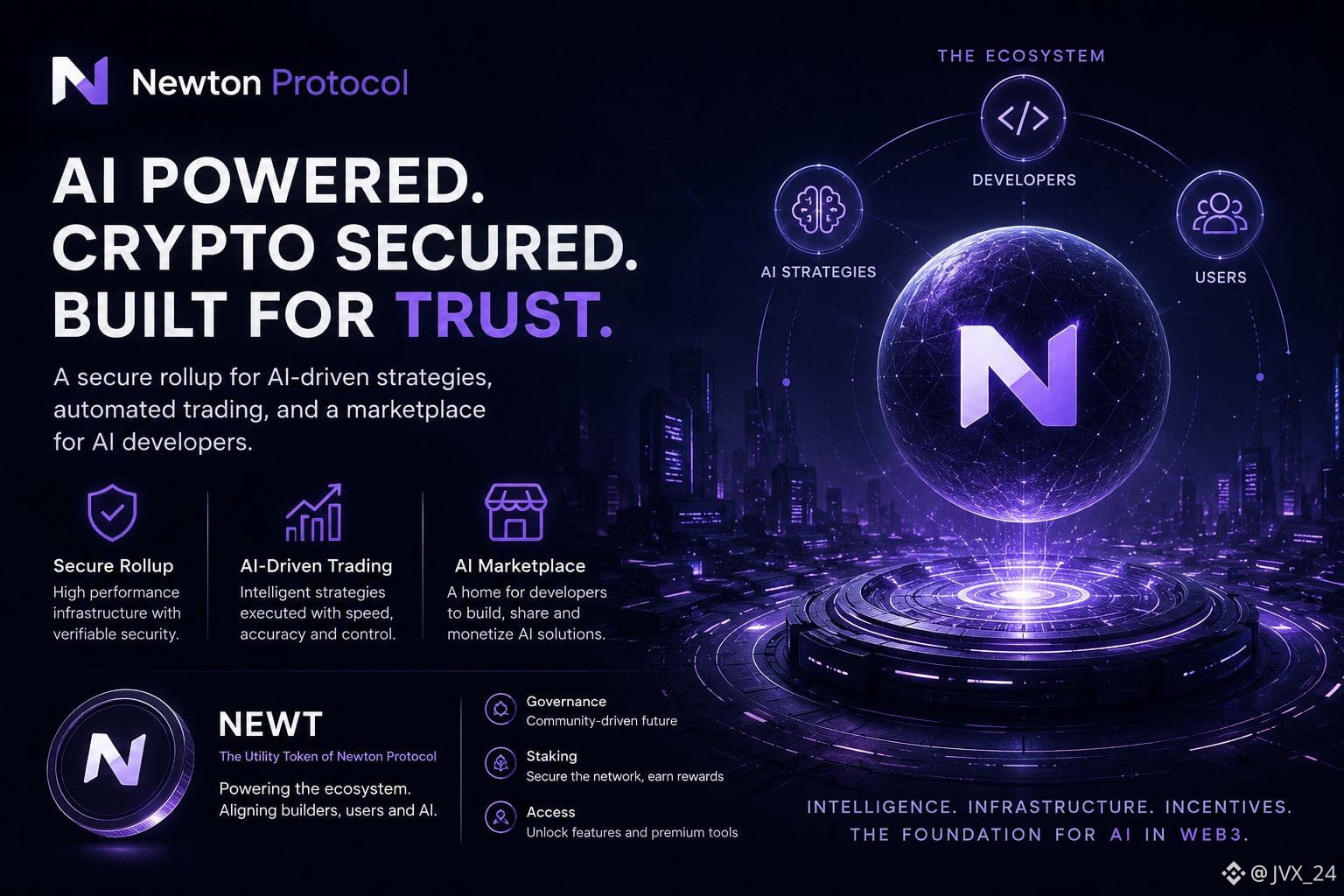
7
7
114
·
--
مقالة
When AI Starts Acting Alone: Why Newton Protocol Made Me Rethink Trust in CryptoI keep coming back to one question whenever I spend time reading about new crypto projects: what happens when software begins making decisions that people can no longer realistically monitor every second?
That question feels more important to me than conversations about faster blockchains or higher transaction speeds. Lately, it seems like the discussion around AI and crypto has become strangely narrow. Most people focus on automation itself. They imagine systems that trade faster, analyze more data, or react before any human could possibly keep up. I understand why that attracts attention. Speed is exciting. Intelligence is exciting. But neither of those answers the question that stays with me.
How do we trust decisions that happen beyond our own ability to follow them?
To me, that is where the conversation often feels incomplete.
Technology has always promised to reduce effort. AI pushes that idea much further. Instead of simply helping us complete tasks, it increasingly offers to perform entire workflows on our behalf. In crypto, that could mean automated investment strategies, portfolio management, market analysis, and interactions across multiple protocols without constant human involvement.
The convenience sounds obvious.
The uncertainty feels just as obvious.
If an AI agent manages digital assets while I sleep, how do I know it followed the rules I expected? If something goes wrong, how can anyone verify what actually happened? If thousands of autonomous systems begin interacting with each other, trust becomes much more complicated than trusting a single application.
That is why Newton Protocol caught my attention.
Not because I think it has already solved these problems, but because it seems willing to start from the uncomfortable assumption that automation alone is not enough.
From what I understand, Newton Protocol is trying to build infrastructure where AI-driven strategies and automated financial activity can operate within a more structured and verifiable environment. Rather than treating AI as something that should simply move faster than humans, the project appears more interested in creating conditions where automated systems can still be accountable.
That difference feels meaningful to me.
Sometimes crypto projects make it sound as if every new layer of automation automatically creates more value. I have never been completely convinced by that argument. More automation can also create more uncertainty if nobody understands how decisions are made or whether those decisions remain consistent with the rules users originally accepted.
Trust is rarely created by making something more powerful.
Often it comes from making something more understandable.
That is why I find myself thinking less about the individual technical components and more about the philosophy behind them.
If AI becomes a permanent part of financial systems, then people will probably spend less time asking whether an algorithm is intelligent enough and more time asking whether it behaves predictably under pressure. Those are different questions. Intelligence can produce impressive demonstrations. Reliability earns confidence over years.
Newton Protocol seems to recognize that difference.
Of course, recognizing a problem is very different from solving it.
Every ambitious crypto project begins with ideas that sound reasonable on paper. The difficult part starts when those ideas encounter real users, real liquidity, unexpected market conditions, and the endless complexity that comes with decentralized ecosystems.
Execution has always been the harder challenge.
That is why I try not to confuse interesting architecture with guaranteed success.
The crypto industry has seen many projects introduce sophisticated concepts that struggled once people actually started using them. Sometimes adoption arrived much slower than expected. Sometimes developers moved in different directions. Sometimes market conditions changed before the technology had enough time to mature.
None of those outcomes necessarily mean the original vision was wrong.
They simply remind me that building infrastructure is usually a long process rather than a single breakthrough moment.
I also think people sometimes underestimate how difficult user behavior can be.
Even if better systems exist, users do not automatically migrate toward them. Habits matter. Simplicity matters. Liquidity matters. Developers often choose ecosystems where activity already exists instead of waiting for technically elegant alternatives to grow.
That creates a difficult balance.
A protocol may solve genuine problems while still facing enormous challenges in convincing enough people to participate.
I think Newton Protocol sits somewhere inside that reality.
Its ideas feel practical because they acknowledge that AI needs guardrails as much as it needs intelligence. Instead of presenting artificial intelligence as something almost magical, the project seems to treat it as software that should remain accountable within financial environments.
That feels more grounded to me.
The longer I follow AI development, the less interested I become in claims about machines replacing human judgment entirely. What interests me more is designing systems where humans can still understand outcomes even if machines handle much of the execution.
Transparency becomes more valuable as complexity increases.
Without it, automation risks becoming something users simply hope is working correctly.
Hope has never been a reliable security model.
When I think about the NEWT token itself, I separate it from the broader ideas behind the protocol.
The project may explore meaningful infrastructure questions, but that does not automatically determine the value of its token. Those are related discussions, not identical ones.
Like many digital assets, NEWT remains speculative.
Its future market value will depend on factors that nobody can predict with confidence. Adoption matters. Developer activity matters. Liquidity matters. Network usage matters. Competition matters. Broader market sentiment matters. The team's ability to execute over time matters as well.
A thoughtful concept alone is rarely enough.
At the same time, I do not think speculation should completely overshadow the underlying discussion.
Sometimes the most interesting projects are valuable because they encourage people to ask better questions, even before they achieve widespread adoption.
Newton Protocol makes me think less about whether AI will participate in crypto and more about how that participation should actually work.
Those are not the same conversation.
I suspect the future will contain far more automated systems than we currently imagine. Whether those systems deserve trust will depend on much more than raw computational ability. They will need environments where accountability, verification, and predictable behavior are treated as essential parts of the design rather than optional improvements added later.
Whether Newton Protocol ultimately succeeds in building that vision remains uncertain.
Like every developing protocol, it still has to prove itself through execution instead of ideas alone. It will have to attract developers, demonstrate usefulness, earn community confidence, and adapt as both AI and crypto continue changing. None of that is guaranteed.
Still, I appreciate projects that encourage me to slow down instead of getting caught up in excitement.
The crypto industry often celebrates whatever appears newest or fastest. I think the harder questions are usually quieter.
How do we trust systems that increasingly act without us?
I started thinking about Newton Protocol because of that question, and after spending time with the project, I find myself returning to it again. I still do not have a complete answer. Maybe nobody does yet. But if AI is going to become a lasting part of decentralized finance, I believe that question will matter far more than whichever protocol happens to process the next transaction a little faster.
@OpenGradient #Newt $NEWT
{future}(NEWTUSDT)
When AI Starts Acting Alone: Why Newton Protocol Made Me Rethink Trust in Crypto
I keep coming back to one question whenever I spend time reading about new crypto projects: what happens when software begins making decisions that people can no longer realistically monitor every second?
That question feels more important to me than conversations about faster blockchains or higher transaction speeds. Lately, it seems like the discussion around AI and crypto has become strangely narrow. Most people focus on automation itself. They imagine systems that trade faster, analyze more data, or react before any human could possibly keep up. I understand why that attracts attention. Speed is exciting. Intelligence is exciting. But neither of those answers the question that stays with me.
How do we trust decisions that happen beyond our own ability to follow them?
To me, that is where the conversation often feels incomplete.
Technology has always promised to reduce effort. AI pushes that idea much further. Instead of simply helping us complete tasks, it increasingly offers to perform entire workflows on our behalf. In crypto, that could mean automated investment strategies, portfolio management, market analysis, and interactions across multiple protocols without constant human involvement.
The convenience sounds obvious.
The uncertainty feels just as obvious.
If an AI agent manages digital assets while I sleep, how do I know it followed the rules I expected? If something goes wrong, how can anyone verify what actually happened? If thousands of autonomous systems begin interacting with each other, trust becomes much more complicated than trusting a single application.
That is why Newton Protocol caught my attention.
Not because I think it has already solved these problems, but because it seems willing to start from the uncomfortable assumption that automation alone is not enough.
From what I understand, Newton Protocol is trying to build infrastructure where AI-driven strategies and automated financial activity can operate within a more structured and verifiable environment. Rather than treating AI as something that should simply move faster than humans, the project appears more interested in creating conditions where automated systems can still be accountable.
That difference feels meaningful to me.
Sometimes crypto projects make it sound as if every new layer of automation automatically creates more value. I have never been completely convinced by that argument. More automation can also create more uncertainty if nobody understands how decisions are made or whether those decisions remain consistent with the rules users originally accepted.
Trust is rarely created by making something more powerful.
Often it comes from making something more understandable.
That is why I find myself thinking less about the individual technical components and more about the philosophy behind them.
If AI becomes a permanent part of financial systems, then people will probably spend less time asking whether an algorithm is intelligent enough and more time asking whether it behaves predictably under pressure. Those are different questions. Intelligence can produce impressive demonstrations. Reliability earns confidence over years.
Newton Protocol seems to recognize that difference.
Of course, recognizing a problem is very different from solving it.
Every ambitious crypto project begins with ideas that sound reasonable on paper. The difficult part starts when those ideas encounter real users, real liquidity, unexpected market conditions, and the endless complexity that comes with decentralized ecosystems.
Execution has always been the harder challenge.
That is why I try not to confuse interesting architecture with guaranteed success.
The crypto industry has seen many projects introduce sophisticated concepts that struggled once people actually started using them. Sometimes adoption arrived much slower than expected. Sometimes developers moved in different directions. Sometimes market conditions changed before the technology had enough time to mature.
None of those outcomes necessarily mean the original vision was wrong.
They simply remind me that building infrastructure is usually a long process rather than a single breakthrough moment.
I also think people sometimes underestimate how difficult user behavior can be.
Even if better systems exist, users do not automatically migrate toward them. Habits matter. Simplicity matters. Liquidity matters. Developers often choose ecosystems where activity already exists instead of waiting for technically elegant alternatives to grow.
That creates a difficult balance.
A protocol may solve genuine problems while still facing enormous challenges in convincing enough people to participate.
I think Newton Protocol sits somewhere inside that reality.
Its ideas feel practical because they acknowledge that AI needs guardrails as much as it needs intelligence. Instead of presenting artificial intelligence as something almost magical, the project seems to treat it as software that should remain accountable within financial environments.
That feels more grounded to me.
The longer I follow AI development, the less interested I become in claims about machines replacing human judgment entirely. What interests me more is designing systems where humans can still understand outcomes even if machines handle much of the execution.
Transparency becomes more valuable as complexity increases.
Without it, automation risks becoming something users simply hope is working correctly.
Hope has never been a reliable security model.
When I think about the NEWT token itself, I separate it from the broader ideas behind the protocol.
The project may explore meaningful infrastructure questions, but that does not automatically determine the value of its token. Those are related discussions, not identical ones.
Like many digital assets, NEWT remains speculative.
Its future market value will depend on factors that nobody can predict with confidence. Adoption matters. Developer activity matters. Liquidity matters. Network usage matters. Competition matters. Broader market sentiment matters. The team's ability to execute over time matters as well.
A thoughtful concept alone is rarely enough.
At the same time, I do not think speculation should completely overshadow the underlying discussion.
Sometimes the most interesting projects are valuable because they encourage people to ask better questions, even before they achieve widespread adoption.
Newton Protocol makes me think less about whether AI will participate in crypto and more about how that participation should actually work.
Those are not the same conversation.
I suspect the future will contain far more automated systems than we currently imagine. Whether those systems deserve trust will depend on much more than raw computational ability. They will need environments where accountability, verification, and predictable behavior are treated as essential parts of the design rather than optional improvements added later.
Whether Newton Protocol ultimately succeeds in building that vision remains uncertain.
Like every developing protocol, it still has to prove itself through execution instead of ideas alone. It will have to attract developers, demonstrate usefulness, earn community confidence, and adapt as both AI and crypto continue changing. None of that is guaranteed.
Still, I appreciate projects that encourage me to slow down instead of getting caught up in excitement.
The crypto industry often celebrates whatever appears newest or fastest. I think the harder questions are usually quieter.
How do we trust systems that increasingly act without us?
I started thinking about Newton Protocol because of that question, and after spending time with the project, I find myself returning to it again. I still do not have a complete answer. Maybe nobody does yet. But if AI is going to become a lasting part of decentralized finance, I believe that question will matter far more than whichever protocol happens to process the next transaction a little faster.
@OpenGradient #Newt $NEWT
That question feels more important to me than conversations about faster blockchains or higher transaction speeds. Lately, it seems like the discussion around AI and crypto has become strangely narrow. Most people focus on automation itself. They imagine systems that trade faster, analyze more data, or react before any human could possibly keep up. I understand why that attracts attention. Speed is exciting. Intelligence is exciting. But neither of those answers the question that stays with me.
How do we trust decisions that happen beyond our own ability to follow them?
To me, that is where the conversation often feels incomplete.
Technology has always promised to reduce effort. AI pushes that idea much further. Instead of simply helping us complete tasks, it increasingly offers to perform entire workflows on our behalf. In crypto, that could mean automated investment strategies, portfolio management, market analysis, and interactions across multiple protocols without constant human involvement.
The convenience sounds obvious.
The uncertainty feels just as obvious.
If an AI agent manages digital assets while I sleep, how do I know it followed the rules I expected? If something goes wrong, how can anyone verify what actually happened? If thousands of autonomous systems begin interacting with each other, trust becomes much more complicated than trusting a single application.
That is why Newton Protocol caught my attention.
Not because I think it has already solved these problems, but because it seems willing to start from the uncomfortable assumption that automation alone is not enough.
From what I understand, Newton Protocol is trying to build infrastructure where AI-driven strategies and automated financial activity can operate within a more structured and verifiable environment. Rather than treating AI as something that should simply move faster than humans, the project appears more interested in creating conditions where automated systems can still be accountable.
That difference feels meaningful to me.
Sometimes crypto projects make it sound as if every new layer of automation automatically creates more value. I have never been completely convinced by that argument. More automation can also create more uncertainty if nobody understands how decisions are made or whether those decisions remain consistent with the rules users originally accepted.
Trust is rarely created by making something more powerful.
Often it comes from making something more understandable.
That is why I find myself thinking less about the individual technical components and more about the philosophy behind them.
If AI becomes a permanent part of financial systems, then people will probably spend less time asking whether an algorithm is intelligent enough and more time asking whether it behaves predictably under pressure. Those are different questions. Intelligence can produce impressive demonstrations. Reliability earns confidence over years.
Newton Protocol seems to recognize that difference.
Of course, recognizing a problem is very different from solving it.
Every ambitious crypto project begins with ideas that sound reasonable on paper. The difficult part starts when those ideas encounter real users, real liquidity, unexpected market conditions, and the endless complexity that comes with decentralized ecosystems.
Execution has always been the harder challenge.
That is why I try not to confuse interesting architecture with guaranteed success.
The crypto industry has seen many projects introduce sophisticated concepts that struggled once people actually started using them. Sometimes adoption arrived much slower than expected. Sometimes developers moved in different directions. Sometimes market conditions changed before the technology had enough time to mature.
None of those outcomes necessarily mean the original vision was wrong.
They simply remind me that building infrastructure is usually a long process rather than a single breakthrough moment.
I also think people sometimes underestimate how difficult user behavior can be.
Even if better systems exist, users do not automatically migrate toward them. Habits matter. Simplicity matters. Liquidity matters. Developers often choose ecosystems where activity already exists instead of waiting for technically elegant alternatives to grow.
That creates a difficult balance.
A protocol may solve genuine problems while still facing enormous challenges in convincing enough people to participate.
I think Newton Protocol sits somewhere inside that reality.
Its ideas feel practical because they acknowledge that AI needs guardrails as much as it needs intelligence. Instead of presenting artificial intelligence as something almost magical, the project seems to treat it as software that should remain accountable within financial environments.
That feels more grounded to me.
The longer I follow AI development, the less interested I become in claims about machines replacing human judgment entirely. What interests me more is designing systems where humans can still understand outcomes even if machines handle much of the execution.
Transparency becomes more valuable as complexity increases.
Without it, automation risks becoming something users simply hope is working correctly.
Hope has never been a reliable security model.
When I think about the NEWT token itself, I separate it from the broader ideas behind the protocol.
The project may explore meaningful infrastructure questions, but that does not automatically determine the value of its token. Those are related discussions, not identical ones.
Like many digital assets, NEWT remains speculative.
Its future market value will depend on factors that nobody can predict with confidence. Adoption matters. Developer activity matters. Liquidity matters. Network usage matters. Competition matters. Broader market sentiment matters. The team's ability to execute over time matters as well.
A thoughtful concept alone is rarely enough.
At the same time, I do not think speculation should completely overshadow the underlying discussion.
Sometimes the most interesting projects are valuable because they encourage people to ask better questions, even before they achieve widespread adoption.
Newton Protocol makes me think less about whether AI will participate in crypto and more about how that participation should actually work.
Those are not the same conversation.
I suspect the future will contain far more automated systems than we currently imagine. Whether those systems deserve trust will depend on much more than raw computational ability. They will need environments where accountability, verification, and predictable behavior are treated as essential parts of the design rather than optional improvements added later.
Whether Newton Protocol ultimately succeeds in building that vision remains uncertain.
Like every developing protocol, it still has to prove itself through execution instead of ideas alone. It will have to attract developers, demonstrate usefulness, earn community confidence, and adapt as both AI and crypto continue changing. None of that is guaranteed.
Still, I appreciate projects that encourage me to slow down instead of getting caught up in excitement.
The crypto industry often celebrates whatever appears newest or fastest. I think the harder questions are usually quieter.
How do we trust systems that increasingly act without us?
I started thinking about Newton Protocol because of that question, and after spending time with the project, I find myself returning to it again. I still do not have a complete answer. Maybe nobody does yet. But if AI is going to become a lasting part of decentralized finance, I believe that question will matter far more than whichever protocol happens to process the next transaction a little faster.
@OpenGradient #Newt $NEWT
1
1
91
·
--
صاعد
OpenGradient made me think about AI infrastructure in a different way.
Most projects talk about running models faster, cheaper, or across more nodes. That sounds good, but speed alone does not solve the trust problem. If an AI answer comes from a distributed network, people still need to know whether the right model was used and whether the work was done honestly.
That is the part I find interesting about OpenGradient. It is not just building around compute. It is trying to make verification part of the network itself. Instead of asking users to blindly trust an operator or platform, the system aims to create proof around execution.
For me, this matters because AI will not stay limited to simple prompts. It will move into trading, automation, finance, data workflows, and decisions where mistakes can be expensive.
The challenge is balance. Verification adds trust, but it should not make the system feel slow or complicated. OpenGradient’s real test is whether it can make verified AI feel smooth enough for everyday use.
@OpenGradient #OPG $OPG
{future}(OPGUSDT)
OpenGradient made me think about AI infrastructure in a different way.
Most projects talk about running models faster, cheaper, or across more nodes. That sounds good, but speed alone does not solve the trust problem. If an AI answer comes from a distributed network, people still need to know whether the right model was used and whether the work was done honestly.
That is the part I find interesting about OpenGradient. It is not just building around compute. It is trying to make verification part of the network itself. Instead of asking users to blindly trust an operator or platform, the system aims to create proof around execution.
For me, this matters because AI will not stay limited to simple prompts. It will move into trading, automation, finance, data workflows, and decisions where mistakes can be expensive.
The challenge is balance. Verification adds trust, but it should not make the system feel slow or complicated. OpenGradient’s real test is whether it can make verified AI feel smooth enough for everyday use.
@OpenGradient #OPG $OPG
Most projects talk about running models faster, cheaper, or across more nodes. That sounds good, but speed alone does not solve the trust problem. If an AI answer comes from a distributed network, people still need to know whether the right model was used and whether the work was done honestly.
That is the part I find interesting about OpenGradient. It is not just building around compute. It is trying to make verification part of the network itself. Instead of asking users to blindly trust an operator or platform, the system aims to create proof around execution.
For me, this matters because AI will not stay limited to simple prompts. It will move into trading, automation, finance, data workflows, and decisions where mistakes can be expensive.
The challenge is balance. Verification adds trust, but it should not make the system feel slow or complicated. OpenGradient’s real test is whether it can make verified AI feel smooth enough for everyday use.
@OpenGradient #OPG $OPG
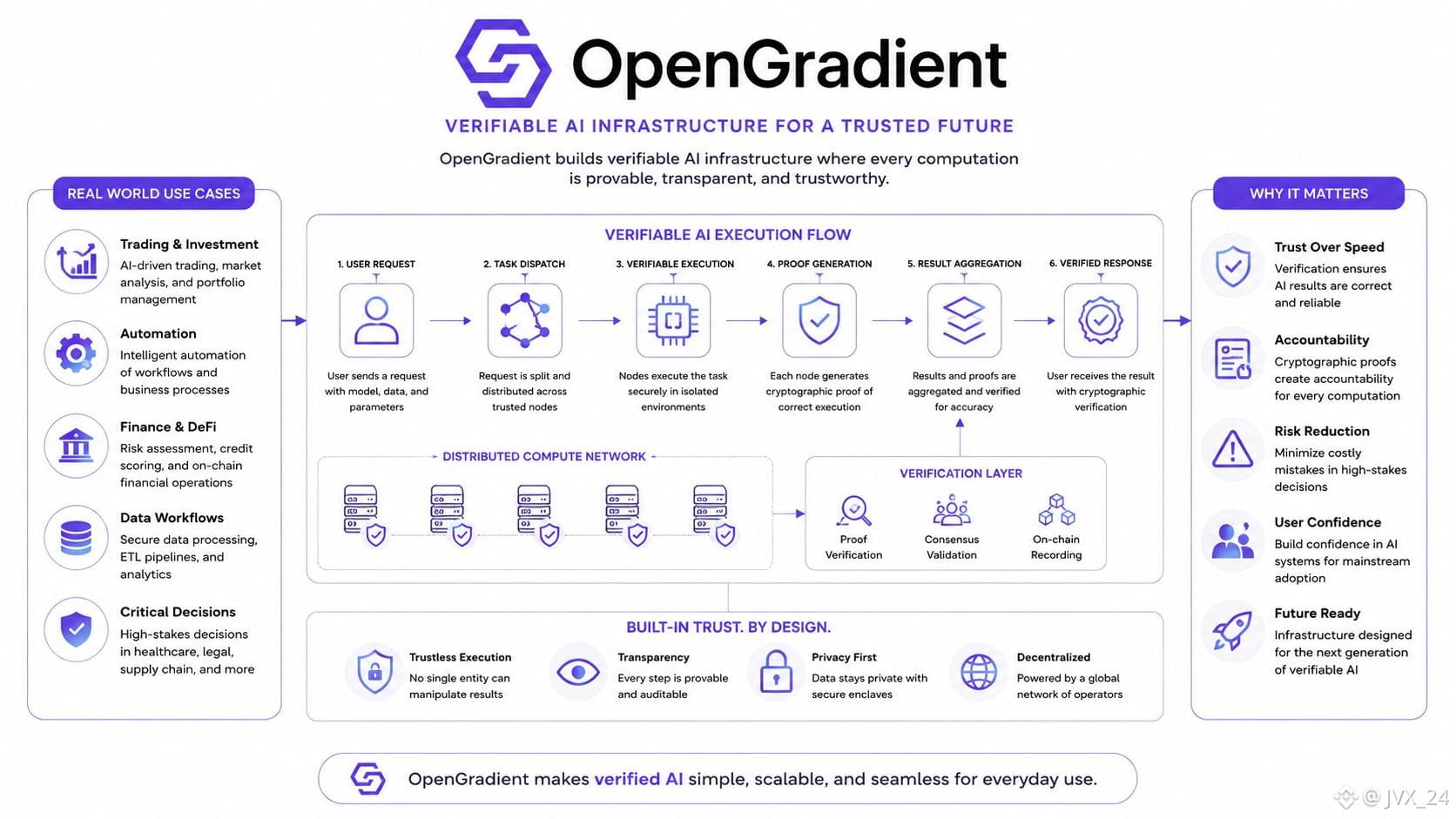
2
368
·
--
صاعد
I used to think AI privacy was only about keeping information safe.
Now I see it a little differently.
People don’t always ask their real questions when they feel watched. They clean up their thoughts, hide the confusing parts, or avoid asking something because it sounds too simple.
But honest thinking usually starts messy.
That’s why @OpenGradientChat feels worth paying attention to. A private AI conversation doesn’t just protect data. It can protect the first version of an idea before it becomes clear.
Good answers matter.
But maybe better questions matter even more.
Because when people feel safe enough to ask freely, AI becomes more than a tool for answers. It becomes a space where curiosity can grow without pressure.
Maybe the real future of AI is not only smarter responses.
Maybe it is helping people think more honestly from the beginning.
#OPG @OpenGradient $OPG
I used to think AI privacy was only about keeping information safe.
Now I see it a little differently.
People don’t always ask their real questions when they feel watched. They clean up their thoughts, hide the confusing parts, or avoid asking something because it sounds too simple.
But honest thinking usually starts messy.
That’s why @OpenGradientChat feels worth paying attention to. A private AI conversation doesn’t just protect data. It can protect the first version of an idea before it becomes clear.
Good answers matter.
But maybe better questions matter even more.
Because when people feel safe enough to ask freely, AI becomes more than a tool for answers. It becomes a space where curiosity can grow without pressure.
Maybe the real future of AI is not only smarter responses.
Maybe it is helping people think more honestly from the beginning.
#OPG @OpenGradient $OPG
Now I see it a little differently.
People don’t always ask their real questions when they feel watched. They clean up their thoughts, hide the confusing parts, or avoid asking something because it sounds too simple.
But honest thinking usually starts messy.
That’s why @OpenGradientChat feels worth paying attention to. A private AI conversation doesn’t just protect data. It can protect the first version of an idea before it becomes clear.
Good answers matter.
But maybe better questions matter even more.
Because when people feel safe enough to ask freely, AI becomes more than a tool for answers. It becomes a space where curiosity can grow without pressure.
Maybe the real future of AI is not only smarter responses.
Maybe it is helping people think more honestly from the beginning.
#OPG @OpenGradient $OPG
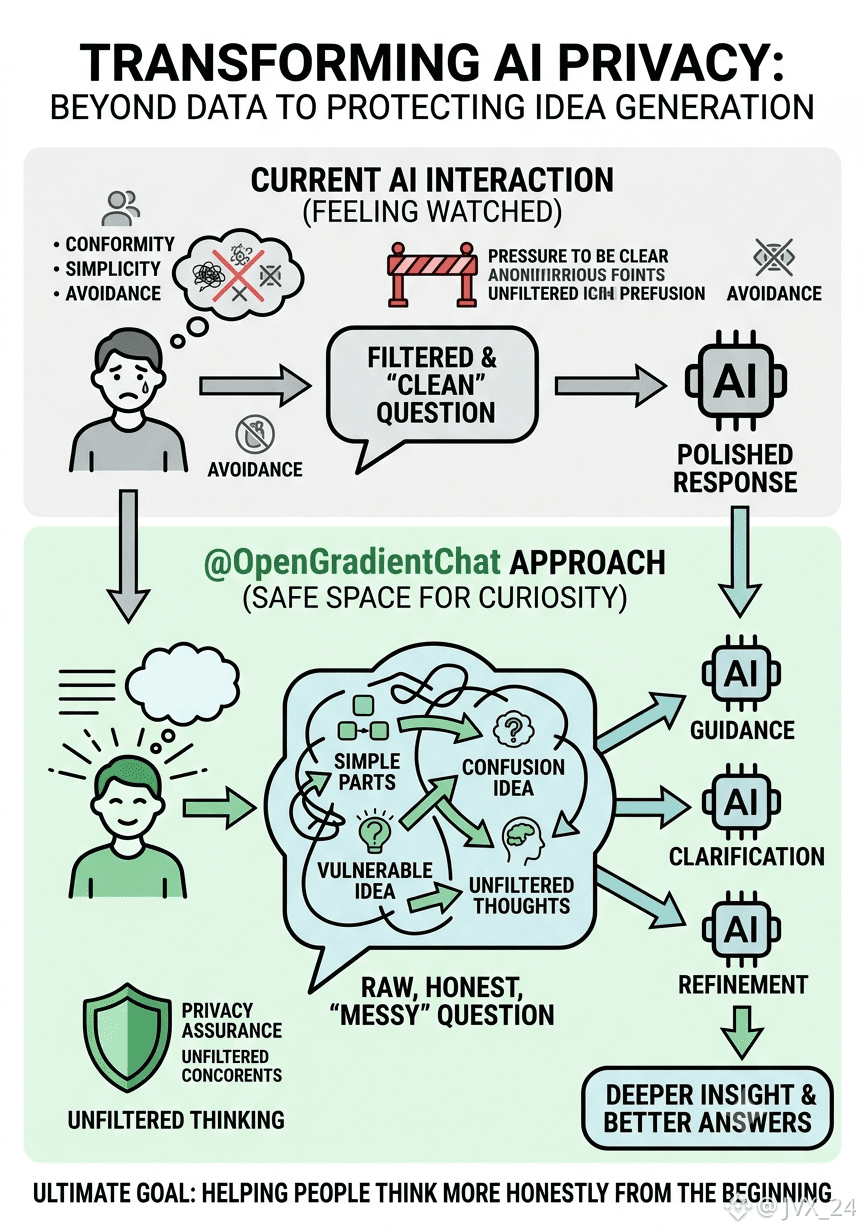
6
1
182
·
--
صاعد
The more I read about OpenGradient, the more I find myself thinking about the parts that aren't finished yet, not just the ones that already work.
One thing that caught my attention was the "coming soon" label next to data nodes. At first I didn't think much of it, but the more I looked into it, the more important it seemed.
The model can already run inside a Trusted Execution Environment (TEE), which helps prove that the computation happened as expected. But that only covers the model's execution. It doesn't automatically prove that the data going into the model was trusted in the first place.
For simple prompts, that may not be a big issue. But if an AI agent is making decisions based on live market data, protocol updates, or other real-time information, then the quality of the input matters just as much as the quality of the model's output.
It makes me wonder how developers are handling that today. Are they relying on external data sources until data nodes are available, or are they adding their own ways to improve trust?
Overall, I think the architecture is heading in a strong direction. I'm just interested to see how this final piece comes together. Once trusted data becomes part of the same verifiable workflow as the model itself, the whole system could become much more reliable. We'll have to see how it develops over time.
$OPG @OpenGradient #OPG
The more I read about OpenGradient, the more I find myself thinking about the parts that aren't finished yet, not just the ones that already work.
One thing that caught my attention was the "coming soon" label next to data nodes. At first I didn't think much of it, but the more I looked into it, the more important it seemed.
The model can already run inside a Trusted Execution Environment (TEE), which helps prove that the computation happened as expected. But that only covers the model's execution. It doesn't automatically prove that the data going into the model was trusted in the first place.
For simple prompts, that may not be a big issue. But if an AI agent is making decisions based on live market data, protocol updates, or other real-time information, then the quality of the input matters just as much as the quality of the model's output.
It makes me wonder how developers are handling that today. Are they relying on external data sources until data nodes are available, or are they adding their own ways to improve trust?
Overall, I think the architecture is heading in a strong direction. I'm just interested to see how this final piece comes together. Once trusted data becomes part of the same verifiable workflow as the model itself, the whole system could become much more reliable. We'll have to see how it develops over time.
$OPG @OpenGradient #OPG
One thing that caught my attention was the "coming soon" label next to data nodes. At first I didn't think much of it, but the more I looked into it, the more important it seemed.
The model can already run inside a Trusted Execution Environment (TEE), which helps prove that the computation happened as expected. But that only covers the model's execution. It doesn't automatically prove that the data going into the model was trusted in the first place.
For simple prompts, that may not be a big issue. But if an AI agent is making decisions based on live market data, protocol updates, or other real-time information, then the quality of the input matters just as much as the quality of the model's output.
It makes me wonder how developers are handling that today. Are they relying on external data sources until data nodes are available, or are they adding their own ways to improve trust?
Overall, I think the architecture is heading in a strong direction. I'm just interested to see how this final piece comes together. Once trusted data becomes part of the same verifiable workflow as the model itself, the whole system could become much more reliable. We'll have to see how it develops over time.
$OPG @OpenGradient #OPG
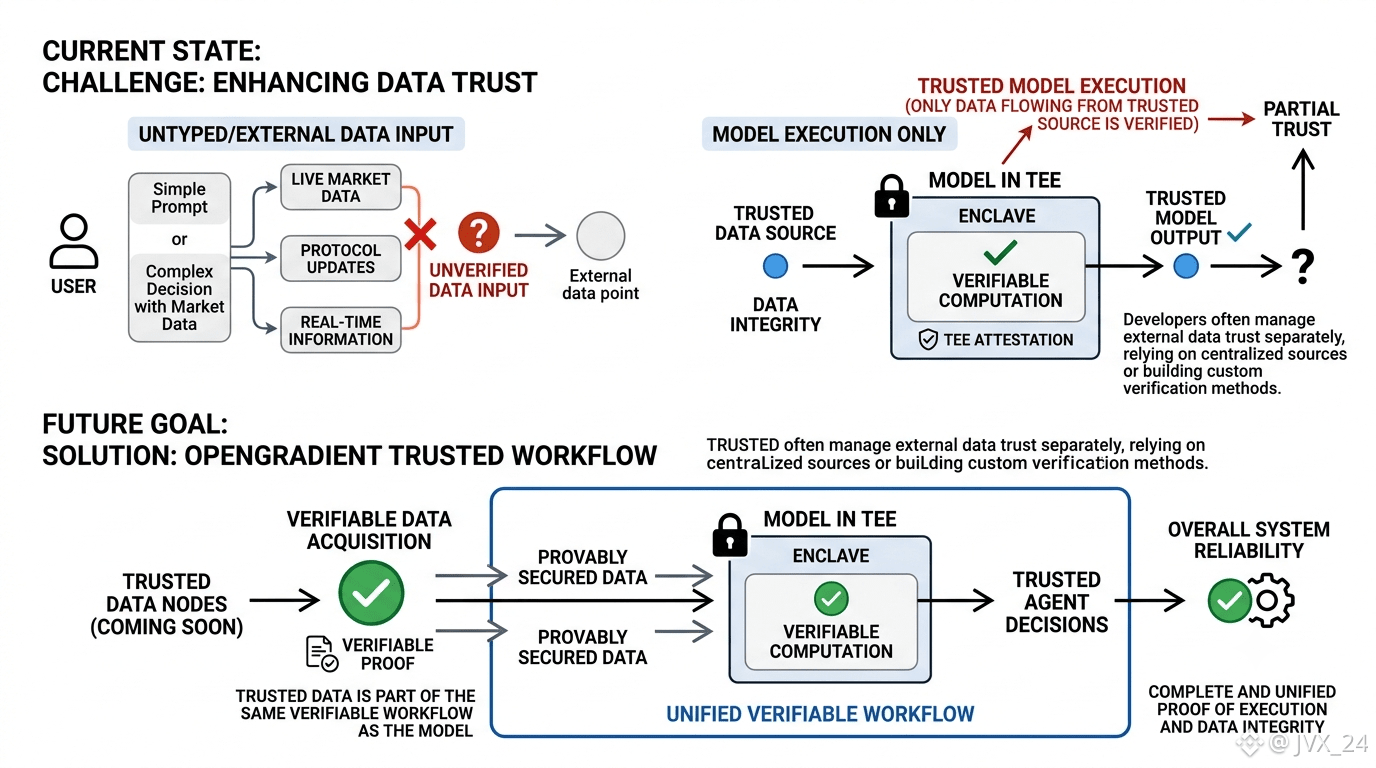
6
1
255
سجّل الدخول لاستكشاف المزيد من المُحتوى
انضم إلى مُستخدمي العملات الرقمية حول العالم على Binance Square
⚡️ احصل على أحدث المعلومات المفيدة عن العملات الرقمية.
💬 موثوقة من قبل أكبر منصّة لتداول العملات الرقمية في العالم.
👍 اكتشف الرؤى الحقيقية من صنّاع المُحتوى الموثوقين.
البريد الإلكتروني / رقم الهاتف
المواضيع الرائجة
WarshSaysInflationIsFedTopFocus
4,135 مشاهدات
211 يقومون بالنقاش
🚨 $BTC drops sharply after Jackson Hole!
Fed Chair Kevin Warsh’s comments came in more hawkish than markets expected. Warsh said inflation is still too high, the 2% PCE target is certain and fixed, and the Fed still has work to do unless inflation returns to target at a sufficient pace.
He also noted that the labor market remains stable and financial conditions are not restrictive enough. #warshsaysinflationisfedtopfocus
Following the remarks, #Bitcoin dropped around 4%.
The scenario markets feared is back on the table: rate cuts could be delayed, while future rate hikes could even become a possibility.
For Bitcoin and other risk assets, higher-for-longer rates remain one of the biggest risks.
Now, all eyes are back on the next inflation data.
Kripto Kurdu
·14 إعجاب
·7.2k مشاهدات
SOLJumps20%OnTheWeek
22,429 مشاهدات
668 يقومون بالنقاش
CaliforniaBillWouldBarOfficialMemeCoins
19,069 مشاهدات
584 يقومون بالنقاش