Binance Square
#dusk.usdt

dusk.usdt

23,492 مشاهدات
178 يقومون بالنقاش
Trade With Nasir 876
·
--
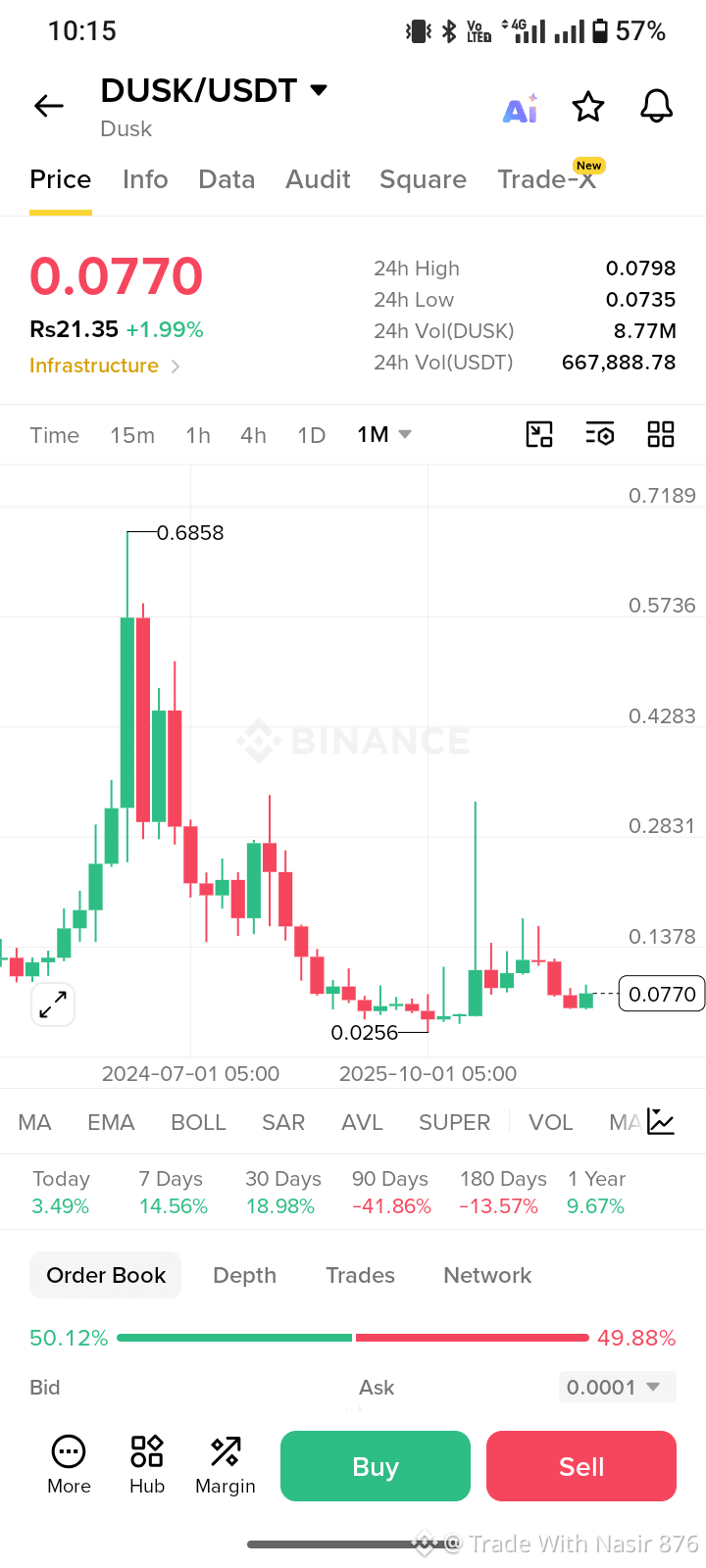
$DUSK 🚀 $DUSK/USDT – Bullish Reversal Loading! 📈 ​$DUSK bottomed out around 0.0256 and is now building strong support at 0.0770. Green momentum is slowly coming back into play. ​Current Price: $0.0770 (+1.99%) ​Key Support: $0.0256 (Strong Base) ​Short-Term Targets: $0.1378 🎯 | $0.2831 🎯 ​Mid-Term Target: $0.5700+ 🚀 ​Weekly consolidation is finishing, and the accumulation phase looks solid. Watch for a breakout above 0.1378 to trigger the next big rally! 🔥 ​#DUSK.USDT #CryptoNewss #bullish #Altcoin #trading
$DUSK
🚀 $DUSK /USDT – Bullish Reversal Loading! 📈
$DUSK bottomed out around 0.0256 and is now building strong support at 0.0770. Green momentum is slowly coming back into play.
​Current Price: $0.0770 (+1.99%)
​Key Support: $0.0256 (Strong Base)
​Short-Term Targets: $0.1378 🎯 | $0.2831 🎯
​Mid-Term Target: $0.5700+ 🚀
​Weekly consolidation is finishing, and the accumulation phase looks solid. Watch for a breakout above 0.1378 to trigger the next big rally! 🔥
#DUSK.USDT #CryptoNewss #bullish #Altcoin #trading
مقالة
DUSK — Privacy Meets the Future of Finance$DUSK I’ve been looking into @Dusk recently, and what caught my attention is its focus on bringing privacy into real-world financial applications. $DUSK is designed as a Layer-1 blockchain where privacy, security, and regulatory requirements can work together. One of the most interesting parts of the Dusk ecosystem is its Confidential Security Contract (XSC) standard. It aims to allow developers and businesses to build applications where sensitive information can remain confidential while transactions and network activity can still be verified. 🧵 Thread Traditional blockchains often make transaction data publicly visible, which can create challenges for businesses dealing with sensitive financial information. Dusk takes a different approach by making privacy a core part of its infrastructure. Its potential use cases include DeFi, digital assets, private transactions, tokenized assets, payments, and institutional finance. This makes Dusk particularly interesting to watch as blockchain adoption continues to move toward real-world financial applications. Of course, technology alone is not enough. Ecosystem growth, developer activity, partnerships, adoption, and continued development will be important factors in determining Dusk’s long-term success. Overall, I think Dusk is a project worth keeping on the radar, especially for anyone interested in the intersection of blockchain, privacy, and finance. #DUSK.USDT

DUSK — Privacy Meets the Future of Finance

$DUSK
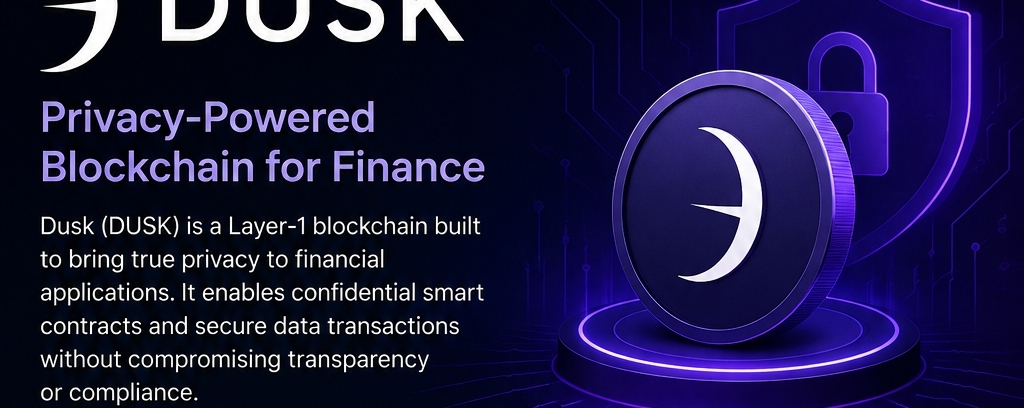
I’ve been looking into @Dusk recently, and what caught my attention is its focus on bringing privacy into real-world financial applications. $DUSK is designed as a Layer-1 blockchain where privacy, security, and regulatory requirements can work together.
One of the most interesting parts of the Dusk ecosystem is its Confidential Security Contract (XSC) standard. It aims to allow developers and businesses to build applications where sensitive information can remain confidential while transactions and network activity can still be verified.
🧵 Thread
Traditional blockchains often make transaction data publicly visible, which can create challenges for businesses dealing with sensitive financial information. Dusk takes a different approach by making privacy a core part of its infrastructure.
Its potential use cases include DeFi, digital assets, private transactions, tokenized assets, payments, and institutional finance. This makes Dusk particularly interesting to watch as blockchain adoption continues to move toward real-world financial applications.
Of course, technology alone is not enough. Ecosystem growth, developer activity, partnerships, adoption, and continued development will be important factors in determining Dusk’s long-term success.
Overall, I think Dusk is a project worth keeping on the radar, especially for anyone interested in the intersection of blockchain, privacy, and finance.
#DUSK.USDT
$DUSK {spot}(DUSKUSDT) $DUSK is trading around $0.0657, with today’s range near $0.0622–$0.0666. Momentum is mildly bullish, with the token up roughly 2.9% from the previous close. Support: $0.0620–$0.0630 Resistance: $0.0665–$0.0680 Bullish breakout: A sustained move above $0.068 could open the way toward $0.070–$0.073. Bearish signal: Losing $0.062 could bring renewed selling pressure. Short-term view: 🟢 Cautiously bullish, but confirmation above resistance is important. #USTraderDeficitShrink #DUSK.USDT #ZTCBinanceTGE
$DUSK
$DUSK is trading around $0.0657, with today’s range near $0.0622–$0.0666. Momentum is mildly bullish, with the token up roughly 2.9% from the previous close.

Support: $0.0620–$0.0630

Resistance: $0.0665–$0.0680

Bullish breakout: A sustained move above $0.068 could open the way toward $0.070–$0.073.

Bearish signal: Losing $0.062 could bring renewed selling pressure.

Short-term view: 🟢 Cautiously bullish, but confirmation above resistance is important.
#USTraderDeficitShrink #DUSK.USDT #ZTCBinanceTGE
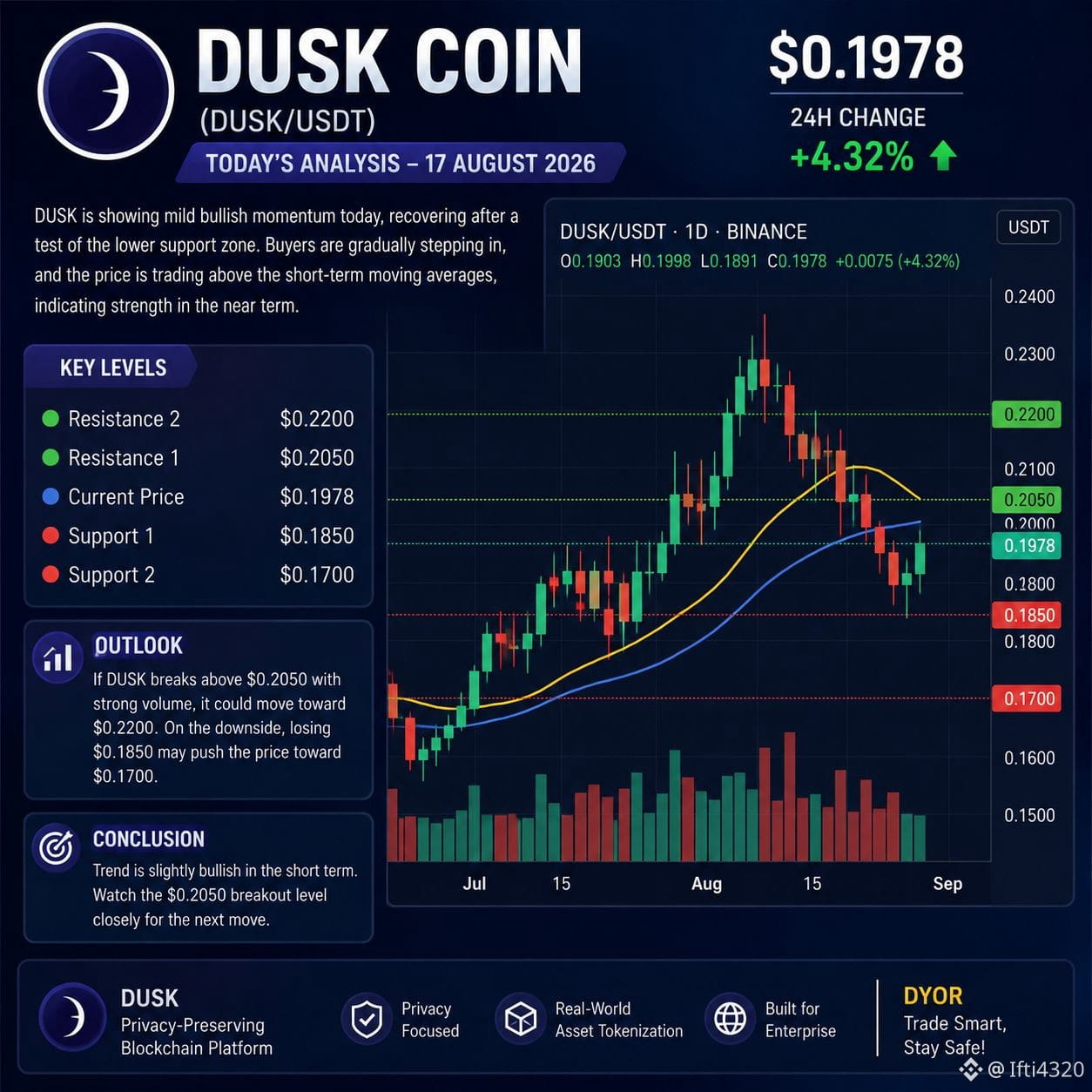
$DUSK is an interesting project positioned around privacy, compliant DeFi and tokenization of real-world assets (RWAs). Its main strength is the attempt to combine blockchain privacy with regulatory requirements, which could make it attractive if institutional adoption of tokenized securities continues. � Dusk +1 Market view: @dusk remains a higher-risk altcoin, so its price can move sharply with BTC/ETH sentiment. The key bullish catalyst is broader adoption of its infrastructure and EVM ecosystem, while weak adoption or delays in development could keep pressure on the token. My view: 🟢 Long-term bullish, short-term cautious. If $DUSK starts breaking major resistance levels with strong volume, it could enter a strong momentum phase. Until then, accumulation on confirmed support is safer than chasing sudden pumps. #Dusk. #DUSK.USDT #DuskNews
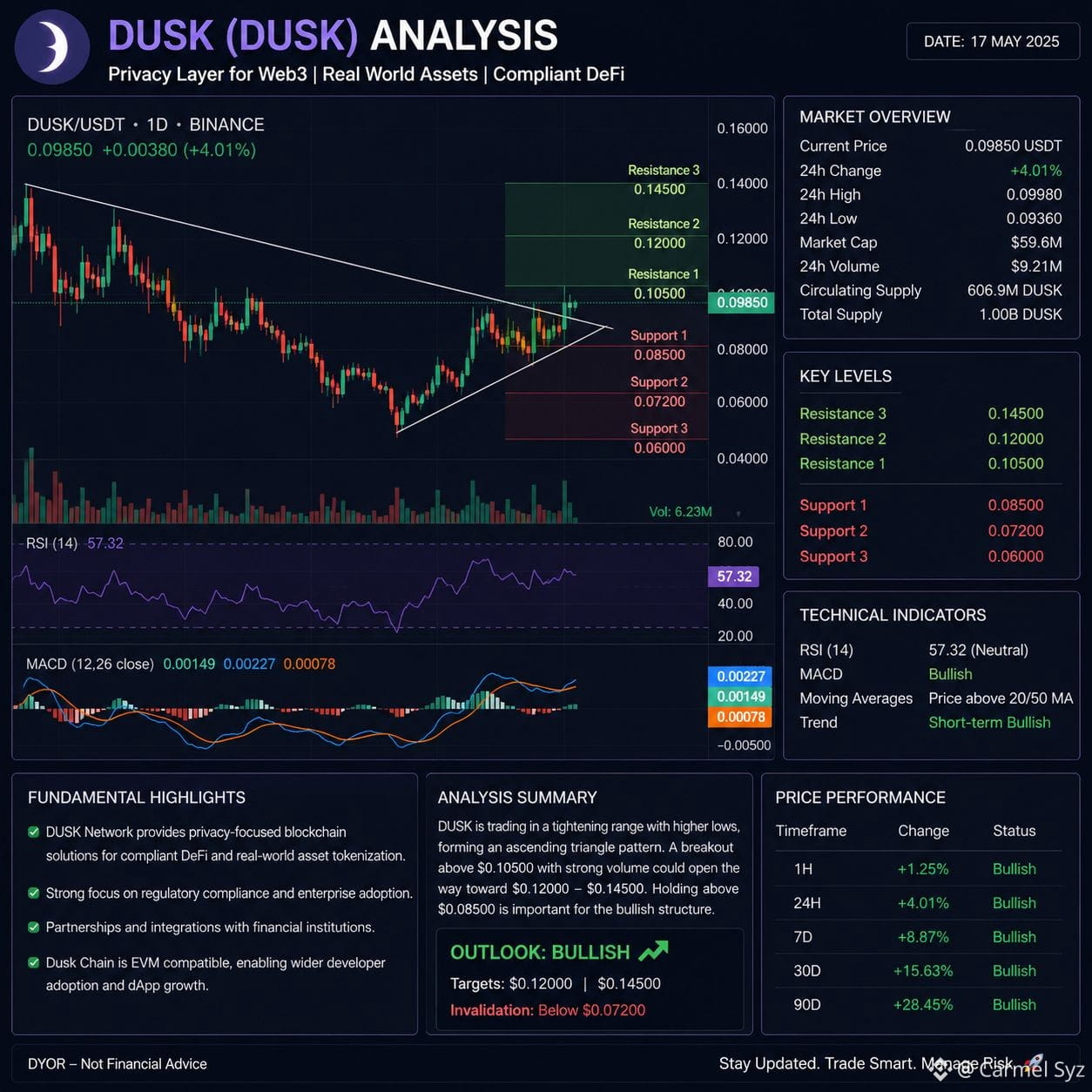
$DUSK is an interesting project positioned around privacy, compliant DeFi and tokenization of real-world assets (RWAs). Its main strength is the attempt to combine blockchain privacy with regulatory requirements, which could make it attractive if institutional adoption of tokenized securities continues. �
Dusk +1
Market view: @dusk remains a higher-risk altcoin, so its price can move sharply with BTC/ETH sentiment. The key bullish catalyst is broader adoption of its infrastructure and EVM ecosystem, while weak adoption or delays in development could keep pressure on the token.
My view: 🟢 Long-term bullish, short-term cautious.
If $DUSK starts breaking major resistance levels with strong volume, it could enter a strong momentum phase. Until then, accumulation on confirmed support is safer than chasing sudden pumps.

#Dusk. #DUSK.USDT #DuskNews

صحيح جزئيًا
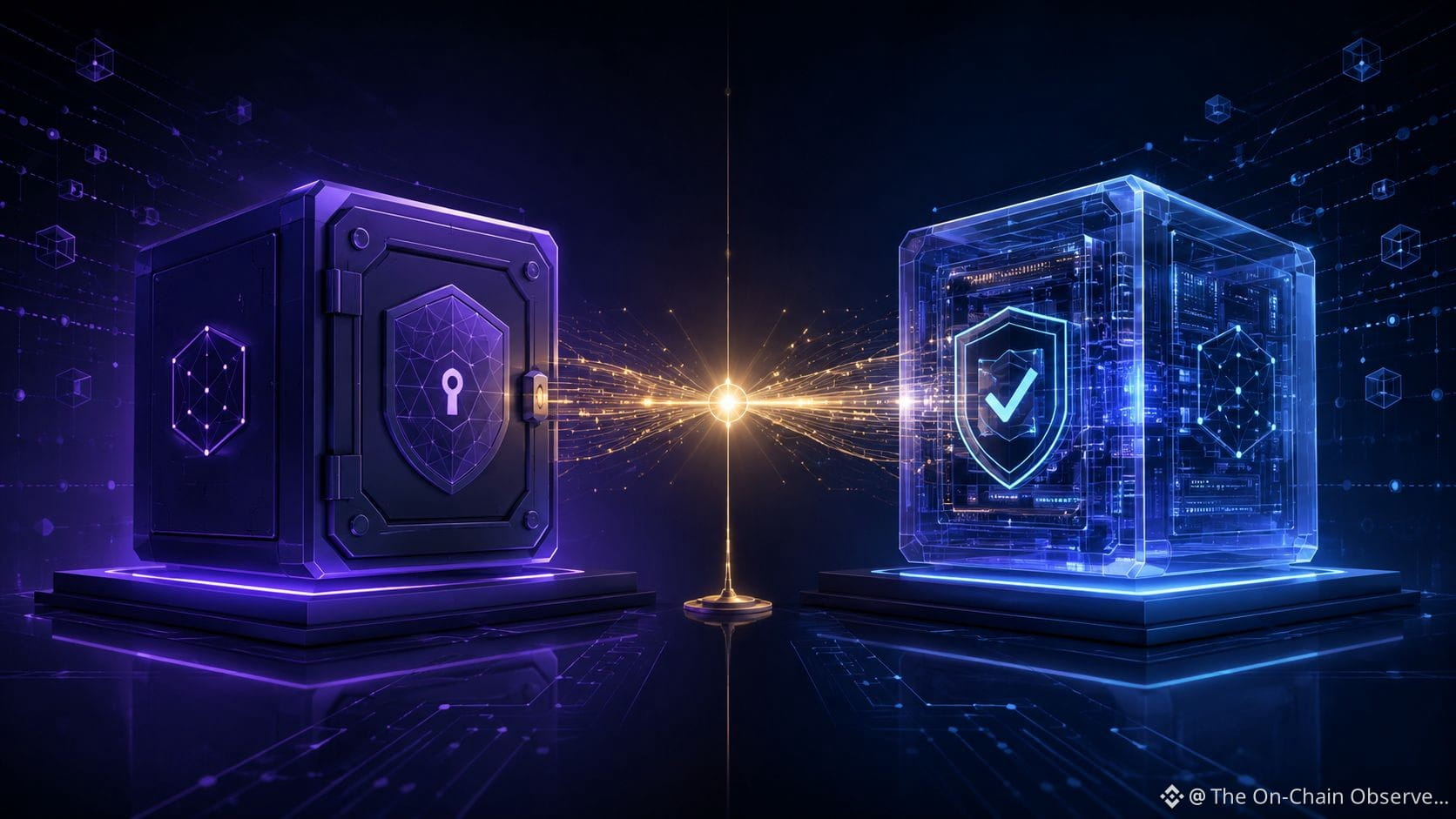
Why "Privacy + Compliance" Is Dusk's Core Thesis The problem Dusk is solving: Public blockchains are transparent by default — every transaction, balance, and counterparty is visible to anyone. That's fine for retail crypto speculation, but it's a dealbreaker for regulated finance. Banks, asset managers, and institutions can't put real securities, corporate transactions, or client data on a chain where competitors and the public can see everything. At the same time, fully private chains (Monero, Zcash-style) go too far the other way — regulators and auditors can't see anything, which makes them non-starters for licensed financial institutions that have KYC/AML obligations. Dusk's bet: you don't have to choose. Using zero-knowledge proofs (PLONK-based) and purpose-built primitives, Dusk lets transactions stay confidential from the public while remaining auditable to authorized parties (regulators, auditors, the counterparties involved). This is the "selective disclosure" model — private by default, provable on demand. Why this matters concretely: MiCA alignment: the EU's regulatory framework increasingly demands exactly this — privacy for commercial reasons, transparency for compliance reasons. Dusk is built around that requirement rather than retrofitting it. Real institutional deals: the NPEX partnership (tokenized securities, hundreds of millions in value) only works because institutions can settle confidentially but still satisfy audit requirements. Differentiation: generic L1s treat privacy as a bolt-on feature (mixers, optional shielding). Dusk treats compliant privacy as the entire architecture — it's not competing with Ethereum on speed, it's competing with traditional finance's back-office infrastructure. @Dusk_Foundation #dusk #Dusk/usdt✅ #DUSKARMY. $DUSK #DUSK.USDT {spot}(DUSKUSDT)
Why "Privacy + Compliance" Is Dusk's Core Thesis

The problem Dusk is solving:
Public blockchains are transparent by default — every transaction, balance, and counterparty is visible to anyone. That's fine for retail crypto speculation, but it's a dealbreaker for regulated finance. Banks, asset managers, and institutions can't put real securities, corporate transactions, or client data on a chain where competitors and the public can see everything. At the same time, fully private chains (Monero, Zcash-style) go too far the other way — regulators and auditors can't see anything, which makes them non-starters for licensed financial institutions that have KYC/AML obligations.

Dusk's bet: you don't have to choose. Using zero-knowledge proofs (PLONK-based) and purpose-built primitives, Dusk lets transactions stay confidential from the public while remaining auditable to authorized parties (regulators, auditors, the counterparties involved). This is the "selective disclosure" model — private by default, provable on demand.

Why this matters concretely:

MiCA alignment: the EU's regulatory framework increasingly demands exactly this — privacy for commercial reasons, transparency for compliance reasons. Dusk is built around that requirement rather than retrofitting it.

Real institutional deals: the NPEX partnership (tokenized securities, hundreds of millions in value) only works because institutions can settle confidentially but still satisfy audit requirements.

Differentiation: generic L1s treat privacy as a bolt-on feature (mixers, optional shielding). Dusk treats compliant privacy as the entire architecture — it's not competing with Ethereum on speed, it's competing with traditional finance's back-office infrastructure.

@Dusk #dusk #Dusk/usdt✅ #DUSKARMY. $DUSK #DUSK.USDT
·
--
صاعد
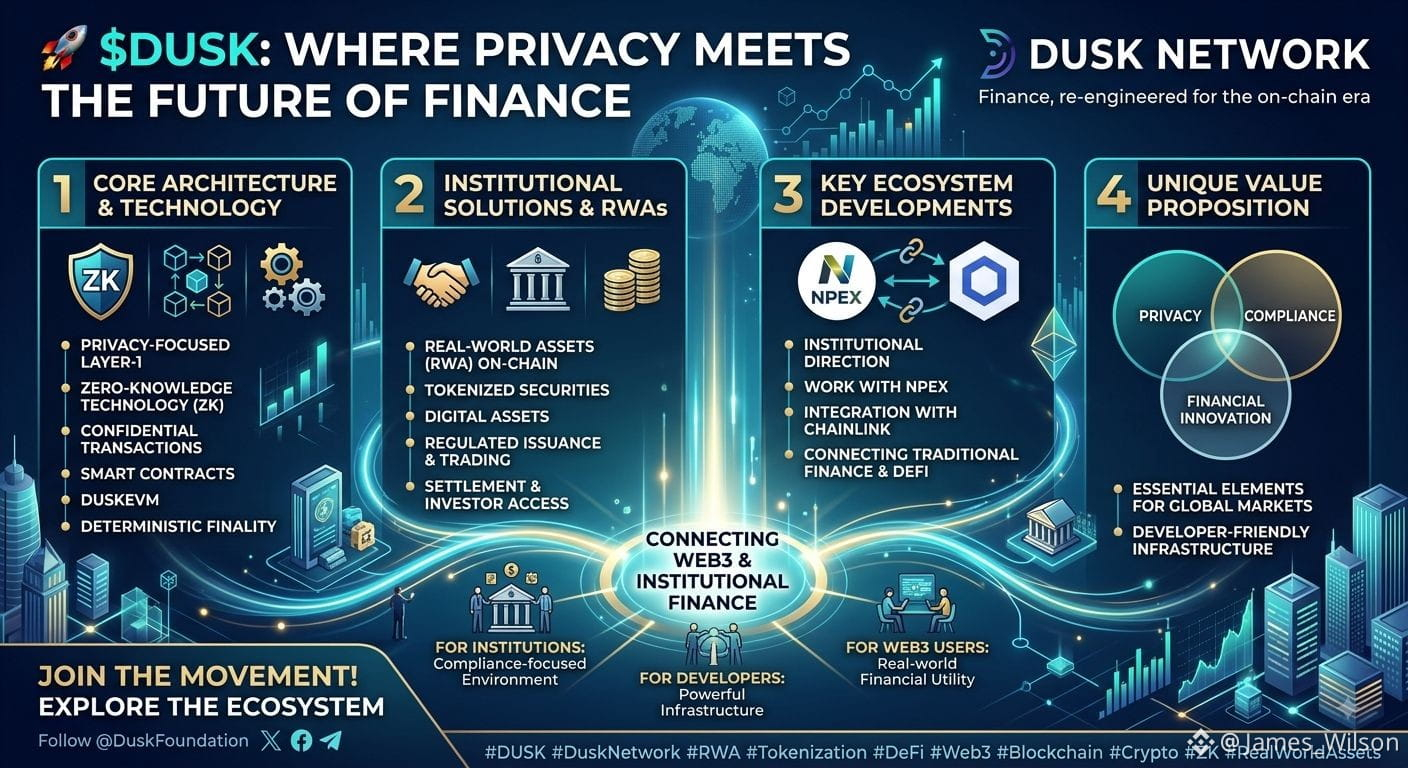
$DUSK : Where Privacy Meets the Future of Finance Dusk Network is building more than another blockchain—it is creating next-generation infrastructure for regulated financial markets and real-world assets on-chain. Powered by a privacy-focused Layer-1 architecture, Dusk combines zero-knowledge technology, confidential transactions, smart contracts, deterministic finality, and DuskEVM to address a critical challenge in Web3: bringing institutional finance on-chain without sacrificing privacy or regulatory compliance. Its vision extends toward tokenized securities, digital assets, regulated issuance, trading, settlement, and investor access within a unified blockchain environment. Dusk’s institutional direction and ecosystem development, including its work with #NPEX and integration with Chainlink, strengthen its mission of connecting traditional finance with decentralized infrastructure. What makes #duskfoundation stand out is the combination of privacy + compliance + financial innovation—three essential elements for the next evolution of global markets. For developers, it offers powerful infrastructure. For institutions, a compliance-focused environment. For Web3 users, a vision centered on real-world financial utility. 🔥 The future of finance won’t just be decentralized—it will be private, compliant, programmable, and accessible. Follow @DuskFoundation, explore the ecosystem, and become part of the movement. Dusk Network — Finance, re-engineered for the on-chain era. #DUSK.USDT #DuskNetwork
$DUSK : Where Privacy Meets the Future of Finance

Dusk Network is building more than another blockchain—it is creating next-generation infrastructure for regulated financial markets and real-world assets on-chain.

Powered by a privacy-focused Layer-1 architecture, Dusk combines zero-knowledge technology, confidential transactions, smart contracts, deterministic finality, and DuskEVM to address a critical challenge in Web3: bringing institutional finance on-chain without sacrificing privacy or regulatory compliance.

Its vision extends toward tokenized securities, digital assets, regulated issuance, trading, settlement, and investor access within a unified blockchain environment. Dusk’s institutional direction and ecosystem development, including its work with #NPEX and integration with Chainlink, strengthen its mission of connecting traditional finance with decentralized infrastructure.

What makes #duskfoundation stand out is the combination of privacy + compliance + financial innovation—three essential elements for the next evolution of global markets.

For developers, it offers powerful infrastructure. For institutions, a compliance-focused environment. For Web3 users, a vision centered on real-world financial utility.

🔥 The future of finance won’t just be decentralized—it will be private, compliant, programmable, and accessible.

Follow @DuskFoundation, explore the ecosystem, and become part of the movement.

Dusk Network — Finance, re-engineered for the on-chain era.

#DUSK.USDT #DuskNetwork

·
--
هابط
📊 DUSK Latest Analysis DUSK is currently around $0.072–$0.073 and remains under short-term selling pressure. The important support area is near $0.068; losing this level could expose approximately $0.0628. On the positive side, DuskEVM’s recent testnet launch using Solidity and Hardhat could strengthen the project's developer ecosystem. Overall outlook: neutral to cautiously bullish if support holds. � $DUSK #DUSKARMY. #Dusk/usdt✅ #DUSK.USDT #DUSKUSDT.p #Dusknet {spot}(DUSKUSDT)
📊 DUSK Latest Analysis
DUSK is currently around $0.072–$0.073 and remains under short-term selling pressure. The important support area is near $0.068; losing this level could expose approximately $0.0628. On the positive side, DuskEVM’s recent testnet launch using Solidity and Hardhat could strengthen the project's developer ecosystem. Overall outlook: neutral to cautiously bullish if support holds. �
$DUSK #DUSKARMY. #Dusk/usdt✅ #DUSK.USDT #DUSKUSDT.p #Dusknet
مقالة
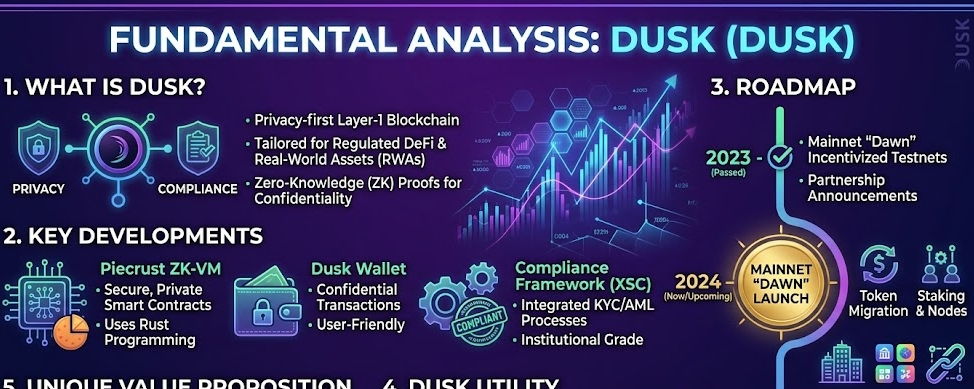
DUSK (DUSK): Fundamental Analysis, Developments, Roadmap & Future Potential$DUSK ( @Dusk_Foundation ) is one of those crypto projects that can be easy to overlook if you only look at narratives like DeFi, memecoins, or general-purpose Layer-1 blockchains. Its thesis is much more specific: **build blockchain infrastructure for regulated financial markets, where privacy, compliance, identity and deterministic settlement are all required at the same time.** That makes DUSK particularly interesting in the growing **real-world asset (RWA) tokenization** sector. But the investment case is not simply “RWAs are going to grow, therefore DUSK will go up.” The important question is whether Dusk can turn its technology into meaningful institutional usage and, ultimately, create enough demand for the DUSK token. ## What exactly is Dusk? Dusk is a Layer-1 blockchain designed around regulated digital assets and financial-market infrastructure. Its architecture combines privacy, access controls, zero-knowledge technology and deterministic settlement. The problem Dusk is trying to solve is fairly straightforward. Traditional financial markets need to know who is allowed to own an asset, comply with regulatory restrictions and maintain records of ownership. Public blockchains, meanwhile, are generally designed around transparency and permissionless participation. Dusk is trying to sit between those two worlds. Its documentation describes applications including regulated asset issuance, digital securities, post-trade infrastructure, shareholder registries, on-chain voting and privacy-preserving transactions. In other words, Dusk isn't primarily trying to become another chain for speculative DeFi applications. Its larger ambition is to become **financial infrastructure for assets that need both blockchain efficiency and regulatory controls.** ## The strongest part of the investment thesis: RWA tokenization Real-world asset tokenization is arguably the most important narrative surrounding Dusk. Bonds, funds, equities, private-market assets and other financial instruments can potentially be represented and settled on blockchain infrastructure. But institutional adoption requires more than simply putting an asset on a public ledger. Institutions need: * Identity and eligibility controls * Compliance with securities regulations * Selective disclosure of sensitive information * Reliable settlement * Transfer restrictions * Ownership records * Corporate actions and servicing * Privacy around positions and counterparties This is where Dusk's architecture becomes interesting. The network explicitly focuses on regulated workflows and selective privacy rather than treating complete transparency as the default. That gives Dusk a differentiated position compared with generic smart-contract platforms. ## Technology and architecture Dusk has developed a fairly specialized technical stack. Its core components include **DuskDS**, which provides settlement, consensus, finality and data availability; **Rusk**, the Rust implementation of the Layer-1; **DuskVM** for native smart-contract execution; **DuskEVM** for EVM-compatible execution; and **Citadel**, its identity and access-control infrastructure. This matters because institutional blockchain adoption isn't necessarily going to happen on a single model. Developers already familiar with Ethereum tooling may prefer an EVM environment, while applications that need Dusk's native privacy and asset functionality can use the underlying Dusk infrastructure. That combination could make the network more flexible than a blockchain built around only one execution environment. ## Privacy is a major differentiator One of Dusk's most interesting characteristics is that it does not treat privacy and compliance as opposing ideas. The goal is **selective disclosure**. A financial institution shouldn't necessarily have to reveal every transaction detail to the entire world simply because the asset exists on a blockchain. At the same time, regulators and authorized parties may need access to relevant information. Dusk's architecture attempts to accommodate both requirements through zero-knowledge technology and controlled disclosure. If tokenized securities become a major part of the financial system, this could be an important competitive advantage. ## The DUSK token The DUSK token isn't merely a governance or speculative asset. DUSK is used for **network transaction fees and staking**. The current protocol documentation states that the minimum stake is 1,000 DUSK. That gives the token genuine utility within the network. The tokenomics are also worth examining carefully. Dusk has an initial 500 million DUSK supply, with another 500 million DUSK scheduled to be emitted over time, giving a maximum supply of 1 billion. The additional emission is intended to fund staking rewards and follows a declining schedule, with the emission rate halving every four years. This is neither a tiny fixed-supply token nor an unlimited-inflation model. For investors, the important point is that future supply growth needs to be considered when valuing DUSK. Network growth has to eventually outpace dilution if token value is to appreciate sustainably. ## Development progress One of the positives with Dusk is that the project has moved beyond being purely conceptual. The **Dusk Mainnet is live**, and the current documentation describes it as a production network supporting regulated assets, privacy-preserving transactions and the broader decentralized market infrastructure vision. The project has also continued developing its infrastructure around identity, smart contracts, EVM compatibility and regulated asset workflows. This is important because the investment thesis becomes considerably stronger when the technology exists in production rather than sitting on a roadmap. Another notable development is the migration infrastructure allowing ERC-20 and BEP-20 DUSK to be moved onto Dusk mainnet. ## Roadmap Dusk's roadmap has historically been organized around major development phases, including **Daybreak, Daylight, Alba and Aurora**. The project's stated objective has been to build infrastructure capable of handling regulated assets while achieving privacy, compliance, performance and deterministic settlement. The later roadmap leading toward mainnet focused on turning those architectural goals into a production-ready network capable of supporting regulated financial assets. Today, the more useful way to think about the roadmap is not simply as a sequence of marketing milestones. The key question is what comes **after the infrastructure has been built**. The next stage of the Dusk story is therefore about: 1. Increasing real-world usage of the mainnet. 2. Bringing regulated assets and financial applications on-chain. 3. Expanding developer adoption. 4. Growing EVM-compatible applications. 5. Improving identity and compliance infrastructure. 6. Building deeper institutional and financial-market integrations. 7. Turning the network into a functioning decentralized market infrastructure rather than simply another Layer-1. That final point is crucial. A successful Dusk would not necessarily need millions of retail users. Its potential value proposition is more about becoming infrastructure for **high-value financial transactions and regulated assets**. ## What could make DUSK successful? The bull case is relatively easy to understand. If tokenization of real-world financial assets becomes a major part of the global financial system, specialized infrastructure could become increasingly valuable. Ethereum and other major chains may capture a large portion of this market, but institutions could also want networks specifically designed around compliance, privacy and regulated asset settlement. Dusk is positioning itself directly in that niche. Its combination of: **RWA + privacy + compliance + identity + settlement + EVM compatibility** is arguably its strongest competitive advantage. The fact that Dusk already has a live mainnet makes the thesis more credible than a project that is still promising future infrastructure. ## The biggest risks However, DUSK is far from a guaranteed winner. ### 1. Competition The RWA market is becoming extremely competitive. Ethereum, Ethereum Layer-2 networks, Avalanche, Polygon, Stellar, Hedera and numerous specialized protocols are all competing for institutional tokenization activity. Dusk needs to demonstrate that its specialized architecture provides enough value to attract users away from much larger ecosystems. ### 2. Adoption is more important than technology This is probably the biggest risk. A technically impressive blockchain can still be a poor investment if nobody uses it. Investors should therefore watch **actual assets, transaction activity, developers, institutional integrations and network fees**, rather than simply counting partnerships or announcements. ### 3. Token value capture This is a particularly important issue for DUSK. A blockchain can succeed as infrastructure without the corresponding token becoming a massive asset. The key question is whether increased network activity creates meaningful demand for DUSK through gas, staking and other network functions. ### 4. Regulatory uncertainty Dusk's focus on regulated finance is simultaneously its strength and its risk. Financial regulations differ across jurisdictions and continue to evolve. Institutional adoption can therefore be much slower than retail crypto adoption. ### 5. Supply emissions The maximum supply is 1 billion DUSK, compared with an initial 500 million. Future emissions are controlled and decline over time, but investors still need to account for them when assessing long-term valuation. ### 6. Security and operational risk Blockchain infrastructure handling financial assets has a particularly high security burden. This is especially relevant because recent reporting indicates that the Dusk Foundation disclosed a security incident involving a team-managed wallet used in bridge operations on August 16, 2026. That does not automatically invalidate the underlying protocol thesis, but it is a reminder that investors should distinguish between the security of the core network and the security of surrounding infrastructure such as bridges and operational wallets. ## Valuation perspective At the time of writing, DUSK is trading around **$0.07**, with roughly 500 million DUSK circulating and a market capitalization in the tens of millions of dollars. Market data is highly volatile and should be checked before making an investment decision. The relatively small market capitalization is both the attraction and the danger. If Dusk captures even a small but meaningful portion of the institutional RWA market, the upside could be substantial because the network is starting from a comparatively small valuation. But the reverse is equally true. A low market cap doesn't mean an asset is undervalued. It can also mean the market is correctly pricing in the uncertainty surrounding adoption. ## My fundamental view I would categorize DUSK as a **high-risk, high-upside infrastructure bet on institutional blockchain adoption**. I like the fundamental thesis more than I like the typical crypto narrative because Dusk is solving a real problem: how to combine blockchain settlement with the privacy, identity and compliance requirements of regulated financial markets. The technology is already much further along than a simple white-paper project, and the live mainnet gives the thesis something tangible to build upon. The biggest question from here isn't whether Dusk has interesting technology. **It does.** The question is whether institutions actually choose to use it. If Dusk can turn its infrastructure into meaningful tokenized-asset issuance, settlement and financial-market activity, today's valuation could look very small in hindsight. If institutional adoption fails to materialize, however, the RWA narrative alone won't be enough. ### Bottom line **Fundamentally: Interesting.** **Technology: Strong and differentiated.** **RWA positioning: Very attractive.** **Token utility: Real, through gas and staking.** **Adoption: The critical variable.** **Competition: High.** **Risk: Very high.** **Potential: High if institutional RWA adoption accelerates.** For me, DUSK is best viewed not as “another crypto token,” but as a speculative bet on a specific future: **regulated financial assets increasingly moving onto blockchain infrastructure.** If that future develops and Dusk captures even a modest share of it, the asymmetric upside could be significant. But until there is stronger evidence of sustained institutional usage, DUSK should be treated as a speculative position rather t han a proven long-term winner. *This is fundamental research, not financial advice. Crypto assets are highly volatile, and the investment thesis can change rapidly as technology, regulation, token economics and adoption evolve.* #dusk #duskcoin #Dusknet #DUSK.USDT #Dusk.

DUSK (DUSK): Fundamental Analysis, Developments, Roadmap & Future Potential

$DUSK ( @Dusk ) is one of those crypto projects that can be easy to overlook if you only look at narratives like DeFi, memecoins, or general-purpose Layer-1 blockchains. Its thesis is much more specific: **build blockchain infrastructure for regulated financial markets, where privacy, compliance, identity and deterministic settlement are all required at the same time.**
That makes DUSK particularly interesting in the growing **real-world asset (RWA) tokenization** sector. But the investment case is not simply “RWAs are going to grow, therefore DUSK will go up.” The important question is whether Dusk can turn its technology into meaningful institutional usage and, ultimately, create enough demand for the DUSK token.
## What exactly is Dusk?
Dusk is a Layer-1 blockchain designed around regulated digital assets and financial-market infrastructure. Its architecture combines privacy, access controls, zero-knowledge technology and deterministic settlement.
The problem Dusk is trying to solve is fairly straightforward.
Traditional financial markets need to know who is allowed to own an asset, comply with regulatory restrictions and maintain records of ownership. Public blockchains, meanwhile, are generally designed around transparency and permissionless participation.
Dusk is trying to sit between those two worlds.
Its documentation describes applications including regulated asset issuance, digital securities, post-trade infrastructure, shareholder registries, on-chain voting and privacy-preserving transactions.
In other words, Dusk isn't primarily trying to become another chain for speculative DeFi applications. Its larger ambition is to become **financial infrastructure for assets that need both blockchain efficiency and regulatory controls.**
## The strongest part of the investment thesis: RWA tokenization
Real-world asset tokenization is arguably the most important narrative surrounding Dusk.
Bonds, funds, equities, private-market assets and other financial instruments can potentially be represented and settled on blockchain infrastructure. But institutional adoption requires more than simply putting an asset on a public ledger.
Institutions need:
* Identity and eligibility controls
* Compliance with securities regulations
* Selective disclosure of sensitive information
* Reliable settlement
* Transfer restrictions
* Ownership records
* Corporate actions and servicing
* Privacy around positions and counterparties
This is where Dusk's architecture becomes interesting.
The network explicitly focuses on regulated workflows and selective privacy rather than treating complete transparency as the default.
That gives Dusk a differentiated position compared with generic smart-contract platforms.
## Technology and architecture
Dusk has developed a fairly specialized technical stack.
Its core components include **DuskDS**, which provides settlement, consensus, finality and data availability; **Rusk**, the Rust implementation of the Layer-1; **DuskVM** for native smart-contract execution; **DuskEVM** for EVM-compatible execution; and **Citadel**, its identity and access-control infrastructure.
This matters because institutional blockchain adoption isn't necessarily going to happen on a single model.
Developers already familiar with Ethereum tooling may prefer an EVM environment, while applications that need Dusk's native privacy and asset functionality can use the underlying Dusk infrastructure.
That combination could make the network more flexible than a blockchain built around only one execution environment.
## Privacy is a major differentiator
One of Dusk's most interesting characteristics is that it does not treat privacy and compliance as opposing ideas.
The goal is **selective disclosure**.
A financial institution shouldn't necessarily have to reveal every transaction detail to the entire world simply because the asset exists on a blockchain. At the same time, regulators and authorized parties may need access to relevant information.
Dusk's architecture attempts to accommodate both requirements through zero-knowledge technology and controlled disclosure.
If tokenized securities become a major part of the financial system, this could be an important competitive advantage.
## The DUSK token
The DUSK token isn't merely a governance or speculative asset.
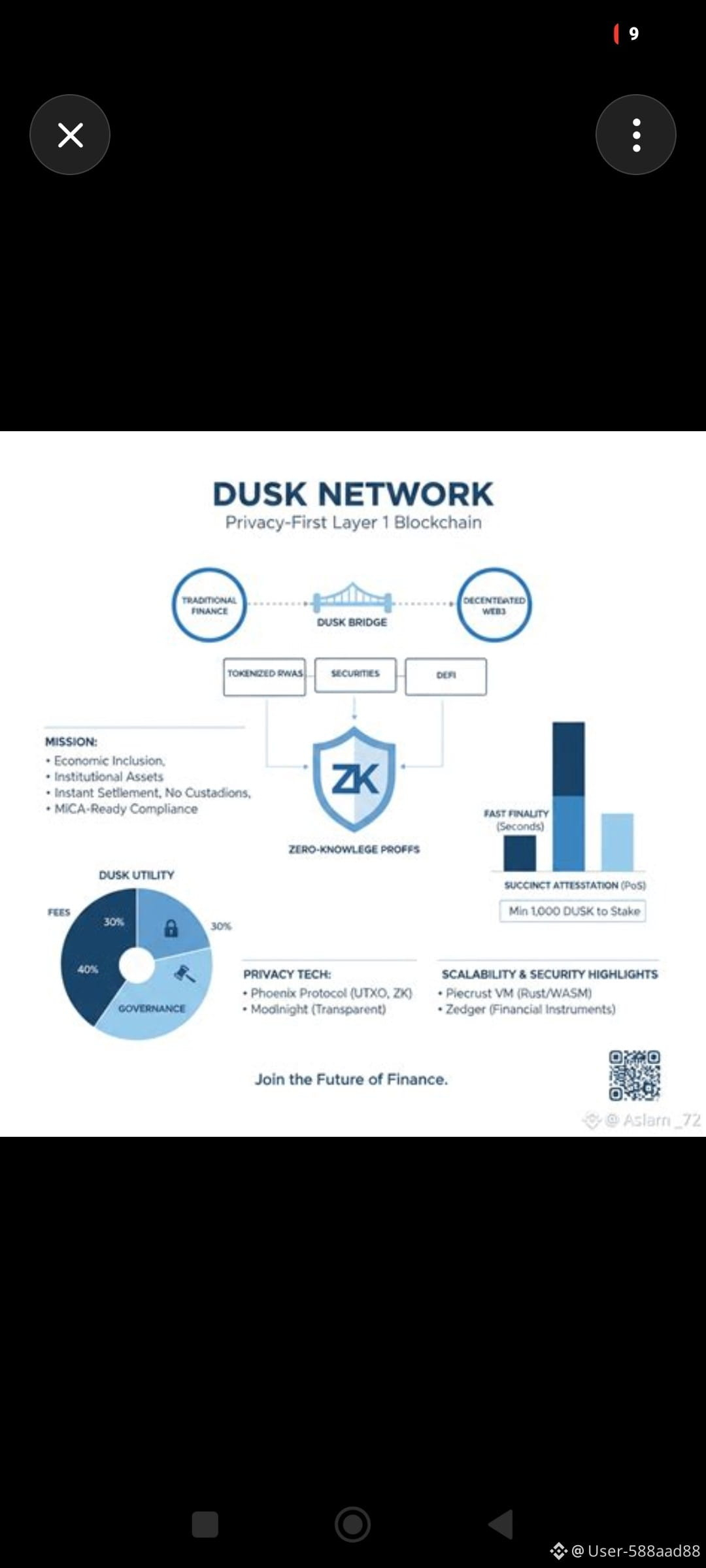
DUSK is used for **network transaction fees and staking**. The current protocol documentation states that the minimum stake is 1,000 DUSK.
That gives the token genuine utility within the network.
The tokenomics are also worth examining carefully.
Dusk has an initial 500 million DUSK supply, with another 500 million DUSK scheduled to be emitted over time, giving a maximum supply of 1 billion. The additional emission is intended to fund staking rewards and follows a declining schedule, with the emission rate halving every four years.
This is neither a tiny fixed-supply token nor an unlimited-inflation model.
For investors, the important point is that future supply growth needs to be considered when valuing DUSK. Network growth has to eventually outpace dilution if token value is to appreciate sustainably.
## Development progress
One of the positives with Dusk is that the project has moved beyond being purely conceptual.
The **Dusk Mainnet is live**, and the current documentation describes it as a production network supporting regulated assets, privacy-preserving transactions and the broader decentralized market infrastructure vision.
The project has also continued developing its infrastructure around identity, smart contracts, EVM compatibility and regulated asset workflows.
This is important because the investment thesis becomes considerably stronger when the technology exists in production rather than sitting on a roadmap.
Another notable development is the migration infrastructure allowing ERC-20 and BEP-20 DUSK to be moved onto Dusk mainnet.
## Roadmap
Dusk's roadmap has historically been organized around major development phases, including **Daybreak, Daylight, Alba and Aurora**. The project's stated objective has been to build infrastructure capable of handling regulated assets while achieving privacy, compliance, performance and deterministic settlement.
The later roadmap leading toward mainnet focused on turning those architectural goals into a production-ready network capable of supporting regulated financial assets.
Today, the more useful way to think about the roadmap is not simply as a sequence of marketing milestones. The key question is what comes **after the infrastructure has been built**.
The next stage of the Dusk story is therefore about:
1. Increasing real-world usage of the mainnet.
2. Bringing regulated assets and financial applications on-chain.
3. Expanding developer adoption.
4. Growing EVM-compatible applications.
5. Improving identity and compliance infrastructure.
6. Building deeper institutional and financial-market integrations.
7. Turning the network into a functioning decentralized market infrastructure rather than simply another Layer-1.
That final point is crucial.
A successful Dusk would not necessarily need millions of retail users. Its potential value proposition is more about becoming infrastructure for **high-value financial transactions and regulated assets**.
## What could make DUSK successful?
The bull case is relatively easy to understand.
If tokenization of real-world financial assets becomes a major part of the global financial system, specialized infrastructure could become increasingly valuable.
Ethereum and other major chains may capture a large portion of this market, but institutions could also want networks specifically designed around compliance, privacy and regulated asset settlement.
Dusk is positioning itself directly in that niche.
Its combination of:
**RWA + privacy + compliance + identity + settlement + EVM compatibility**
is arguably its strongest competitive advantage.
The fact that Dusk already has a live mainnet makes the thesis more credible than a project that is still promising future infrastructure.
## The biggest risks
However, DUSK is far from a guaranteed winner.
### 1. Competition
The RWA market is becoming extremely competitive.
Ethereum, Ethereum Layer-2 networks, Avalanche, Polygon, Stellar, Hedera and numerous specialized protocols are all competing for institutional tokenization activity.
Dusk needs to demonstrate that its specialized architecture provides enough value to attract users away from much larger ecosystems.
### 2. Adoption is more important than technology
This is probably the biggest risk.
A technically impressive blockchain can still be a poor investment if nobody uses it.
Investors should therefore watch **actual assets, transaction activity, developers, institutional integrations and network fees**, rather than simply counting partnerships or announcements.
### 3. Token value capture
This is a particularly important issue for DUSK.
A blockchain can succeed as infrastructure without the corresponding token becoming a massive asset.
The key question is whether increased network activity creates meaningful demand for DUSK through gas, staking and other network functions.
### 4. Regulatory uncertainty
Dusk's focus on regulated finance is simultaneously its strength and its risk.
Financial regulations differ across jurisdictions and continue to evolve. Institutional adoption can therefore be much slower than retail crypto adoption.
### 5. Supply emissions
The maximum supply is 1 billion DUSK, compared with an initial 500 million. Future emissions are controlled and decline over time, but investors still need to account for them when assessing long-term valuation.
### 6. Security and operational risk
Blockchain infrastructure handling financial assets has a particularly high security burden.
This is especially relevant because recent reporting indicates that the Dusk Foundation disclosed a security incident involving a team-managed wallet used in bridge operations on August 16, 2026. That does not automatically invalidate the underlying protocol thesis, but it is a reminder that investors should distinguish between the security of the core network and the security of surrounding infrastructure such as bridges and operational wallets.
## Valuation perspective
At the time of writing, DUSK is trading around **$0.07**, with roughly 500 million DUSK circulating and a market capitalization in the tens of millions of dollars. Market data is highly volatile and should be checked before making an investment decision.
The relatively small market capitalization is both the attraction and the danger.
If Dusk captures even a small but meaningful portion of the institutional RWA market, the upside could be substantial because the network is starting from a comparatively small valuation.
But the reverse is equally true.
A low market cap doesn't mean an asset is undervalued. It can also mean the market is correctly pricing in the uncertainty surrounding adoption.
## My fundamental view
I would categorize DUSK as a **high-risk, high-upside infrastructure bet on institutional blockchain adoption**.
I like the fundamental thesis more than I like the typical crypto narrative because Dusk is solving a real problem: how to combine blockchain settlement with the privacy, identity and compliance requirements of regulated financial markets.
The technology is already much further along than a simple white-paper project, and the live mainnet gives the thesis something tangible to build upon.
The biggest question from here isn't whether Dusk has interesting technology.
**It does.**
The question is whether institutions actually choose to use it.
If Dusk can turn its infrastructure into meaningful tokenized-asset issuance, settlement and financial-market activity, today's valuation could look very small in hindsight.
If institutional adoption fails to materialize, however, the RWA narrative alone won't be enough.
### Bottom line
**Fundamentally: Interesting.**
**Technology: Strong and differentiated.**
**RWA positioning: Very attractive.**
**Token utility: Real, through gas and staking.**
**Adoption: The critical variable.**
**Competition: High.**
**Risk: Very high.**
**Potential: High if institutional RWA adoption accelerates.**
For me, DUSK is best viewed not as “another crypto token,” but as a speculative bet on a specific future: **regulated financial assets increasingly moving onto blockchain infrastructure.**
If that future develops and Dusk captures even a modest share of it, the asymmetric upside could be significant. But until there is stronger evidence of sustained institutional usage, DUSK should be treated as a speculative position rather t
han a proven long-term winner.
*This is fundamental research, not financial advice. Crypto assets are highly volatile, and the investment thesis can change rapidly as technology, regulation, token economics and adoption evolve.*
#dusk #duskcoin #Dusknet #DUSK.USDT #Dusk.
·
--
صاعد
#dusk $DUSK @Dusk_Foundation The chain doesn’t just record the asset. It becomes the asset. Most “tokenization” is theater. A ledger holds a pointer. The real security still lives in transfer agents, legal docs, corporate secretaries, and a swamp of intermediaries. The blockchain is just a shared notice board. Easy. Safe. Pointless. $DUSK ’s Zedger goes further. Minting under hard constraints. Burning. Corporate actions that actually change rights and economics. Ownership rules enforced by the protocol itself—not merely noted. The asset starts carrying its own logic. Reconciliation loops die. Exception teams shrink. Manual corporate-action circus gets quieter. Truth and enforcement finally live in the same place. But coherence is expensive. Financial instruments aren’t pure state machines. They sit inside legal regimes that shift, contain ambiguities, demand interpretation, and sometimes require human override or regulatory intervention. Dividends, splits, conversions, defaults, sanctions, transfer restrictions—clean on paper, messy in reality. Encode more of that lifecycle and a bug no longer misrecords. It mis-executes. Complexity doesn’t vanish. It relocates. Operational friction falls. New friction rises: protocol design, formal verification, upgrade governance, and the brutal problem of mapping open-ended legal language into deterministic code. The real question isn’t whether a chain can hold a security. It’s whether making the chain responsible for more of the asset’s life shrinks the total surface area of finance… or concentrates a larger, more unforgiving piece of it into one place. That’s the tension. That’s the bet. #Dusk/usdt✅ #Dusk. #DUSK.USDT #DUSKARMY. {spot}(DUSKUSDT)
#dusk $DUSK @Dusk The chain doesn’t just record the asset. It becomes the asset.

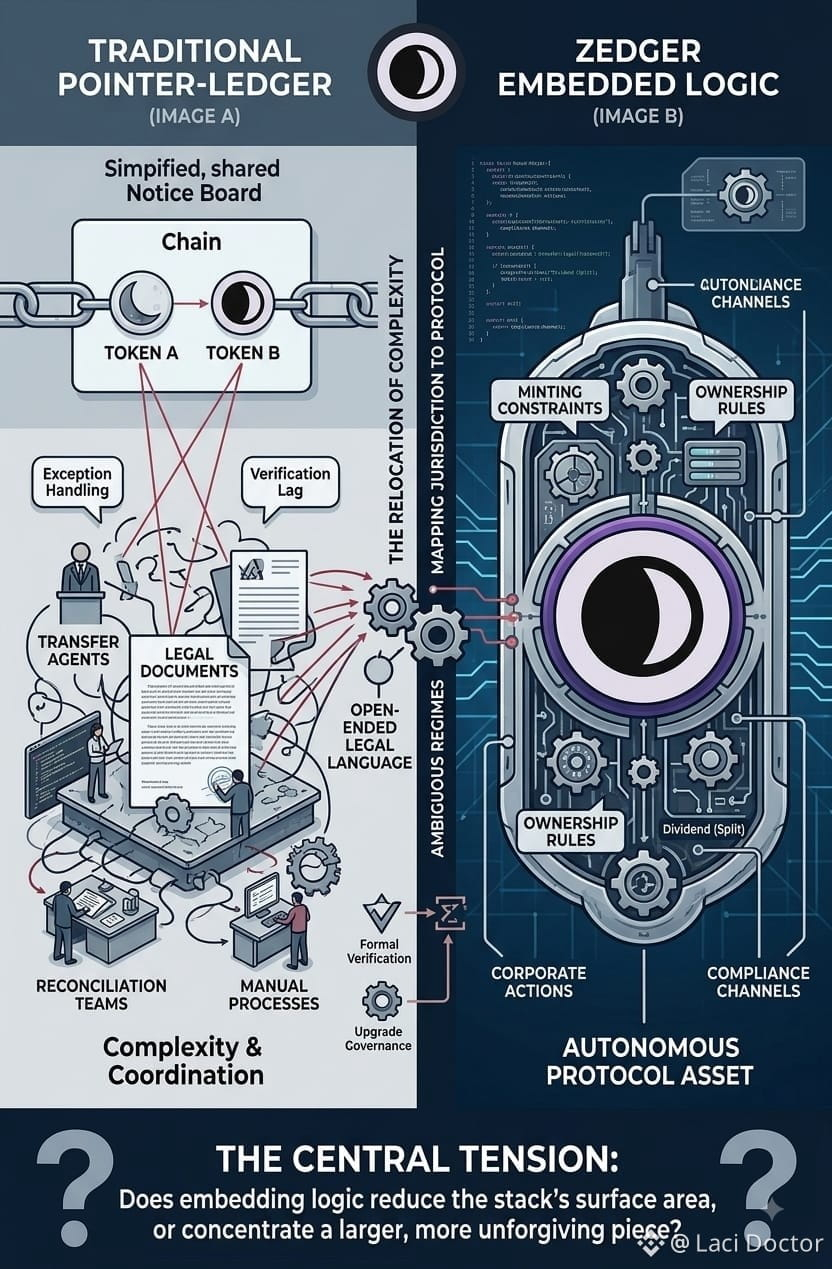
Most “tokenization” is theater. A ledger holds a pointer. The real security still lives in transfer agents, legal docs, corporate secretaries, and a swamp of intermediaries. The blockchain is just a shared notice board. Easy. Safe. Pointless.

$DUSK ’s Zedger goes further. Minting under hard constraints. Burning. Corporate actions that actually change rights and economics. Ownership rules enforced by the protocol itself—not merely noted. The asset starts carrying its own logic. Reconciliation loops die. Exception teams shrink. Manual corporate-action circus gets quieter. Truth and enforcement finally live in the same place.

But coherence is expensive.

Financial instruments aren’t pure state machines. They sit inside legal regimes that shift, contain ambiguities, demand interpretation, and sometimes require human override or regulatory intervention. Dividends, splits, conversions, defaults, sanctions, transfer restrictions—clean on paper, messy in reality. Encode more of that lifecycle and a bug no longer misrecords. It mis-executes.

Complexity doesn’t vanish. It relocates. Operational friction falls. New friction rises: protocol design, formal verification, upgrade governance, and the brutal problem of mapping open-ended legal language into deterministic code.

The real question isn’t whether a chain can hold a security.
It’s whether making the chain responsible for more of the asset’s life shrinks the total surface area of finance…
or concentrates a larger, more unforgiving piece of it into one place.

That’s the tension. That’s the bet.
#Dusk/usdt✅ #Dusk. #DUSK.USDT #DUSKARMY.
·
--
صاعد
#dusk $DUSK @Dusk_Foundation #Dusk/usdt✅ #Dusk. #duskcoin #DUSK.USDT Still poking at Dusk staking Yeah I actually went and staked a little instead of just reading about it this time. Wanted to feel how it works, not just the pitch. First thing that got me was topping up an existing stake and watching only most of it go active. The rest just sits there doing nothing. No yield, can’t touch it unless you fully pull out. Then whatever you put in still has to wait through this long quiet stretch before it even counts for anything. Not the smooth flow I was expecting. Rewards are pure maybe-energy too, nothing fixed ticking up, just chance based on whether you get picked and how big your share is. The whole “let a contract stake for you, no node required” thing is still going through other people and stuck in beta. So right now the ones actually getting clean rewards are the people running infrastructure 24/7. Everyone else is kind of holding a promise. Doesn’t feel like a red flag exactly, more like the simple version and the real version are just two different products at the moment. I kept refreshing my stake status like it would somehow speed up. It didn’t. Anyone actually running a full node on this full time, or is it still mostly early hands like mine poking around?👇 {spot}(DUSKUSDT)
#dusk $DUSK @Dusk #Dusk/usdt✅ #Dusk. #duskcoin #DUSK.USDT
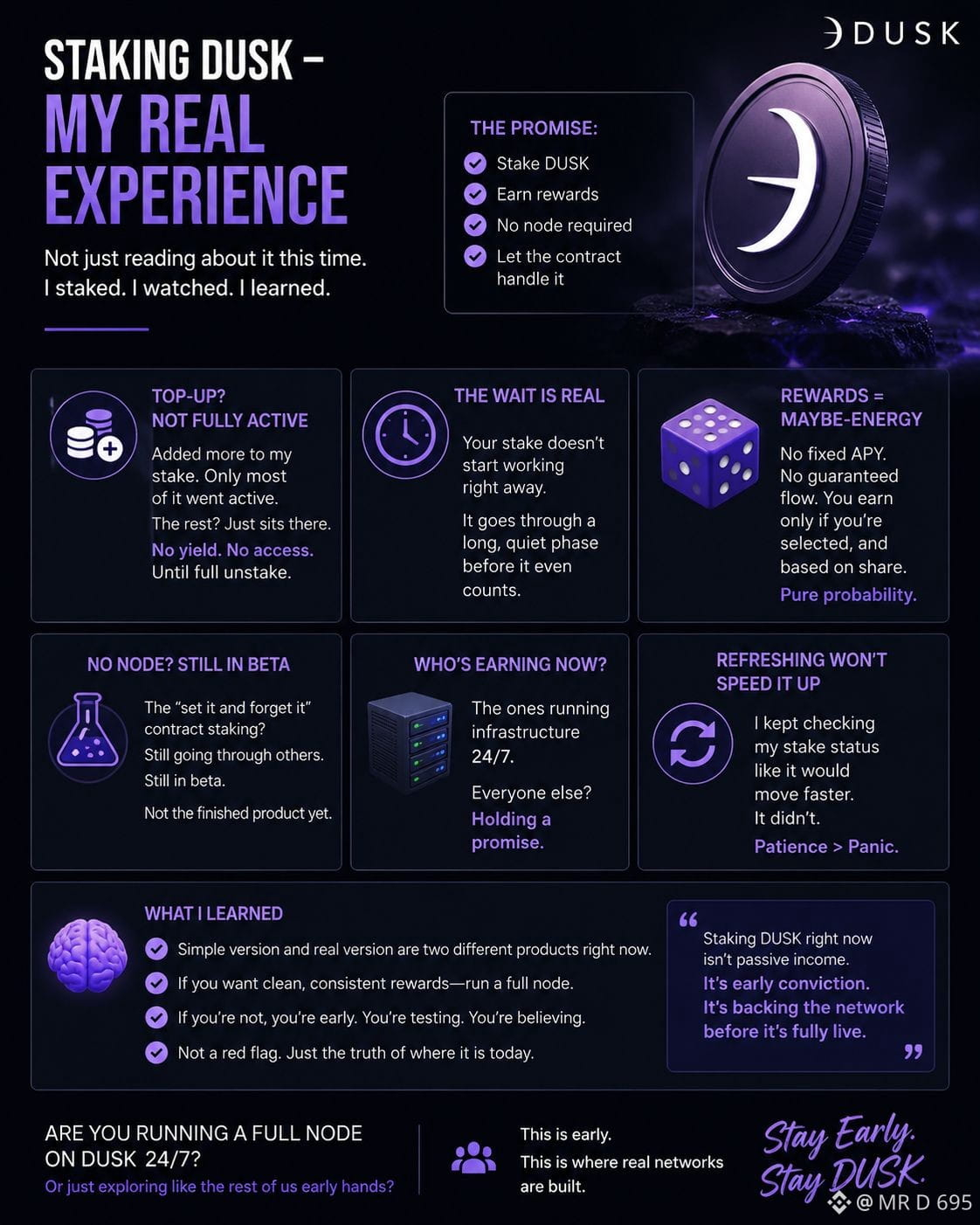
Still poking at Dusk staking

Yeah I actually went and staked a little instead of just reading about it this time. Wanted to feel how it works, not just the pitch. First thing that got me was topping up an existing stake and watching only most of it go active. The rest just sits there doing nothing. No yield, can’t touch it unless you fully pull out. Then whatever you put in still has to wait through this long quiet stretch before it even counts for anything. Not the smooth flow I was expecting. Rewards are pure maybe-energy too, nothing fixed ticking up, just chance based on whether you get picked and how big your share is. The whole “let a contract stake for you, no node required” thing is still going through other people and stuck in beta. So right now the ones actually getting clean rewards are the people running infrastructure 24/7. Everyone else is kind of holding a promise. Doesn’t feel like a red flag exactly, more like the simple version and the real version are just two different products at the moment. I kept refreshing my stake status like it would somehow speed up. It didn’t. Anyone actually running a full node on this full time, or is it still mostly early hands like mine poking around?👇
سجّل الدخول لاستكشاف المزيد من المُحتوى
انضم إلى مُستخدمي العملات الرقمية حول العالم على Binance Square
⚡️ احصل على أحدث المعلومات المفيدة عن العملات الرقمية.
💬 موثوقة من قبل أكبر منصّة لتداول العملات الرقمية في العالم.
👍 اكتشف الرؤى الحقيقية من صنّاع المُحتوى الموثوقين.
البريد الإلكتروني / رقم الهاتف